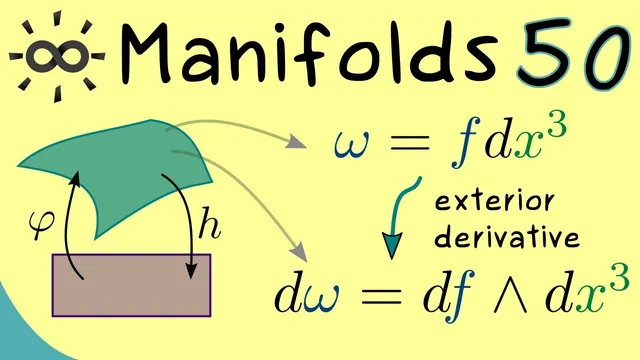
Manifolds 50 | Example of Exterior Derivative
Based on The Bright Side of Mathematics's video on YouTube. If you like this content, support the original creators by watching, liking and subscribing to their content.
On a chart U≅R^n, the exterior derivative of a term f times a wedge of coordinate 1-forms is df wedged with the remaining factors, where df=Σ_j (∂f/∂x_j) dx_j.
Briefing
Exterior (Cartan) derivative sends a k-form to a (k+1)-form in a way that behaves like differentiation while respecting the wedge product’s antisymmetry. Locally, on a chart U identified with R^n, a k-form can be written as a sum of component functions times wedge products of coordinate 1-forms. Because the exterior derivative is linear, it suffices to compute it on one term: for a component function f, the exterior derivative produces df wedged with the remaining 1-forms. In coordinates, df becomes a sum of partial derivatives, so the local rule is essentially “take ordinary derivatives of the coefficients and wedge them into the form.” This local formula is the engine behind the key algebraic properties.
Using that chart-level definition, the exterior derivative inherits a product rule for wedge products. For a k-form ω and an ℓ-form η, applying d to ω∧η splits into two terms: d(ω∧η)=dω∧η plus a sign-adjusted term involving ω∧dη. The sign comes from moving dη past ω’s k 1-form factors, using the wedge product’s graded antisymmetry. This mirrors the familiar Leibniz rule from calculus, but the bookkeeping depends on k.
The same local computation proves the “complex property” d∘d=0. Starting with a k-form ω, applying d twice yields a (k+2)-form whose coefficient contains second derivatives. Those second derivatives are symmetric in the indices by Schwartz’s theorem (mixed partials commute for smooth functions), while the wedge part is antisymmetric in the same indices. When the symmetric and antisymmetric contributions are summed over all index placements, the terms cancel pairwise, forcing the result to be zero on each chart—and therefore everywhere.
A concrete example on R^3 ties the abstract machinery to classical vector calculus. Take a 1-form ω=v1 dx1+v2 dx2+v3 dx3, where the coefficients v1,v2,v3 form a vector field V. Computing dω using partial derivatives produces a 2-form whose components match the curl of V. The wedge-product structure automatically enforces the correct antisymmetry, so terms with dx_i∧dx_i vanish and the remaining cross terms combine with the appropriate minus signs. The resulting 2-form corresponds to curl(V) in the standard identification between 2-forms and pseudovectors in three dimensions.
Finally, the familiar identity “div(curl(V))=0” appears as a special case of d∘d=0: in three dimensions, applying exterior derivative twice translates to divergence of curl vanishing. The calculation shows that the higher-dimensional statement is the underlying reason, while the three-dimensional curl/divergence formulas are recovered once the differential forms are interpreted with the correct ordering conventions.
Cornell Notes
The exterior (Cartan) derivative d maps k-forms to (k+1)-forms by differentiating the coefficient functions and wedging the result into the form. On a chart U≅R^n, if a k-form term looks like f times a wedge of coordinate 1-forms, then d(f·(…)) becomes df∧(…), with df expressed as a sum of partial derivatives times dxj. This leads to a wedge-product Leibniz rule: d(ω∧η)=dω∧η+(-1)^k ω∧dη, where the sign (-1)^k comes from moving dη past k one-form factors. A second application gives d(dω)=0 because mixed partial derivatives are symmetric (Schwartz’s theorem) while the wedge part is antisymmetric, so contributions cancel. In R^3, d applied to ω=v1 dx1+v2 dx2+v3 dx3 yields a 2-form whose components match curl(V), and the identity div(curl(V))=0 follows as a special case of d∘d=0.
What is the local coordinate rule for the exterior derivative of a k-form term?
How does the Leibniz (product) rule for d work with wedge products, and where does the sign come from?
Why does applying d twice always give zero (d∘d=0)?
How does d act on a 1-form in R^3 of the form ω=v1 dx1+v2 dx2+v3 dx3?
How does the identity div(curl(V))=0 relate to d∘d=0?
Review Questions
- What is the coordinate expression for df in terms of partial derivatives and dx_j, and how does it increase the degree of a form?
- In the formula d(ω∧η)=dω∧η+(-1)^k ω∧dη, why exactly does the exponent k appear in the sign?
- In the proof that d∘d=0, which part is symmetric (Schwartz’s theorem) and which part is antisymmetric (wedge product), and how does that force cancellation?
Key Points
- 1
On a chart U≅R^n, the exterior derivative of a term f times a wedge of coordinate 1-forms is df wedged with the remaining factors, where df=Σ_j (∂f/∂x_j) dx_j.
- 2
The exterior derivative is linear, so computations reduce to checking it on one coefficient function term at a time.
- 3
The wedge-product Leibniz rule is d(ω∧η)=dω∧η+(-1)^k ω∧dη for a k-form ω, with the sign determined by moving dη past k one-form factors.
- 4
The complex property d∘d=0 follows because mixed partial derivatives are symmetric (Schwartz’s theorem) while the wedge basis is antisymmetric, making terms cancel.
- 5
In R^3, applying d to ω=v1 dx1+v2 dx2+v3 dx3 produces a 2-form whose components match curl(V).
- 6
The familiar vector identity div(curl(V))=0 is a three-dimensional instance of the general rule d∘d=0, once the form/vector identifications are used.