Mapping a Civil War Experience | 37th Iowa Infantry - the Graybeard Regiment | Roam Your Roots
Based on Roam Your Roots's video on YouTube. If you like this content, support the original creators by watching, liking and subscribing to their content.
Use muster rolls and pension files to map an individual’s Civil War path, especially when muster status shows absence during a regiment’s movement.
Briefing
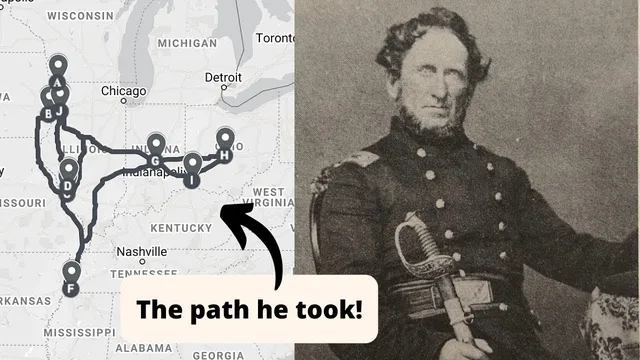
A Civil War ancestor’s service record becomes a road-trip map: George West’s 37th Iowa Infantry route is traced from Dubuque through multiple Union garrisons and prison-related postings, ending at Davenport after mustering out. The central payoff is geographic—seeing how far and how often the regiment moved—while the practical method uses Google My Maps to build a point-by-point itinerary with driving directions.
The mapping starts in Dubuque, where George is listed in 1862. By October 1862, the regiment is ordered into quarters at Camp Strong in Muscatine, so Muscatine becomes the second stop. The creator notes that Camp Strong’s physical presence appears limited today, but the area is marked historically around Muscatine. Google My Maps is then used to generate a general Dubuque-to-Muscatine route labeled as points A and B, with the understanding that the driving path won’t match the exact Civil War travel route—yet it provides a usable framework for a modern visit.
From there, the regiment’s timeline is anchored in muster rolls and pension-related material rather than relying solely on regimental histories. George is marked absent through December in muster records while the regiment goes to St. Louis, creating uncertainty about his exact whereabouts during that window. Still, St. Louis is added as the next major destination because it appears as a key place in his service journey. In St. Louis, the regiment is associated with Benton Barracks and Schofield Barracks; those specific sites are added as sub-points for later on-the-ground visits.
The route continues northward and then back across the Midwest. In late July 1863, the 37th Iowa Infantry is ordered to Alton, Illinois, where it remains until January 1864. Next comes Rock Island, Illinois—specifically the Rock Island Arsenal area—described as a Union prison camp holding Confederate prisoners of war. The regiment departs Rock Island in June 1864 and heads to Memphis, Tennessee, a major geographic leap south.
Memphis becomes the most personal stop in the narrative. George’s pension testimony and supporting affidavits place his hearing loss in Memphis, with details tying the cause to shelling heard at Mud Island near the mouth of the Wolf River. The map also includes a camp location described as “three miles east of the city,” reflecting additional Memphis-era stationing. After only a few months, the regiment moves to Indianapolis and then to Columbus, Ohio, where it stands guard at Camp Morton and later Camp Chase. By April 1865, the companies are ordered to Cincinnati, then to Davenport, where they are mustered out—closing the loop near where the journey began.
The result is both a genealogical reconstruction and a geography lesson: a single ancestor’s Civil War experience is translated into a modern, visitable route that highlights how frequently units shifted stations and how those movements shaped individual lives.
Cornell Notes
George West’s service in the 37th Iowa Infantry (the “Greybeards”) is converted into a point-by-point map itinerary using Google My Maps. The route begins in Dubuque (1862), moves to Camp Strong in Muscatine (October 1862), then to St. Louis (by December 1862), with specific St. Louis sites tied to Benton Barracks and Schofield Barracks. The regiment later goes to Alton, Illinois (late July 1863 to January 1864), then to Rock Island Arsenal (June 1864 departure), and far south to Memphis (including Mud Island and a camp “three miles east of the city”). George’s pension testimony links his deafness to shelling in Memphis, and the journey continues through Indianapolis, Columbus (Camp Chase), Cincinnati, and ends at Davenport for mustering out. The approach matters because muster rolls and pension files can clarify gaps that regimental histories may miss.
Why does the mapping rely on muster rolls and pension testimony instead of only regimental histories?
How does the map handle uncertainty in George West’s timeline between Muscatine and St. Louis?
What St. Louis locations are added, and why?
What makes Mud Island in Memphis a pivotal stop in George West’s story?
How does the route illustrate the regiment’s geographic scale across the Civil War?
What are the final stops before mustering out, and what do they represent?
Review Questions
- Which records in George West’s case help resolve gaps that regimental histories might not capture, and what kind of gap do they address?
- How does the account connect George West’s deafness to a specific Memphis location, and what geographic feature is used to explain it?
- List the major mapped stops in order from Dubuque to Davenport, including at least one specific site within St. Louis and one within Memphis.
Key Points
- 1
Use muster rolls and pension files to map an individual’s Civil War path, especially when muster status shows absence during a regiment’s movement.
- 2
Turn major stationing locations into map pins, then add sub-points for specific sites (like Benton Barracks and Schofield Barracks in St. Louis) to make a road trip actionable.
- 3
Treat driving routes from modern mapping tools as general geography, not a claim about exact Civil War travel paths.
- 4
When a personal record includes sensory or medical details (like George West’s deafness), use it to identify precise locations (Mud Island) rather than relying on broad city-level stops.
- 5
A single ancestor’s timeline can reveal how often units redeployed across regions—north, south, and back—making the scale of service visible.
- 6
Build your itinerary in sequence (A, B, C…) so each stop reflects a chronological movement and supports later research at each location.