Mapping the Multiverse
Based on PBS Space Time's video on YouTube. If you like this content, support the original creators by watching, liking and subscribing to their content.
A rotating black hole is described by the Kerr metric, whose spin creates an ergosphere where spacetime dragging forces even light into co-rotation.
Briefing
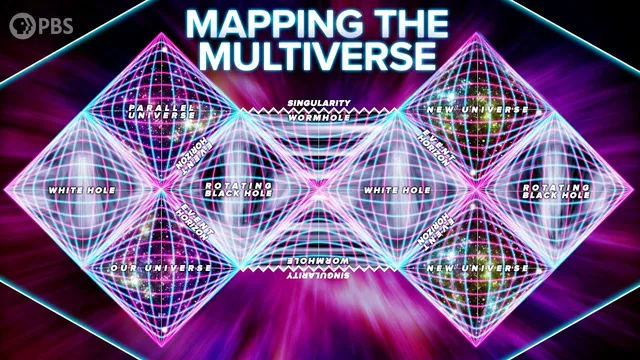
Rotating black holes don’t just swallow matter—they can act like gateways to a chain of causally disconnected regions of spacetime, complete with inner horizons, “white hole” behavior, and even closed-timelike curves in the idealized mathematics. The core takeaway is that the maximally extended Kerr solution to Einstein’s equations replaces the simple “one-way” picture of a black hole with a Penrose diagram where paths can re-emerge into entirely different universes, but only at the cost of running into extreme instabilities that likely make the exotic regions unreal.
In the Kerr spacetime, rotation reshapes the geometry near the event horizon. Outside the horizon lies the ergosphere, where spacetime itself is dragged into a vortex so fast that even light cannot resist being carried along. The event horizon is also distorted—wider at the equator than at the poles—mirroring the effect of spin. The story turns when crossing inward: the inward pull slows because the outward “centrifugal” pressure from rotation partially counteracts gravity, producing a second boundary called the inner horizon. In the idealized diagram, an observer who crosses can explore the interior rather than being immediately crushed by the singularity.
Inside, the singularity is not a point but a ring of infinite density, surrounded by a second ergosphere. Geodesics—free-fall paths—behave differently depending on where they aim: trajectories heading toward the ring’s disk are repelled by the spinning singularity and rebound, while those exactly on the equator hit the ring and end. With enough speed, a traveler can punch through the ring, but that “portal” doesn’t lead back to the same region. Instead, the ring becomes repulsive (as if it carried negative mass), the usual horizon structure above disappears, and the ring is treated as a naked singularity. In the toroidal region around it, some paths allow closed-timelike curves—trajectories that return to the starting location in both space and time—often nicknamed the “Carter time machine.”
Yet the mathematics’ most dramatic promise collides with a physical warning: the inner horizon is catastrophically unstable. The complete Kerr Penrose diagram contains two inner event horizons leading to two parallel wormhole-connected branches. Crucially, time-flow directions conflict at the inner horizon, so any tiny amount of matter or radiation triggers counter-streaming of positive- and negative-energy fluxes. Instead of canceling, the streams amplify each other, producing “mass inflation,” an exponential runaway that drives the inner structure toward a Big Bang–scale energy bath and likely collapses the would-be portals before they can be used.
The transcript also notes that similar instability mechanisms appear in charged (Reissner–Nordström) black holes, where electromagnetic effects play the role of rotation. The upshot is a split verdict: Kerr geometry mathematically permits multiverse-like extensions, but realistic perturbations make the inner regions so unstable that the exotic causal shortcuts—time travel and traversable wormhole behavior—are probably artifacts of the idealized solution rather than features of nature.
Cornell Notes
Kerr black holes (rotating black holes) have a richer causal structure than non-rotating ones. In the maximally extended Carter–Penrose diagram, crossing the outer event horizon can lead to an inner horizon and then to regions connected through wormhole-like extensions, including a ring singularity that can act like a portal. The same geometry also admits a naked-singularity scenario and, in idealized form, closed-timelike curves (“Carter time machine”). However, the inner horizon is expected to be catastrophically unstable: even tiny amounts of matter or radiation trigger counter-streaming energy fluxes that cause mass inflation and likely destroy the inner structure before any time-machine-like behavior could occur.
What changes when a black hole rotates, and why does that matter for the spacetime diagram?
How does the inner horizon arise in the Kerr interior?
Why is the Kerr singularity a ring, and how do free-fall paths behave near it?
What exotic features appear after punching through the ring singularity in the idealized Kerr extension?
Why does the inner horizon likely prevent the multiverse/time-travel picture from being physically realized?
Review Questions
- In Kerr spacetime, what role does the ergosphere play in determining which paths light and matter can take?
- How do geodesics near the Kerr ring singularity differ for equatorial approaches versus approaches toward the disk bounded by the ring?
- What mechanism produces mass inflation at the Kerr inner horizon, and why does it require only a tiny amount of infalling matter or radiation?
Key Points
- 1
A rotating black hole is described by the Kerr metric, whose spin creates an ergosphere where spacetime dragging forces even light into co-rotation.
- 2
Crossing the outer event horizon in Kerr spacetime can lead to a second boundary—the inner horizon—because rotational effects partially counteract the inward acceleration.
- 3
The Kerr singularity is a ring, not a point; free-fall trajectories behave differently depending on whether they target the ring directly or the disk region it bounds.
- 4
In the idealized maximally extended Kerr solution, punching through the ring can produce a repulsive naked singularity region and closed-timelike curves (the “Carter time machine”).
- 5
The inner horizon is expected to be catastrophically unstable: counter-streaming positive- and negative-energy fluxes trigger mass inflation and destroy the inner structure.
- 6
Similar inner-horizon instability logic applies to charged (Reissner–Nordström) black holes, where electromagnetic effects play a role analogous to rotation.