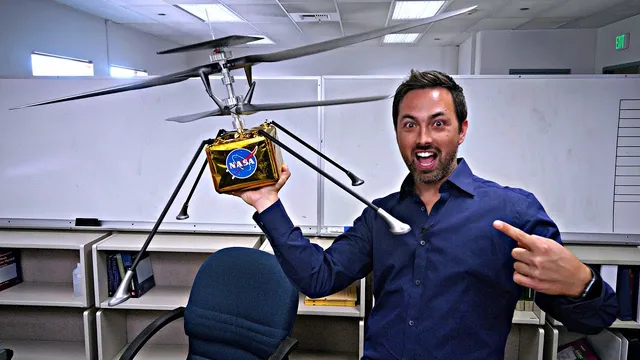
Mars Helicopter (before it went to Mars)
Based on Veritasium's video on YouTube. If you like this content, support the original creators by watching, liking and subscribing to their content.
Mars Helicopter is a technology demonstration aimed at proving powered flight on Mars, not conducting primary science observations.
Briefing
Mars Helicopter is built to prove that powered flight is possible in the thin Martian atmosphere—an engineering milestone that matters because it turns “aircraft on another world” from a concept into a design path for future exploration. The craft is scheduled to ride with the Mars 2020 mission, where it will be deployed on the surface and then fly autonomously, capturing color photos and video while generating the data needed to design later aircraft.
The core challenge is that Mars air density is about 1% of Earth’s, meaning a helicopter has to move far more air to produce lift. That forces the rotors to spin dramatically faster than on Earth: the Mars blades run between 2300 rpm and 2900 rpm—roughly five times the typical ~500 rpm rotor speeds used on Earth helicopters. Even with faster spinning, the design has to avoid transonic blade-tip conditions; engineers keep blade-tip Mach numbers below about 0.7 (70% the speed of sound) to prevent shockwaves and messy aerodynamic behavior.
Gravity adds another constraint. Mars gravity is about 38% of Earth’s, which helps, but the helicopter still must be extremely lightweight. The entire vehicle weighs less than 1.8 kilograms (under four pounds), with blades made from foam core and carbon fiber layups, each about 35 grams. That mass budget is central to the lift calculation: two 35-gram blades must lift an ~1800-gram craft by spinning about 40 times per second in a 1% atmosphere. The helicopter is designed for up to 90 seconds per flight, a short duration by human standards but long enough to validate control, stability, and performance in a new environment.
Testing the craft on Earth requires simulating both atmosphere and gravity. Aerodynamics are evaluated in a 25-foot space simulator chamber that can reproduce Martian pressures. Gravity is faked using a “gravity offload” system that pulls up on the helicopter so it only supports about 38% of its weight, implemented with a motor, reaction torque sensor, pulley, and real fishing line tuned for the right spring behavior. In the chamber, the helicopter can “feel” like it’s on Mars; it also turns out the sound is still loud—described as a sustained “baaaaaah”—even at 1% atmospheric density.
Control is another make-or-break issue. Human piloting from Earth is effectively impossible due to the ~20-minute communication delay and the helicopter’s control lag. Instead, the craft uses onboard gyros, accelerometers, an altimeter, an inclinometer, and a camera to estimate its state at hundreds of Hertz and feed that into a closed-loop controller that continuously adjusts blade pitch. The vehicle can look calm in footage while the rotors work intensely to maintain hover and execute lateral moves.
Survivability is handled like a spacecraft problem as much as an aircraft problem. The helicopter must endure launch vibration loads exceeding about 80G, survive a seven-month cruise with radiation exposure, and survive entry into the Martian atmosphere. Deployment comes from the rover: the helicopter is stowed underneath, rotated upright and released using explosive devices and frangibolts (breakable bolts triggered by a phase-change mechanism). After landing, it waits about two hours for RF contact, then issues a “fly now” command. Flights are planned conservatively around 11 a.m. local Mars time to balance battery warmth, avoid brownout risk, and reduce wind-driven density changes.
The mission’s purpose is not to make new science discoveries directly. It’s a technology demonstration—collecting flight and engineering data to inform future aircraft concepts, such as scout vehicles that could carry science payloads, retrieve samples, or explore terrain rovers can’t reach easily.
Cornell Notes
Mars Helicopter is designed to demonstrate powered flight on Mars by proving that lift, stability, and control can work in an atmosphere only about 1% as dense as Earth’s. To compensate, the rotors spin at 2300–2900 rpm while engineers cap blade-tip Mach numbers below ~0.7 to avoid transonic shock effects. The craft is extremely lightweight (under 1.8 kg) with carbon-fiber blades and is built to fly up to 90 seconds per attempt. Testing on Earth combines a chamber that reproduces Martian pressure with a “gravity offload” system that reduces effective weight to ~38% of Earth’s. Autonomy replaces human piloting because Earth-to-Mars delay makes joystick control impractical; onboard sensors and closed-loop control continuously adjust blade pitch.
Why does Mars require much faster rotor speeds than Earth helicopters?
What aerodynamic risk do engineers manage when spinning blades so fast?
How do engineers test a Mars helicopter on Earth without Mars air and Mars gravity?
Why can’t the helicopter be piloted directly from Earth?
What onboard systems let the helicopter fly autonomously and look steady in flight footage?
How does the helicopter survive the trip and get onto the Martian surface?
Review Questions
- What specific changes to rotor speed and blade-tip aerodynamics are used to make lift possible in a ~1% Earth-density atmosphere?
- How do the chamber and gravity offload system work together to reproduce Martian flight conditions on Earth?
- What sensor-and-control loop design choices make autonomy necessary given the ~20-minute Earth-to-Mars communication delay?
Key Points
- 1
Mars Helicopter is a technology demonstration aimed at proving powered flight on Mars, not conducting primary science observations.
- 2
Mars air density is about 1% of Earth’s, so the rotors spin at 2300–2900 rpm to generate enough lift.
- 3
Blade-tip Mach numbers are kept below ~0.7 to avoid shockwaves and transonic aerodynamic complications.
- 4
The helicopter is built to be extremely light (under 1.8 kg) with carbon-fiber/foam blades, enabling lift in thin air.
- 5
Earth testing combines a pressure-reproducing 25-foot space simulator with a gravity offload system that reduces effective weight to ~38% of Earth’s.
- 6
Autonomous flight replaces human piloting because Earth-to-Mars delay (~20 minutes) makes real-time joystick control impractical.
- 7
Deployment relies on rover stowage and explosive release using frangibolts, followed by a timed wait for RF link before the first flight command.