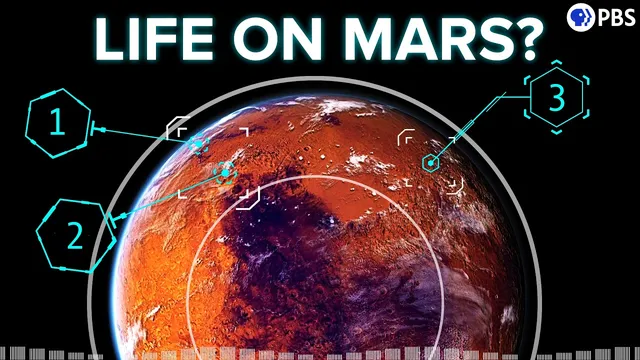
Martian Soil Is Deadly. And That's Why It Might Support Life.
Based on PBS Space Time's video on YouTube. If you like this content, support the original creators by watching, liking and subscribing to their content.
Mars’s surface regolith is heavily altered by radiation and long-term chemistry, producing oxidizing salts such as perchlorates that are generally damaging to organic-based life.
Briefing
Mars may be chemically hostile, but its surface chemistry could still create brief, habitable windows—especially just centimeters below ground—where hardy Earth microbes might survive and possibly even use Martian salts. Recent experiments and related studies point to a central tension: perchlorates and other oxidizing compounds are abundant on Mars and can be lethal, yet they also absorb water vapor and act as antifreeze, enabling thin films of briny liquid at temperatures far below freezing. That combination—liquid water in tiny, transient forms plus protection from harsh radiation—makes shallow regolith a plausible place for life to persist in a slow, stressed, and intermittently active state.
The case starts with why the Martian surface is so damaging. After Mars lost its thick atmosphere and global magnetic protection, ultraviolet radiation and cosmic rays began battering exposed ground. Over billions of years, meteorite-driven regolith was photochemically altered into salts of chlorine and sulfur, including highly oxidizing perchlorates. With no tectonic recycling and little water to dissolve or redistribute these chemicals, the salts accumulate and create an environment that is generally hostile to organic molecules.
To find where habitability might overlap with survival, the discussion frames life’s requirements as a three-part overlap: liquid water, protection from radiation and temperature extremes, and an energy source. The simplest way to reduce radiation and thermal swings is to go underground. Even a few centimeters can dramatically cut ultraviolet exposure, while tens of centimeters add buffering against temperature swings. At those depths, the surface remains below freezing, but perchlorates may solve that problem by being hygroscopic (pulling in water vapor) and strongly antifreezing—allowing water to remain liquid down to about −70°C under the right humidity and temperature conditions. The proposed mechanism is deliquescence: salts form thin brine films around particles and in pore spaces, likely forming at night and evaporating during the day. In this model, microbes could enter stasis during the most oxidizing periods and metabolize when chemical gradients become available.
Experiments support parts of the picture. Tardigrades—often cited as extreme survivors—can endure many aspects of Martian conditions, but they struggle when perchlorates are introduced. In parallel, halophilic bacteria and fungi survive well in Mars-like regolith simulations at shallow depths until perchlorates appear. Yet perchlorate toxicity may not be a dead end. Some Earth microbes use perchlorates in their metabolism, and lab work with E. coli shows that increasing perchlorate concentrations trigger DNA repair and stress-mitigation pathways. The implication is that Mars could host specialized microbes adapted to its slow, long-term buildup of oxidants.
Beyond shallow regolith, the most promising habitats shift underground. Near-surface ground ice at high latitudes—and likely buried ice at mid-latitudes—would block UV and cosmic rays and slow the chemistry that produces perchlorates. A 2024 NASA study suggests melt water could occasionally form beneath ice layers, potentially creating thin liquid environments fueled by geothermal heat and UV-depleted sunlight. Another possibility comes from radiolysis in ice, where radiation can split water into hydrogen and oxidants—energy sources that deep subsurface microbes on Earth can exploit.
Still deeper, temperature rises with depth, and recent seismic interpretations using NASA’s InSight data suggest parts of the midcrust might contain large aquifers at roughly 10–20 km. If water-saturated fractured rock connects over large scales, it could support deep ecosystems sustained by geochemical energy, nutrient replenishment, and waste removal—though verifying this would require drilling kilometers down, a challenge likely beyond near-term robotic missions.
The bottom line is uncertainty with high stakes: no one knows whether Mars has life today or ever did. But the combination of radiation shielding, transient brines, and potential energy sources makes multiple underground niches plausible. If life exists, it could reveal whether Earth’s biology was seeded by interplanetary hitchhikers—or whether life emerges independently and repeatedly across the solar system and beyond.
Cornell Notes
Mars’s surface is extremely hostile due to intense radiation, thin atmosphere, and regolith chemistry that produces oxidizing salts like perchlorates. The most promising habitability targets are underground niches where radiation and temperature swings drop and where briny liquid water might form. Perchlorates are a paradox: they are lethal to many organisms, but they are also hygroscopic and antifreeze-capable, enabling thin films of brine at very low temperatures under the right humidity and temperature cycles. Earth analogs—especially salt-loving microbes and perchlorate-metabolizing pathways—suggest that adapted Martian microbes could survive in shallow regolith. Deeper ice layers, radiolysis-driven chemistry, lava tubes, and even proposed 10–20 km aquifers expand the range of possible habitats, though the deepest scenarios are hardest to test.
Why are perchlorates such a double-edged sword for Martian habitability?
How does going underground change the odds for life on Mars?
What evidence suggests some Earth microbes might tolerate or even use Martian-like conditions?
What role could Martian ice play in creating habitable microenvironments?
Why are proposed deep aquifers (10–20 km) considered a major but hard-to-test opportunity?
Review Questions
- What specific properties of perchlorates allow them to both threaten life and potentially enable liquid brines on Mars?
- Which underground depth ranges are highlighted as most effective for reducing radiation and temperature stress, and why?
- How do ice-related processes like meltwater formation and radiolysis differ as potential energy and habitability mechanisms?
Key Points
- 1
Mars’s surface regolith is heavily altered by radiation and long-term chemistry, producing oxidizing salts such as perchlorates that are generally damaging to organic-based life.
- 2
Underground niches are the main strategy because even shallow burial can sharply reduce ultraviolet exposure and dampen temperature swings.
- 3
Perchlorates can form transient brines by absorbing water vapor and acting as antifreeze agents, potentially creating liquid films at temperatures as low as about −70°C.
- 4
Experiments show many extreme organisms struggle when perchlorates are present, but Earth microbes demonstrate both perchlorate metabolism and perchlorate-driven stress responses (e.g., DNA repair in E. coli).
- 5
Ice-rich regions could provide strong radiation shielding and may occasionally generate meltwater beneath the surface, while radiolysis in ice could supply chemical energy.
- 6
Lava tubes and other subsurface voids could offer thermal and radiation protection, but the key unknown is whether water or brines exist there.
- 7
Seismic interpretations from NASA’s InSight suggest possible deep aquifers at 10–20 km, which could support larger ecosystems if fractures allow flow and sustained chemical gradients—yet testing this would be extremely challenging.