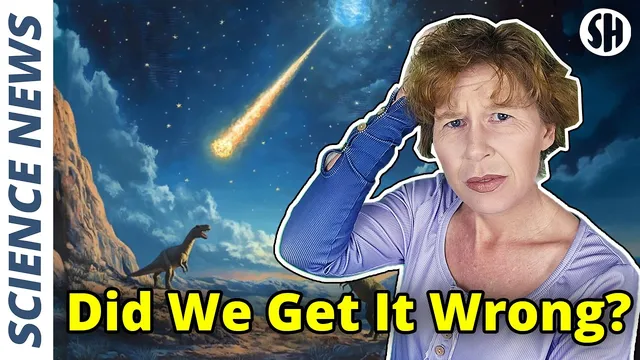
Mass Extinction Isn’t What We Thought
Based on Sabine Hossenfelder's video on YouTube. If you like this content, support the original creators by watching, liking and subscribing to their content.
The end-Cretaceous extinction removed about 60% of marine species but eliminated only 2 of 37 ecological roles, indicating functional resilience.
Briefing
Mass extinctions don’t work like a full evolutionary “reset.” A new analysis of the end-Cretaceous die-off—66 million years ago, when the asteroid impact wiped out the dinosaurs—finds that most marine ecosystems kept their functional backbone. About 60% of marine species disappeared, yet only 2 of 37 identified ecological roles vanished. That mismatch matters because it challenges the common picture of extinction as a clean slate that lets entirely new kinds of ecosystems assemble from a few survivors.
Researchers focused on clams, mussels, and other seafloor-dwelling animals, using their ecological roles—how they fed, moved, and lived—to build a functional map. The study grouped species into 37 distinct roles, ranging from stationary filter-feeders buried in sand to mobile grazers on rocks, including mixed “do-it-all” forms. After the extinction, the loss was severe in species count, but function was largely preserved: most roles, even rare ones, survived.
To test whether this pattern could happen by chance, the team ran thousands of computer simulations of random extinctions. Nearly every simulated event eliminated more roles than the real extinction did. The probability of getting the observed functional pattern “by luck” came out below 1%, implying that something non-random shaped survival. In other words, the end-Cretaceous event restructured marine life without wiping out the majority of its ecological functions.
The study also tracked what emerged afterward. Over the next 66 million years, 12 new ecological roles appeared—examples include animals that burrowed deeply and fed from the surface using tube-like structures, likened to “working from home.” But these innovations didn’t spread widely. Instead, the roles that dominate today are largely the same ones that existed before the extinction.
The nuance is crucial: while ecosystems proved robust, functional loss can be hard to reverse. Two roles disappeared entirely. One involved a clam that lived in symbiosis with algae, using photosynthesis to build reef structures; that function never returned. The other role also failed to reappear. The takeaway is that extinction can reduce populations across many functions while leaving functional diversity mostly intact—yet once a specific role is gone, evolution may not readily recreate it.
That framing feeds directly into modern conservation. Scientists warn that Earth may be entering a sixth mass extinction driven by human activity. Biodiversity debates often emphasize species counts, but this work argues for tracking what species do. Losing ecological roles can erode ecosystem function even if some species remain. The practical implication is to preserve a variety of roles, not just maximize the number of surviving species.
Cornell Notes
The end-Cretaceous mass extinction (66 million years ago) killed about 60% of marine species, but it did not erase most ecological functions. By classifying seafloor animals into 37 ecological roles (based on feeding, movement, and habitat), researchers found that only 2 roles vanished. Simulations of random extinctions almost always removed more roles than observed, making the pattern unlikely to be chance. After the event, 12 new roles appeared, yet none spread widely; today’s dominant roles largely predate the extinction. The study suggests ecosystems can be functionally resilient, but if a role disappears—such as an algae-symbiotic reef-building clam—it may not return, which is a warning for ongoing biodiversity loss.
How did researchers measure “what survived” during the end-Cretaceous extinction?
What was surprising about the extinction’s impact on ecological roles?
Why do computer simulations matter in this study?
What happened after the extinction—did ecosystems rebuild into a brand-new functional world?
What warning does the study draw from the roles that did disappear?
How does this change what conservation should measure?
Review Questions
- What evidence suggests the end-Cretaceous extinction was not random with respect to ecological roles?
- Why might new ecological roles fail to spread widely even after a major extinction event?
- Which two ecological roles disappeared, and what does their absence imply about ecosystem recovery?
Key Points
- 1
The end-Cretaceous extinction removed about 60% of marine species but eliminated only 2 of 37 ecological roles, indicating functional resilience.
- 2
Random-extinction simulations rarely match the observed pattern; the chance of the real outcome occurring randomly was under 1%.
- 3
New ecological roles appeared over the following 66 million years, but they remained limited to a few species rather than becoming widespread.
- 4
Modern dominant marine roles largely trace back to pre-extinction functions, contradicting the idea of a full evolutionary reset.
- 5
Functional roles can vanish permanently: an algae-symbiotic reef-building clam role did not return even after 66 million years.
- 6
Conservation should track ecological roles (functional diversity), not just species counts, because losing roles can degrade ecosystem function.