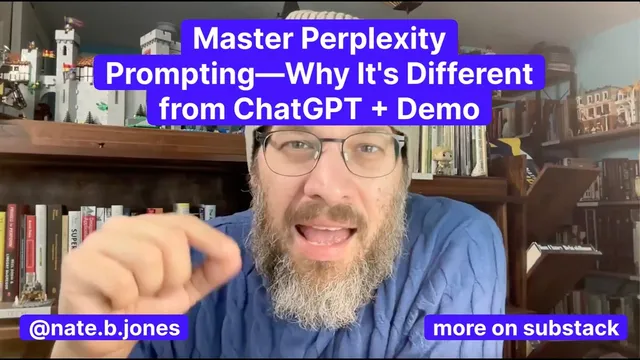
Master Perplexity Prompting -- Why It's Different from ChatGPT + Demo
Based on AI News & Strategy Daily | Nate B Jones's video on YouTube. If you like this content, support the original creators by watching, liking and subscribing to their content.
Perplexity is built on retrieval-augmented generation: it fetches web documents per query, extracts supporting passages, and answers with citations.
Briefing
Perplexity’s edge over ChatGPT isn’t better “chat”—it’s an internet-first architecture built for retrieval, citations, and recency. Instead of generating answers from what’s already inside its model weights, Perplexity pulls relevant documents from across the web, extracts supporting passages, and then synthesizes an answer with sources. That retrieval-augmented generation (RAG) approach changes what kinds of questions work best and how prompts should be written.
A key distinction is how Perplexity handles “research mode.” Using the same underlying RAG pipeline, research mode effectively turns up the effort: it runs dozens of searches, reads hundreds of sources, and makes multiple passes to improve the odds of finding the best answer. In contrast, ChatGPT is described as a parametric answer engine—its default behavior relies on training-time knowledge rather than live web lookup. That’s why it can miss new developments (including recent model-related facts) and why Perplexity is positioned as the tool for knowledge that changes quickly.
These architectural differences drive a set of prompting strategies tailored to Perplexity. First, short prompts can work—adding just a few critical words of context can sharply narrow results. “Climate models” yields broad semantic coverage, while “climate prediction models for urban planning” pulls a more precise slice. Second, “few-shot prompting” (providing example answers) is discouraged for Perplexity because it can cause the system to overfit to the examples and dredge up only similar material.
Third, prompt specificity should mirror the controls Perplexity exposes through its API: limit sources, filter by date, and adjust search depth. Vague instructions like “only search recent sources” are less effective than explicit date filters. Fourth, prompts should demand triangulation—asking for comparisons across at least three peer-reviewed studies and explicitly noting conflicts pushes the system toward evidence gathering rather than a single-source synthesis.
Fifth, the workflow should be iterative. Instead of locking in a tightly structured intent from the start (a style often used with ChatGPT), Perplexity can be treated like a conversation that progressively deepens: start broad to map the territory, then drill down with increasingly actionable follow-ups as new threads emerge. Sixth, output constraints reduce hallucinations: requiring evidence with section references or page numbers forces tighter verification.
Perplexity also offers modes and organizational features that fit these workflows. “Focus mode” can shift the search toward academic, social, or finance sources mid-conversation to reset thinking without wiping context. “Spaces” and “Labs” support repeatable internet-native workflows—such as competitor intelligence, news monitoring, and financial analysis—where ongoing instructions and report-style outputs benefit from repeated web retrieval.
The transcript also tackles hallucinations directly. Since Perplexity can cite AI-generated spam that looks real, single-source answers—especially from unfamiliar blogs or random LinkedIn posts—should be treated skeptically. Quote attribution needs manual checking in the cited source, because phrasing may differ or context may shift. For high-stakes accuracy, the advice is to cross-check with another LLM and, for precision-critical queries, use academic focus (e.g., PubMed or Semantic Scholar) to reduce low-quality sources.
Ultimately, Perplexity is framed as a response to two pressures: the knowledge recency problem (LLMs can’t update their training knowledge quickly) and the fluency-versus-factuality gap (as models sound more confident, factual verification becomes harder). With transparent sourcing and verifiable chains of evidence, Perplexity is presented as a more accountable way to search the web for current facts—illustrated by a demo that uncovers “Korea’s Claude code culture,” something described as difficult to obtain without live internet retrieval.
Cornell Notes
Perplexity is positioned as an “AI-native” search engine built on retrieval-augmented generation (RAG): it fetches relevant web documents, extracts supporting passages, and then synthesizes answers with citations. Research mode increases effort by running many searches, reading hundreds of sources, and making multiple passes to improve answer quality. That architecture differs sharply from ChatGPT’s parametric answer approach, which relies on model weights and doesn’t automatically pull in new information. Because of this, prompts should be shorter but more specific, avoid few-shot examples that can overfit, use date/source/search-depth controls, demand multiple perspectives, and constrain outputs to evidence. The result is a more verifiable workflow for fast-changing topics, though hallucinations can still occur—especially via AI-generated spam—so citations and quotes should be checked and cross-verified when accuracy matters.
How does Perplexity’s RAG approach change what it can answer compared with ChatGPT’s parametric model?
Why does “few-shot prompting” tend to work against Perplexity?
What prompt details most reliably improve Perplexity search quality?
How can prompts reduce hallucinations when using an internet-based system?
What does “progressively deepen” mean in Perplexity prompting?
When should “focus mode” be used during a conversation?
Review Questions
- What architectural difference between Perplexity and ChatGPT most directly explains why one is better for up-to-date information?
- Give two examples of prompt constraints that would likely reduce hallucinations in Perplexity.
- Why might demanding multiple perspectives (e.g., at least three peer-reviewed studies) improve both accuracy and usefulness of the output?
Key Points
- 1
Perplexity is built on retrieval-augmented generation: it fetches web documents per query, extracts supporting passages, and answers with citations.
- 2
Research mode increases retrieval effort by running many searches, reading hundreds of sources, and performing multiple passes to improve answer quality.
- 3
Short prompts can be effective if they include critical context (e.g., adding “for urban planning” to narrow climate results).
- 4
Avoid few-shot prompting with Perplexity because examples can cause overfitting and overly narrow retrieval.
- 5
Use explicit search controls in prompts—especially date filters, source limits, and search depth—rather than vague “recent” wording.
- 6
Demand triangulation and evidence: ask for comparisons across multiple studies and require specific references (section/page) for claims.
- 7
Hallucinations still happen; treat single-source citations skeptically, verify quotes in the cited text, and cross-check with another LLM for high-stakes accuracy.