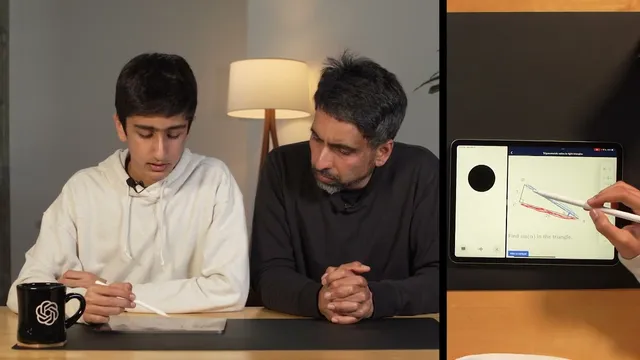
Math problems with GPT-4o
Based on OpenAI's video on YouTube. If you like this content, support the original creators by watching, liking and subscribing to their content.
The tutoring approach solves the problem in steps: label sides relative to angle Alpha before applying any trigonometric formula.
Briefing
A live math tutoring session demonstrates how GPT-4o can guide a learner through a right-triangle trigonometry problem without handing over the final answer. The interaction starts with a targeted check for understanding: the tutor asks the student to label triangle sides relative to angle Alpha—opposite, adjacent, and hypotenuse—then uses the student’s partial guesses to correct misconceptions.
The student first identifies angle Alpha correctly, then struggles to pick the hypotenuse. The tutor steers the learner toward the key rule: in a right triangle, the hypotenuse is the longest side and sits opposite the right angle. After the student selects the long side from A to B, the tutor confirms it as the hypotenuse. Next, the tutor asks for the opposite side to angle Alpha. The student initially mixes up earlier labels, but the tutor’s earlier clarification helps the student reason through the geometry, landing on BC as the opposite side.
With the side relationships established, the session shifts from geometry to computation. The tutor prompts the student to recall the sine definition for a right triangle: sin(θ) equals opposite over hypotenuse. The student then applies the identified lengths—BC as 7 and AB as 25—to compute sin(Alpha). The final result is sin(Alpha) = 7/25, which the tutor validates.
What matters most is the tutoring pattern: the system doesn’t just provide the answer; it breaks the problem into conceptual steps (identify angle-relative sides, then apply the correct trig ratio) and uses short questions to keep the learner doing the reasoning. The student’s errors—especially around hypotenuse identification and the opposite/adjacent distinction—are treated as teachable moments, corrected through rule-based nudges rather than direct solution dumping. The outcome is a complete worked example that reinforces both triangle labeling and the sine ratio, culminating in a correct numeric expression for sin(Alpha).
Cornell Notes
The tutoring exchange uses GPT-4o-style questioning to solve a right-triangle trig problem for sin(Alpha) without giving away the final answer. The learner is guided to identify the hypotenuse as the longest side opposite the right angle, then to determine the opposite side relative to angle Alpha. Once the opposite and hypotenuse are correctly labeled (BC = 7 and AB = 25), the student recalls the sine relationship sin(θ) = opposite/hypotenuse and computes sin(Alpha) = 7/25. The key value is the step-by-step method: concept checks first, then formula application, with corrections delivered through rules and targeted prompts.
How does the tutoring interaction determine whether the learner understands the triangle’s geometry before any formula is used?
What rule distinguishes the hypotenuse from the other sides in a right triangle during the session?
Why does the tutor ask for the opposite side after the hypotenuse is known?
What formula is used to compute sin(Alpha), and how is it applied numerically?
What kind of feedback loop keeps the learner from simply guessing through the problem?
Review Questions
- In a right triangle, what two properties uniquely identify the hypotenuse, and how do they relate to the right angle?
- Given a right triangle with angle Alpha, how do you determine which side is opposite and which is hypotenuse before using sin(Alpha)?
- If opposite to angle Alpha is 7 and the hypotenuse is 25, what is sin(Alpha) and why?
Key Points
- 1
The tutoring approach solves the problem in steps: label sides relative to angle Alpha before applying any trigonometric formula.
- 2
In a right triangle, the hypotenuse is the longest side and is opposite the right angle.
- 3
Opposite and adjacent sides are defined relative to the chosen angle, not by position alone.
- 4
Sine in a right triangle uses the ratio sin(θ) = opposite/hypotenuse.
- 5
Correct side identification (BC as opposite and AB as hypotenuse) is required to compute sin(Alpha) accurately.
- 6
The final computed value in the session is sin(Alpha) = 7/25, derived from the labeled side lengths.