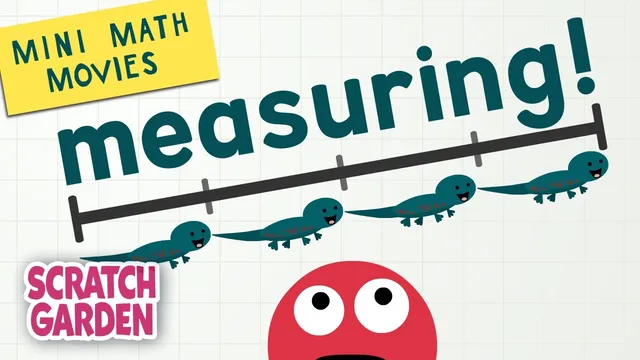
Measuring! | Mini Math Movies | Scratch Garden
Based on Scratch Garden's video on YouTube. If you like this content, support the original creators by watching, liking and subscribing to their content.
Length is the distance between two points, measured by counting units.
Briefing
Measuring length becomes simple when kids use consistent units and follow a clear set of rules. The lesson defines length as the distance between two points—such as how far something stretches from start to end—and emphasizes that measuring always depends on units, whether standard ones like inches and centimeters or playful non-standard units like “salamanders.” The activity then turns that idea into practice by comparing the heights and widths of three cows wearing funny hats.
Before any counting begins, four measuring rules are laid out for length in straight lines using non-standard units. First, every unit must be the same size and point in the same direction; mismatched “tiny salamanders” or different animals (like a turtle) don’t count. Second, units should touch end-to-end without overlapping or leaving gaps. Third, the units should form a straight line—no bending or crooked placement. Fourth, measurement must start at one end of the object and end at the other end; starting from the middle or from the wrong spot produces an incorrect length.
With the rules established, the video measures the height of three hats—Blue Cow, Red Cow, and Yellow Cow—using salamanders as the counting unit. Blue Cow’s hat measures 2 salamanders long (2 salamanders high). Red Cow’s hat measures 4 salamanders long. Yellow Cow’s hat measures 5 salamanders long. Comparing the numbers shows that 4 is larger than 2, so Red Cow’s hat is taller than Blue Cow’s hat. Likewise, 5 is larger than 4, so Yellow Cow’s hat is taller than Red Cow’s hat. Since 5 is also larger than 2, Yellow Cow’s hat is the tallest among the three.
The lesson then shifts from height to width, introducing width as the side-to-side distance measured from left to right. The video cues viewers to measure how many salamanders wide each hat is—again using the same unit rules—before wrapping up. It ends by encouraging kids to measure everyday objects after the lesson, using whatever tools they have, such as rulers, erasers, or even body parts like feet, if salamanders aren’t available.
Cornell Notes
Length is defined as the distance between two points, and measuring requires units. The lesson uses salamanders as a non-standard unit and gives four rules for measuring length in straight lines: use units of the same size and direction, place them end-to-end without gaps or overlaps, keep them in a straight line, and start at one end of the object and finish at the other end. Using these rules, Blue Cow’s hat measures 2 salamanders high, Red Cow’s hat measures 4, and Yellow Cow’s hat measures 5. Since 5 is the largest number, Yellow Cow’s hat is the tallest. The same idea is then applied to width, measured side-to-side from left to right.
Why does measuring length require units, and what makes salamanders a “good” unit in this lesson?
What are the four rules for measuring length with non-standard units in a straight line?
How tall is each cow’s hat when measured in salamanders?
How does the lesson decide which hat is tallest?
What changes when measuring width instead of height?
Review Questions
- What incorrect measuring choices would violate Rule 2 (touching end-to-end) or Rule 4 (starting and ending at the correct ends)?
- If an object measures 3 salamanders long and another measures 6 salamanders long, which is longer and why?
- How would you measure width using the same unit rules without measuring height by mistake?
Key Points
- 1
Length is the distance between two points, measured by counting units.
- 2
Units must be the same size and direction to make comparisons fair.
- 3
Units must touch end-to-end with no gaps and no overlaps.
- 4
Measuring must use a straight line and must start at one end of the object and end at the other.
- 5
Blue Cow’s hat measures 2 salamanders high, Red Cow’s hat measures 4, and Yellow Cow’s hat measures 5.
- 6
Because 5 is the largest count, Yellow Cow’s hat is the tallest.
- 7
Width is measured side-to-side (left to right), using the same end-to-end unit rules.