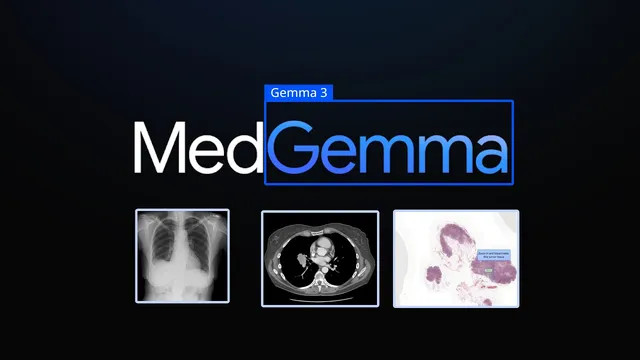
MedGemma - An Open Doctor Model?
Based on Sam Witteveen's video on YouTube. If you like this content, support the original creators by watching, liking and subscribing to their content.
MedGemma is released as two models: a 4B multimodal image+text model and a 27B text-only model, both tuned for medical text and image analysis.
Briefing
Google’s newly released MedGemma models put open-source medical AI within reach for researchers and developers—complete with multimodal (image+text) and text-only variants, benchmark scores on MedQA, and fine-tuning code. The central shift is practical: instead of relying on closed, hard-to-access medical systems, teams can now download, test, and adapt a medical-tuned model family built on the Gemma 3 architecture.
MedGemma arrives in two sizes and modalities: a 4B multimodal model that accepts images (such as chest X-rays) plus text prompts, and a 27B text-only model. The smaller multimodal system can generate radiology-style descriptions when given an image and an instruction like “describe this x-ray,” while both models support instruction-style medical conversations. In the transcript’s examples, the models don’t just answer—when prompted with a “helpful medical assistant” system instruction, they paraphrase reported symptoms and then ask follow-up questions, steering toward a more structured intake. That interaction pattern matters because it can help users gather relevant history in settings where clinicians are scarce or expensive, even as the models include clear disclaimers that they can’t provide definitive diagnoses.
The performance story is anchored in MedQA. The model card figures cited include a zero-shot score of 87.7% for the larger model and 89.8% “best out of five,” with the 4B variant trailing on the same benchmark. The transcript also compares MedGemma’s results to earlier Med-PaLM and Med-PaLM2 work, noting that a smaller, more recent model can outperform much larger earlier systems (including a reference to Med-PaLM-era parameter counts). The implied takeaway is that open medical models are catching up through better training data and instruction tuning, not just through scaling up to massive sizes.
This release also lands in a longer arc of medical AI that repeatedly stalled on access and liability rather than raw capability. Earlier efforts such as Med-PaLM (reportedly available only to researchers) and Med-PaLM2 generated strong results in academic benchmarks and even internal confidence among clinicians, but weren’t broadly downloadable. Meanwhile, IBM Watson-style medical AI faced legal and risk barriers that limited real-world deployment. Against that backdrop, MedGemma’s open availability—paired with terms of use and opt-in legal framing—signals a new phase where medical AI can be evaluated and customized without waiting for proprietary access.
Beyond inference, MedGemma’s release includes notebooks and code for fine-tuning. The transcript highlights that pretrained and instruction-tuned checkpoints can be adapted for specific tasks using LoRa via Hugging Face’s PEFT tooling. An example fine-tuning workflow targets image classification across tissue types, illustrating how teams could tailor the model for particular clinical workflows while keeping computation manageable (potentially on one or two GPUs). Overall, MedGemma is presented as both a medical tool and a proof point: open models, when specialized and fine-tuned, can reach levels that previously belonged to the biggest proprietary systems—while offering on-prem and privacy-friendly deployment options.
Cornell Notes
MedGemma is an open medical model family built on the Gemma 3 architecture, released in two main forms: a 4B multimodal model that can take images plus text prompts, and a 27B text-only model. On the MedQA benchmark, the larger model posts a cited zero-shot score of 87.7% (and 89.8% best out of five), with the smaller model scoring lower. A key theme is that smaller, more data-rich and instruction-tuned open models are now outperforming much larger earlier medical models from the Med-PaLM era. The models also support interactive “medical assistant” conversations that paraphrase symptoms and ask follow-up questions, and they come with notebooks and fine-tuning code (including LoRa via Hugging Face PEFT) for task-specific customization.
What are the two MedGemma variants, and how do their capabilities differ?
Why does the MedQA benchmark matter in this context?
How does the transcript demonstrate the models’ “conversation” behavior?
What historical pattern does the transcript connect to MedGemma’s release?
How can developers adapt MedGemma for specific tasks?
Review Questions
- What capabilities does the 4B multimodal MedGemma model add compared with the 27B text-only model?
- How do the cited MedQA zero-shot and best-of-five numbers support the claim that smaller models can outperform earlier large medical models?
- What role do system instructions play in turning MedGemma from direct answering into an interactive symptom-intake conversation?
Key Points
- 1
MedGemma is released as two models: a 4B multimodal image+text model and a 27B text-only model, both tuned for medical text and image analysis.
- 2
MedQA benchmark figures cited in the transcript include 87.7% zero-shot and 89.8% best out of five for the larger model, with the smaller model scoring lower.
- 3
The release is positioned as a practical step forward because the models are downloadable and testable, unlike earlier medical models that were limited to researchers.
- 4
Interactive behavior emerges when prompts include a “helpful medical assistant” system instruction that drives follow-up questions and structured intake.
- 5
The transcript emphasizes that smaller open models can outperform much larger earlier medical models, suggesting gains from better training and instruction tuning.
- 6
MedGemma comes with notebooks and fine-tuning code, including LoRa via Hugging Face PEFT, enabling task-specific customization such as tissue classification.
- 7
Legal terms of use and disclaimers are part of the deployment context, reflecting caution about medical claims and substitution for clinicians.