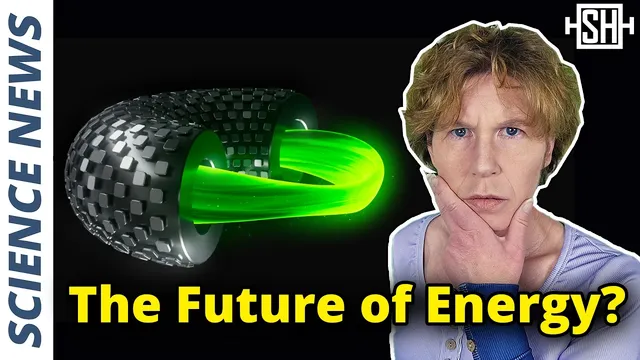
Meet the Reactors Set to Upend Nuclear Fusion
Based on Sabine Hossenfelder's video on YouTube. If you like this content, support the original creators by watching, liking and subscribing to their content.
Tokamaks have achieved long plasma confinement times, but those milestones are still control test runs rather than sustained fusion power.
Briefing
Nuclear fusion has long been treated as the “holy grail” of clean, safe, near-limitless energy—but the central obstacle remains control. Hot plasma must be confined long enough for fusion to occur, and doing so reliably has proven brutally difficult. Recent momentum is shifting toward stellarators, a fusion approach that can run with greater stability than the tokamak method, and multiple companies have now published detailed plans showing how quickly that technology is converging toward practical power plants.
Tokamaks, the dominant and most studied fusion design, use a mix of magnetic and electric fields to keep plasma suspended. They often rely on a plasma current to help with confinement. That strategy has produced impressive control records without yet delivering sustained fusion energy: China’s East Tok achieved plasma confinement for over 1,000 seconds in January, while France’s West Tok later set a new record by maintaining plasma for over 1,300 seconds. But these milestones are still test runs—critical for learning control, not proof of net fusion power.
Fusion has been demonstrated in tokamaks, notably with the Joint European Torus (JET) in the UK, which produced a record-breaking 69 megajoules of energy in October 2023. Yet JET came close to break-even only for the plasma itself; it did not account for the extra energy required to run the reactor. More importantly, JET shut down at the end of 2023 after hundreds of plasma disruptions—sudden losses of control that can slam plasma into reactor walls and potentially damage the machine. The recurring theme is a tradeoff between the precision required by Maxwell’s equations and the reality of Murphy’s law.
Stellarators aim to sidestep tokamak’s reliance on plasma current. Instead, they generate the confining magnetic fields entirely through coils shaped into complex three-dimensional geometries. That design choice can make the plasma more stable and allows continuous operation, but stellarators were historically hard to build: coil geometry demanded heavy supercomputer simulation, and the resulting magnet structures were so intricate they sometimes had to be physically bent by hand.
That bottleneck appears to be easing. Three private companies have recently published stellarator roadmaps almost in parallel. In January, US-based TAE Energy released peer-reviewed papers and design plans for a “planar coil stellarator,” using simpler coils plus algorithms to steer the magnetic field—moving complexity from hardware into software. By March, it reported prototype magnetic fields above three Tesla, sufficient for a fusion-relevant confinement regime. In April, Germany’s Proxima Fusion published design plans for a commercial stellarator power plant called Stellaris and open-sourced the code used to calculate plasma behavior, targeting a demonstration device by 2031. Around the same time, Type One Energy released detailed modeling for its pilot plant, Infinity 2, projecting 800 megawatts of fusion power and aiming for an operational plant by the mid-2030s.
The clustering of announcements matters because it suggests stellarators are rapidly becoming a serious contender—possibly even the frontrunner—while also highlighting a cultural shift in fusion development. Private firms are publishing design details and, in some cases, code, making replication easier for the broader community. In fusion, that transparency is a major change: designs once required security clearance; now they can be shared over Wi‑Fi.
Cornell Notes
Fusion’s biggest hurdle is not creating hot plasma, but controlling it long enough and reliably enough for sustained fusion. Tokamaks have achieved long confinement times and even record energy output, but disruptions and engineering challenges have limited progress toward net power. Stellarators offer a different path: they avoid relying on plasma current by using complex coil-generated magnetic fields, which can improve stability and enable continuous operation. Historically, stellarators were hard to design and build, but recent advances in machine learning and precision engineering are making them more feasible. Multiple private companies have recently published detailed stellarator designs and models, signaling fast convergence toward practical power-plant timelines.
Why do tokamaks struggle to move from plasma control records to practical fusion power?
What is the core engineering difference between tokamaks and stellarators?
How are recent stellarator designs trying to reduce the historical complexity of coil geometry?
What do the latest company announcements suggest about the state of stellarator development?
Why does open publication of fusion designs and code matter for the field?
Review Questions
- How do tokamak disruptions affect the path to net fusion power, and what example illustrates this risk?
- What specific design choice allows stellarators to avoid relying on plasma current, and how does that influence stability?
- Compare the roles of hardware complexity versus software/algorithms in the newer stellarator approaches mentioned (planar coils and open-source modeling).
Key Points
- 1
Tokamaks have achieved long plasma confinement times, but those milestones are still control test runs rather than sustained fusion power.
- 2
JET’s record 69 megajoules demonstrated fusion energy, yet disruptions and the gap to net power (including reactor operating energy) limited its path forward.
- 3
Stellarators aim for greater stability by generating confining magnetic fields with external coils rather than relying on a plasma current.
- 4
Machine learning and precision engineering are reducing the historical difficulty of stellarator coil design and construction.
- 5
TAE Energy, Proxima Fusion, and Type One Energy have recently published detailed stellarator roadmaps, suggesting rapid convergence toward power-plant timelines.
- 6
Private fusion firms are increasingly sharing design plans and code, lowering barriers to replication and accelerating progress.
- 7
The shift from security-clearance-era secrecy to Wi‑Fi-accessible design information marks a notable cultural change in fusion R&D.