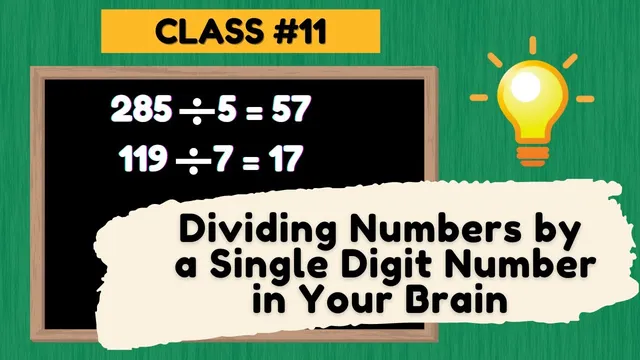
Mental Division Tricks | Dividing numbers by a one-digit number in brain | Mental Math - Class #11
Based on Obsidian Soft's video on YouTube. If you like this content, support the original creators by watching, liking and subscribing to their content.
Memorize multiplication tables before attempting mental division; division depends on instant product recall.
Briefing
Single-digit division in your head starts with one non-negotiable skill: memorized multiplication facts. Division is treated as the “opposite” of multiplication, so solving something like 35 ÷ 7 becomes a matter of finding which multiplication result equals 35 in the 7-times table. Since 7 × 5 = 35, the quotient is 5. The same logic handles 18 ÷ 2: 2 × 9 = 18, so the answer is 9. Without reliable multiplication tables, mental division stalls.
For larger numbers, the method mirrors long division but stays entirely inside working memory. When dividing 87 ÷ 3, the process begins with the leftmost digit 8. Because 8 is greater than 3, it can be divided; the closest product in the 3-times table that does not exceed 8 is 3 × 2 = 6. That 2 becomes the first quotient digit, and the remainder is computed mentally: 8 − 6 = 2. Bringing down the next digit forms 27, and 27 ÷ 3 is recognized directly from the 3-times table (3 × 9 = 27), yielding the final quotient 29. The same left-to-right logic works for 96 ÷ 4: 9 is greater than 4, and the closest product not exceeding 9 is 4 × 2 = 8, leaving 9 − 8 = 1; combining gives 16, and 16 ÷ 4 = 4, so the total is 24.
When the dividend is bigger and the first digit can’t stand alone, the approach adjusts by grouping digits until the partial dividend is at least as large as the divisor. For 119 ÷ 7, the first digit 1 is too small, so 11 is used instead. The closest multiple of 7 not exceeding 11 is 7 × 1 = 7, leaving 11 − 7 = 4. Bringing down the next digit gives 49, and 49 ÷ 7 is immediate because 7 × 7 = 49. The quotient is 17.
A second mental strategy breaks division into chunks using easy multiples of 10. For 87 ÷ 3, the easiest multiplication fact is 3 × 10 = 30. Subtract 30 from 87 to get 57, subtract another 30 to get 27, and track the number of tens removed (two tens). Now 27 ÷ 3 is fast from the multiplication facts (9), and adding the counts gives 29. For 96 ÷ 4, subtract 40 twice (since 4 × 10 = 40): 96 − 40 = 56, then 56 − 40 = 16. Since 16 ÷ 4 = 4, the quotient is 20 + 4 = 24. For 119 ÷ 7, subtract 70 (7 × 10): 119 − 70 = 49, and 49 ÷ 7 = 7, so the result is 17.
Finally, a “cool trick” targets division by 5. Instead of dividing by 5 directly, multiply the number by 2 and then divide by 10 (effectively dividing by 5). For 85 ÷ 5: 85 × 2 = 170, and 170 ÷ 10 = 17. For 285 ÷ 5: 285 × 2 = 570, and 570 ÷ 10 = 57. The class closes by emphasizing practice and mastery of multiplication tables—at least through 12, with 16 recommended—to make mental division reliable.
Cornell Notes
Mental division for single-digit divisors depends on memorized multiplication facts, because each quotient corresponds to a known product in the divisor’s times table. For multi-digit dividends, one approach follows long division left-to-right entirely in the head: choose the largest safe multiple of the divisor, subtract mentally, and bring down the next digit. A second approach uses multiples of 10: subtract (divisor × 10) repeatedly to reduce the problem, then finish with a smaller division using direct multiplication facts. For division by 5, a shortcut multiplies by 2 and then divides by 10, since that transformation preserves the correct quotient. These methods reduce cognitive load by turning division into subtraction and table recall.
Why can’t mental division work reliably without multiplication facts?
How does the “long division in your head” method handle 87 ÷ 3?
What changes when the first digit of the dividend is smaller than the divisor?
How does the “multiples of 10” strategy simplify 96 ÷ 4?
What’s the shortcut for dividing by 5, and why does it work?
Review Questions
- For 87 ÷ 3 using the left-to-right mental long division method, what are the intermediate remainder and the first quotient digit?
- Using multiples of 10, compute 119 ÷ 7 and show the subtraction steps before the final table-based division.
- Apply the division-by-5 trick to 210 ÷ 5 and state the intermediate multiplication and final division results.
Key Points
- 1
Memorize multiplication tables before attempting mental division; division depends on instant product recall.
- 2
Treat division as the inverse of multiplication: find the quotient by matching the dividend to a product in the divisor’s table.
- 3
Use left-to-right mental long division for multi-digit dividends: choose the largest safe multiple, subtract mentally, then bring down the next digit.
- 4
When the first digit is smaller than the divisor, group digits until the partial dividend is large enough to divide.
- 5
Use multiples of 10 to break harder divisions into easier steps: subtract (divisor × 10) repeatedly, then finish with a smaller division.
- 6
For division by 5, multiply by 2 and divide by 10 (remove the zero) to get the quotient quickly.
- 7
Practice multiplication facts through at least the 12-times table (and ideally up to 16) to make mental division dependable.