Messages For The Future
Based on Vsauce's video on YouTube. If you like this content, support the original creators by watching, liking and subscribing to their content.
Interstellar messaging is as much about choosing durable carriers and formats as it is about choosing content.
Briefing
A practical way to think about humanity’s “last message” is to treat it like an archive problem: if Earth ends, what survives long enough—and in a form alien minds might decode—to preserve evidence of who we were? The core idea is that cosmic communication isn’t just about sending words into space; it’s about choosing durable carriers, using universal reference systems, and diversifying formats so some record survives whatever destroys us.
The discussion begins with an image of Earth taken from Saturn by NASA’s Cassini spacecraft on July 19, 2013—an example of how carefully timed, externally planned “messages” can reach the future. That sets up a thought experiment tied to Sky 1’s “You, Me and the Apocalypse,” where characters learn they have only 34 days left before a comet likely ends humanity. With no bucket list except one final act, the proposed response is to compile a “bucket list” of information about Earthlings and send it far away—like ripples from a stone thrown into a lake, where effects persist after the original moment is gone.
From there, the focus shifts to how to write for an audience that might be unimaginably different. A message might take millions or billions of years to be found, and the discoverers might not share human senses or even the chemistry needed to read a physical medium. The most reliable common ground, the account argues, is math and physics—assumed to be consistent across the universe. That principle underpins interstellar attempts such as the Arecibo message (binary information sent toward the M13 star cluster) and Earth’s radio and TV leakage into space, which forms a growing “bubble” of signals roughly 200 light-years across.
Because broadcast signals fade with distance, the transcript emphasizes physical time capsules in orbit. LAGEOS-1, launched in 1976, carries a plaque designed by Carl Sagan with binary numbers and the arrangement of Earth’s continents across deep time—timed to the satellite’s expected orbital stability of about 8.4 million years. The same logic extends to geostationary satellites: around 450 “monuments” remain in high, stable orbits, and when they fail they’re moved into “graveyard orbits,” effectively turning machine lifetimes into long-lasting artifacts. Some, like EchoStar XVI, include additional artwork and records—such as a silicon disc by Trevor Paglen containing images of Earth and Earthlings—aimed at preserving a visual snapshot for any future intelligence.
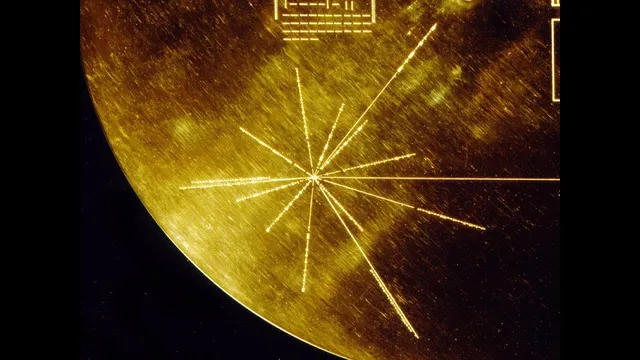
If the solar system itself is lost, the transcript points to interstellar probes carrying messages outward: Pioneer 10 and Pioneer 11, Voyager 1 and Voyager 2, and New Horizons. Pioneer plaques use hydrogen’s hyperfine transition (about 2.7 nanoseconds and 21 centimeters) and a pulsar map to encode units and location. Voyager’s “golden record” goes further, combining images, audio, video, and a playback system, plus a message from U.S. President Jimmy Carter describing the record as a present meant to survive profound future change.
Finally, the transcript asks whether sending “enough” is even the right question. It introduces the Library of Babel—Jonathan Basile’s system that generates every possible 3200-character combination of English letters and punctuation—suggesting that the universe of possible statements is finite and enumerable. The closing tension is philosophical: a library can contain everything that can be said, but meaning requires intention. The real challenge isn’t just what survives; it’s what we choose to send with agency.
Cornell Notes
Humanity’s “messages for the future” are treated as an archive design problem: if Earth ends, what evidence of human life can survive long enough and be decodable by unknown minds? The transcript argues that math and physics offer the best universal reference points, so interstellar artifacts rely on binary, hydrogen’s hyperfine transition, and pulsar timing to communicate units and location. It then surveys long-lived carriers—orbital plaques like LAGEOS-1, geostationary “monuments” and their graveyard orbits, and deep-space probes such as Pioneer and Voyager with plaques and the golden record. The stakes are both practical (durability, distance, signal loss) and philosophical (a record can contain possibilities, but meaning depends on intention).
Why does the transcript treat “writing for the future” as harder than just sending information into space?
What makes the Arecibo message and other physics-based approaches more likely to be understood?
How does LAGEOS-1 function as a time capsule, and why is its timescale significant?
What technical strategy do Pioneer plaques use to communicate units and location to aliens?
What makes Voyager’s golden record different from Pioneer’s plaques?
How does the Library of Babel challenge the idea that sending messages is about “creating” new content?
Review Questions
- Which parts of the Pioneer plaque are meant to be universal, and why are hydrogen and pulsars central to that universality?
- Compare the durability logic behind LAGEOS-1, geostationary satellites, and Voyager/Pioneer probes—what problem does each approach solve?
- What philosophical distinction does the transcript draw between a system that contains all possible statements and a message that carries intention?
Key Points
- 1
Interstellar messaging is as much about choosing durable carriers and formats as it is about choosing content.
- 2
Math and physics are treated as the most reliable shared language because they don’t depend on human senses or local culture.
- 3
Broadcast signals from Earth fade with distance, so physical time capsules in orbit and deep-space probes offer a more persistent alternative.
- 4
LAGEOS-1’s plaque uses binary and Earth-continent maps across millions of years to communicate a timeline to any future intelligence.
- 5
Geostationary satellites act like long-lived monuments; when they fail, graveyard orbits preserve them as artifacts for extremely distant observers.
- 6
Pioneer plaques encode units and location using hydrogen’s hyperfine transition and pulsar timing rather than human measurements.
- 7
Voyager’s golden record combines a playback system with images, audio, video, and a dated physical composition, aiming to preserve a fuller picture of humanity.