Meta Up 10%, Microsoft Down 10%, Tesla Killing Cars. This Week Broke Something.
Based on AI News & Strategy Daily | Nate B Jones's video on YouTube. If you like this content, support the original creators by watching, liking and subscribing to their content.
Meta’s AI infrastructure capex guidance jumped to $115–$135 billion (from $72 billion in 2025), and investors rewarded it because the spending ties to controllable ad and recommendation revenue.
Briefing
AI is shifting from a boardroom talking point to an all-at-once reality—markets, regulators, and companies are now judging execution, control, and accountability. The week’s biggest throughline was Wall Street’s split reaction to AI spending: investors rewarded infrastructure bets that map cleanly to revenue, while punishing strategies that leave companies dependent on AI partners they don’t control.
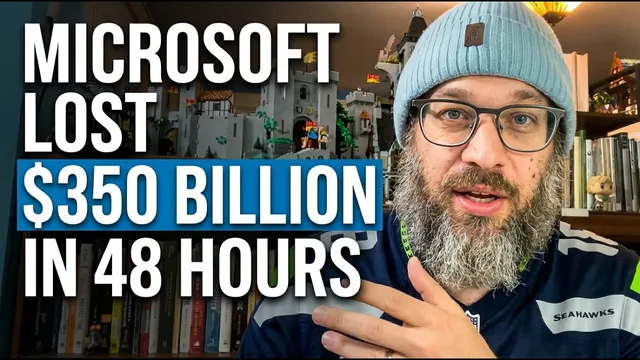
Meta and Microsoft reported within hours of each other, and both beat expectations—yet their stock moves diverged sharply. Meta’s results came with a forward-looking capex jump to $115–$135 billion (up from $72 billion in 2025), and the market largely cheered. The logic: Meta can tie AI infrastructure directly to its existing engine—recommendation algorithms and advertising—where each model generation improves measurable performance. Microsoft’s story looked strong on paper too—Azure grew 39%—but the market focused on what sits underneath. Nearly half of Microsoft’s $625 billion commercial backlog is tied to OpenAI commitments, meaning a large share of future contracted revenue depends on a third party. The takeaway for enterprise AI strategy is blunt: building proprietary AI capabilities is expensive and slow but defensible; “renting” frontier models can be faster but creates structural exposure to another company’s execution.
That same execution pressure showed up beyond earnings. A Whimo robo taxi struck a child in Santa Monica on January 23, prompting preliminary NHTSA review and adding to a separate NTSB inquiry into Austin operations where vehicles allegedly passed stopped school buses at least 19 times. Whimo’s response leaned on statistical comparisons to human drivers, but the incident still landed as a narrative problem: safety accountability is the social acceptance bottleneck for autonomous systems. The message was that “safer on average” doesn’t resolve the core question of who is responsible when something goes wrong.
Meanwhile, the infrastructure buildout is accelerating in ways that suggest a second wave of AI spending—moving from model development to the physical and logical layers needed to deploy at scale. Nvidia invested $2 billion in Coreweave to expand AI-optimized data centers targeting 5 gigawatts of capacity by 2030. Microsoft also signed a $750 million, three-year deal with Perplexity, giving access to OpenAI, Anthropic, and XAI models via Microsoft Foundry, while Perplexity emphasized AWS as its primary cloud provider to avoid overreliance on a single hyperscaler. Together, these deals frame AI infrastructure as “plumbing” for the AI economy.
Tesla added another pivot: it’s increasingly positioning itself as an AI and robotics company rather than a premium car maker. Tesla is discontinuing Model S and Model X, converting Fremont production lines toward Optimus robot output, and expanding robo taxi service to multiple metro areas. It also deployed Grok across the vehicle fleet and announced a $2 billion investment in XAI.
Finally, the funding and agent ecosystem kept moving. Anthropic closed a round valuing it at $350 billion, with enterprise traction and a “constitutional AI” approach cited as differentiation. And Open Claw—an AI agent that can connect to messaging and run cross-platform tasks—crossed 100,000 GitHub stars, highlighting both the appeal of agent-based automation and the security risks of broad system access.
Across markets, regulators, and product roadmaps, the phase where companies could talk about AI potential is ending. The next chapter is about irreversible commitments—and whether they can deliver.
Cornell Notes
The week’s central pattern was a shift from AI as a promise to AI as an executed, accountable system—financially, operationally, and socially. Meta’s AI infrastructure spending was rewarded because it ties directly to its ad and recommendation revenue engine, while Microsoft’s AI exposure was punished because much of its backlog depends on OpenAI commitments it doesn’t control. Autonomous vehicle incidents underscored that “safer on average” won’t earn acceptance without clear accountability when harm occurs. Infrastructure deals (Nvidia–Coreweave, Microsoft–Perplexity) signal a second wave focused on deployable capacity, not just model building. Tesla’s move away from Model S/X toward Optimus and robotics shows companies are betting that AI’s future is physical and scalable—not just software.
Why did Meta’s AI capex surge get a positive market response while Microsoft’s similar AI spending narrative didn’t?
What does the Whimo robo taxi incident reveal about the real barrier to autonomous vehicles?
How do Nvidia–Coreweave and Microsoft–Perplexity deals illustrate a “second wave” of AI spending?
What strategic shift is Tesla making, and what operational changes support it?
Why is Anthropic’s valuation growth framed as tied to enterprise traction and “constitutional AI”?
What makes Open Claw both compelling and risky as an AI agent?
Review Questions
- How does investor preference differ between AI infrastructure spending that directly supports a company’s own revenue engine versus spending that creates dependency on an external AI provider?
- What accountability expectations emerged from the Whimo incident, and why do statistical comparisons to human drivers fail to address them?
- Which examples in the transcript suggest AI spending is moving from model development toward deployment infrastructure, and what capacity targets or deal structures support that shift?
Key Points
- 1
Meta’s AI infrastructure capex guidance jumped to $115–$135 billion (from $72 billion in 2025), and investors rewarded it because the spending ties to controllable ad and recommendation revenue.
- 2
Microsoft’s AI strategy faced skepticism because 45% of its $625 billion commercial backlog is linked to OpenAI commitments, creating structural dependence on a partner it doesn’t control.
- 3
Autonomous vehicle acceptance depends on clear accountability after incidents; “safer on average” arguments don’t resolve the responsibility question when harm occurs.
- 4
Nvidia’s $2 billion investment in Coreweave and Coreweave’s 5 gigawatt-by-2030 target signal a second wave focused on deployable AI infrastructure.
- 5
Microsoft’s $750 million, three-year Perplexity deal highlights how AI deployment is becoming a “plumbing” layer, while Perplexity’s AWS hedge shows hyperscaler concentration risk is a live concern.
- 6
Tesla’s discontinuation of Model S and Model X and conversion of Fremont lines toward Optimus production reflect a pivot toward robotics and AI-driven services over low-volume car manufacturing.
- 7
Open Claw’s rapid GitHub growth underscores both the appeal of agent-based automation and the security risks of broad system access enabling action on private data.