Meta's Crime Empire
Based on The PrimeTime's video on YouTube. If you like this content, support the original creators by watching, liking and subscribing to their content.
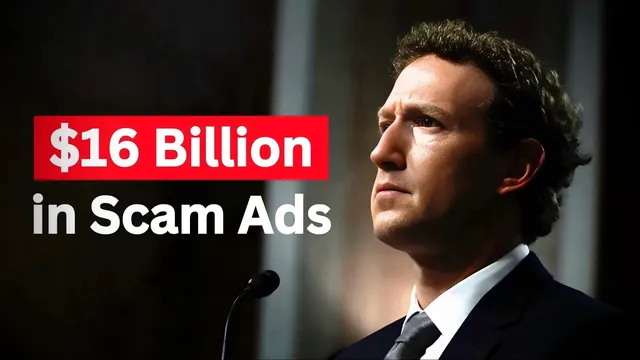
The transcript cites internal documents projecting that scam ads account for about 10% of Meta’s 2024 revenue (roughly $16 billion).
Briefing
Meta’s internal documents reportedly project that scams are a major revenue stream for Facebook and Instagram—about 10% of 2024 ad revenue, roughly $16 billion. The scale is framed as staggering: one-third of successful U.S. scams are said to originate from Facebook, and 53% of UK payment-related scams are attributed to Facebook. The implication is that Meta’s ad targeting machinery—built on massive user data and sophisticated ad delivery—creates an environment where scammers can find victims efficiently, and where scam ads can spread faster than enforcement can remove them.
The transcript argues that the system’s effectiveness for legitimate advertisers is also what makes it attractive to fraudsters. People using Facebook and Instagram generate large volumes of behavioral and identity data, and Meta has invested heavily in engineering to optimize ad targeting. Scammers, according to claims cited from internet forums, find it easier to scam on Meta than on Google—suggesting that the platform’s ad infrastructure lowers the friction for fraud campaigns.
Enforcement, however, appears to lag behind the volume and sophistication of scam activity. The transcript cites a figure that 96% of “valid scam reports” are rejected, with a stated goal of improving acceptance to 75%. Even when reports get through, account removal is described as extremely difficult: for high-value accounts, it reportedly takes over 500 successful reports—equated to roughly 12,500 people reporting the same scam. The frustration is sharpened by an additional claim that some scam accounts can effectively operate with impunity if they are small enough relative to Meta’s overall revenue. If a scam account’s spend is only 0.015% of Meta revenue, the team responsible for takedowns “can’t even touch” it, meaning fraud can remain profitable as long as it stays under internal thresholds.
The transcript also points to Meta’s public-facing safety messaging as potentially mismatched with internal incentives. Meta promoted online safety through a partnership with “Estabbon,” using Instagram horoscope-style posts—such as Mercury retrograde survival tips—alongside generic advice like enabling two-factor authentication. The critique is that this kind of youth-targeted content may do little to reduce scam ads that generate substantial income.
A key economic argument is introduced via the Laffer curve: if Meta removed all scam ads, revenue would collapse because trust and click-through rates would fall. The transcript further claims that Meta has internal acknowledgment that regulatory fines are “certain,” with penalties potentially up to $1 billion—still framed as less than the revenue from scam ads. Another internal document is cited as saying Meta earns $3.5 billion every six months from scam ads carrying higher legal risk. Even an internal effort to spotlight “scamiest scammers” is portrayed as ineffective: Reuters reportedly checked five accounts named in such weekly reports and found two still live more than six months later, including an ad campaign for an unlicensed online casino.
The closing takeaway is blunt: change is unlikely unless user engagement with ads declines enough to threaten overall revenue, or unless the cost of enforcement and legal exposure rises above what scam ads generate. In that framing, Meta’s incentives are aligned with tolerating scams rather than eliminating them—at least in the near term.
Cornell Notes
Internal documents cited in the transcript claim scams generate about 10% of Meta’s 2024 ad revenue (roughly $16 billion). Reported enforcement gaps include rejecting 96% of valid scam reports and requiring hundreds of successful reports before high-value accounts are deleted. The transcript argues Meta’s incentives may favor keeping some scam ads online because removing them would reduce trust and click-through rates, while fines are expected and potentially smaller than scam-ad revenue. It also describes internal “scamiest scammer” spotlights that reportedly failed to shut down accounts quickly, including an unlicensed online casino ad that remained active months later. The stakes are framed as large-scale fraud: major shares of U.S. and UK scams are attributed to Facebook.
What revenue share from scams does the transcript claim Meta projected for 2024, and why does that matter?
How does the transcript describe the reporting and takedown process for scam ads?
Why does the transcript say scammers can operate effectively on Meta compared with other platforms?
What economic logic is used to argue Meta may not want to eliminate scam ads entirely?
What example is given to show internal scam-spotlighting efforts may not lead to quick enforcement?
How does the transcript connect Meta’s public safety messaging to the broader critique?
Review Questions
- According to the transcript, what combination of reporting rejection rates and report volume is described as required before high-value scam accounts are removed?
- How does the transcript link Meta’s ad targeting capabilities to the ease of running scams on the platform?
- What role do anticipated regulatory fines and click-through/trust incentives play in the transcript’s argument about why scam ads persist?
Key Points
- 1
The transcript cites internal documents projecting that scam ads account for about 10% of Meta’s 2024 revenue (roughly $16 billion).
- 2
It claims Facebook is a major source of scams, including one-third of successful U.S. scams and 53% of UK payment-related scams.
- 3
Reported enforcement weaknesses include rejecting 96% of valid scam reports and requiring hundreds of successful reports for takedowns of high-value accounts.
- 4
The transcript argues that Meta’s data collection and ad targeting engineering can make scam campaigns easier to run than on other platforms.
- 5
It describes internal incentives that may favor tolerating some scam ads, including expectations of regulatory fines and claims that fines are smaller than scam-ad revenue.
- 6
A cited example from Reuters suggests that even accounts highlighted as “scamiest” can remain active for months, including an unlicensed online casino ad.
- 7
The transcript frames Meta’s safety promotions as potentially misaligned with the scale of scam-ad profitability.