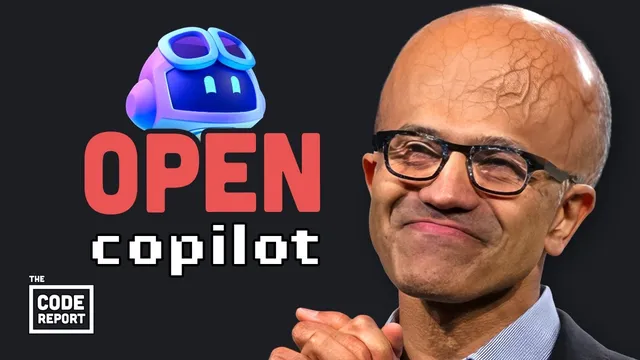
Microsoft just opened the flood gates…
Based on Fireship's video on YouTube. If you like this content, support the original creators by watching, liking and subscribing to their content.
GitHub Copilot’s underlying code was released as free, open-source software under the MIT license, enabling forks and modifications.
Briefing
Microsoft has released the code behind GitHub Copilot as free, open-source software under the MIT license—an abrupt move that turns a major paid AI coding product into something developers can legally fork, modify, and build on. The practical impact is straightforward: teams can now extend Copilot’s underlying tooling without being locked into Microsoft’s closed development cycle, and independent builders can create competing products without the legal and operational constraints that typically come with proprietary platforms.
The timing matters. The announcement lands amid shifting relationships and fast-moving AI coding competition: Microsoft and OpenAI previously had a tighter partnership for model training on Azure, but that exclusive arrangement has ended. In the same broader window, OpenAI has announced Codex, a cloud-based coding agent positioned as a parallel bug generator, and Microsoft has been rolling out deeper GitHub integration for AI coding workflows—along with support for the Model Context Protocol across its products, including Windows 11. Together, these moves point toward a future where AI tooling can operate with broader access to developer environments, potentially escalating from “assistant” to “agent” behavior.
Copilot’s open-source release also reframes what users are actually paying for. Even with the underlying software now open, Copilot is not becoming free in practice: the transcript emphasizes that subscription fees—up to about $390 per year—primarily cover the cloud compute required to generate code, not the Copilot codebase itself. In other words, open sourcing reduces friction for customization and community contributions, but it doesn’t eliminate the cost of running large models.
Microsoft’s decision is presented as both strategic and operational. With recent layoffs affecting thousands of employees, open sourcing can accelerate feature development by tapping external contributors and reducing reliance on internal engineering throughput. It also strengthens Microsoft’s position in the developer “hearts and minds” race: programmers are described as the dominant paying audience for LLM services, and winning developers often determines which AI tools become default.
The move is also cast as a competitive pressure point. Closed-source AI coding editors—such as Cursor and Windsurf—can’t easily match the transparency, security review, and rapid patching that open code enables. Meanwhile, Microsoft’s history of open-source wins—citing VS Code, TypeScript, and WSL as ecosystem-shaping examples—suggests the company expects Copilot’s open release to expand adoption and spur a broader ecosystem of extensions.
Finally, the transcript ties the Copilot release to a larger career and productivity theme, arguing that AI-assisted coding could make skilled developers far more effective. The message is that the real advantage won’t come from “anyone can code” hype alone, but from developers who can leverage AI to multiply output while still applying judgment, security awareness, and engineering discipline.
Cornell Notes
Microsoft released GitHub Copilot’s underlying code as free, open-source software under the MIT license, allowing anyone to fork and modify it. The subscription price for Copilot is expected to remain, because users mainly pay for the cloud compute needed to generate code rather than for the Copilot codebase itself. The open release is framed as a strategic move in a fast-changing AI coding market where OpenAI and Microsoft are pushing agent-style coding tools and deeper GitHub integration. Open sourcing also enables faster community-driven improvements, better transparency, and easier security auditing compared with closed competitors. Overall, the change could accelerate an ecosystem of Copilot-based tools and extensions while keeping Microsoft’s compute-based revenue model intact.
What exactly changed with GitHub Copilot, and what does the MIT license enable?
Why isn’t Copilot necessarily free even though the code is open?
How does the timing connect to the broader AI coding competition?
What competitive advantage does open sourcing create versus closed AI coding editors?
Why might Microsoft open source Copilot now despite it being a paid product?
Review Questions
- How does the MIT license change what developers can legally do with Copilot’s code, and how does that differ from the subscription cost model?
- What does the transcript imply about the future of AI coding agents when Model Context Protocol support and deeper GitHub integration are added?
- Why might open sourcing a paid AI tool still strengthen Microsoft’s competitive position rather than weaken it?
Key Points
- 1
GitHub Copilot’s underlying code was released as free, open-source software under the MIT license, enabling forks and modifications.
- 2
Copilot subscriptions are expected to remain paid because users mainly pay for cloud compute used to generate code, not for the open-source codebase itself.
- 3
The open-source move arrives amid rapid AI coding competition, including OpenAI’s Codex and Microsoft’s GitHub integration and Model Context Protocol support.
- 4
Open sourcing can improve transparency, security auditing, and patch speed compared with closed-source AI coding editors.
- 5
Microsoft’s broader open-source track record (e.g., VS Code, TypeScript, WSL) is used to argue this strategy can expand adoption and ecosystem extensions.
- 6
The release is framed as a developer-mindshare play, targeting a market where programmers are described as the dominant paying LLM users.