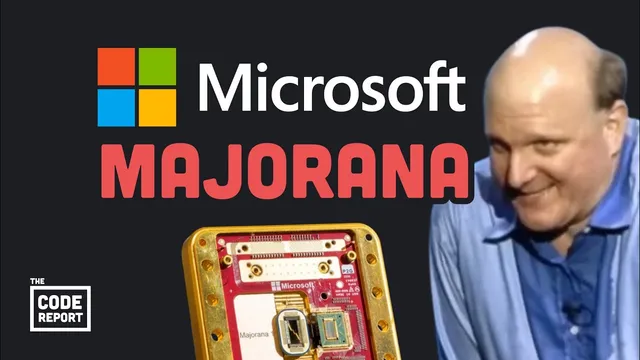
Microsoft’s new chip looks like science fiction…
Based on Fireship's video on YouTube. If you like this content, support the original creators by watching, liking and subscribing to their content.
Topological quantum computing is presented as a strategy to reduce errors by making qubits more resistant to decoherence rather than relying only on error correction.
Briefing
Microsoft’s newly announced topological quantum computing chip, “Myer on a one” (as named in the transcript), is pitched as a potential route to scaling quantum computers without the usual fragility that makes today’s machines unreliable. The central claim is that the chip’s underlying physics—using “myeron a fon” particles (Majorana-like modes)—could create a qubit design far more resistant to decoherence, the environmental noise that collapses quantum superposition and drives up error rates. If that holds up experimentally, it could be a scaling breakthrough on the order of the transistor: not just a faster prototype, but a path toward quantum systems with millions of qubits that are actually usable.
The transcript contrasts this approach with the broader quantum race. Google’s “Willow” chip is described as having produced a meaningful advance via improved error correction, even though it remains “useless for all practical purposes” today. IBM is also mentioned as being ahead in the race, while Microsoft is framed as taking a longer-term bet on topological quantum computing—an architecture that aims to encode information in a way that is inherently protected by the topology of the quantum states.
At the heart of the pitch is the myeron a fon, described as a particle that is its own antiparticle—analogous to how an electron has a negative charge while its opposite partner (a positron) has the opposite charge, except the myeron a fon has no distinct positive/negative identity. That “self-image” property is said to make it resistant to decoherence. The transcript links this to a specific method: braiding and fusing these particles so that quantum information is manipulated through topological operations rather than fragile, direct control of individual qubits.
The proposed implementation runs on an engineered nanowire. The transcript describes myeron a zero modes at either end of the wire, where computation is performed by measuring whether there is an even or odd number of electrons. Those measurements are said to yield a “topo conductor,” described as a semiconductor–superconductor hybrid where the semiconductor behaves like the superconductor. Multiple such units could, in principle, be chained to scale up qubit counts on a small chip.
Still, the transcript stresses major caveats. The chip must operate near absolute zero, and—crucially—Microsoft’s claimed scaling to “millions of cubits” is not demonstrated yet in practice. The myeron a fon itself was theorized in 1937, observed only in 2020 in gold-based systems, and Microsoft’s earlier work from 2018 is said to have been retracted due to misrepresented results. That history raises the stakes: the announcement could be either a genuine breakthrough or another round of hype.
Finally, the transcript argues that if topological quantum computing works as promised, software would need a fundamental rewrite to target quantum hardware efficiently—implying a future where quantum programming becomes a new optimization frontier rather than a drop-in upgrade. It also notes that, for now, the practical quantum advantage remains out of reach, even as the race shifts toward architectures designed to survive noise rather than merely correct it after the fact.
Cornell Notes
Microsoft’s announced topological quantum computing chip (named “Myer on a one” in the transcript) aims to tackle quantum computers’ biggest weakness: decoherence. The approach relies on “myeron a fon” particles, described as their own antiparticles, which are claimed to resist decoherence and reduce error rates. The method uses engineered nanowires with myeron a zero modes at both ends, where braiding/fusing operations and parity measurements (even vs. odd electron counts) encode and read out information. The promise is scaling to millions of qubits on a small chip, but the transcript emphasizes that this scale has not yet been achieved and that earlier related claims were retracted. If the physics holds, it could enable quantum systems that are far more reliable than today’s fragile qubits.
What problem is topological quantum computing trying to solve, and why does it matter for real performance?
How does the transcript describe the “myeron a fon” particle, and what makes it special for qubits?
What hardware mechanism is described for implementing the qubits on the chip?
What does “braiding and fusing” mean in this context, and how is it used for computation?
What evidence and timeline concerns are raised about the myeron a fon approach?
Why is scaling to “millions of cubits” still an open question in the transcript?
Review Questions
- What role does decoherence play in limiting quantum computers, and how does the transcript claim topological designs change that?
- Explain the parity measurement (even vs. odd electrons) described in the nanowire setup and how it relates to encoding information.
- What specific historical issues about earlier myeron a fon claims are mentioned, and why do they matter for interpreting the new announcement?
Key Points
- 1
Topological quantum computing is presented as a strategy to reduce errors by making qubits more resistant to decoherence rather than relying only on error correction.
- 2
The transcript centers the “myeron a fon” concept: a particle described as its own antiparticle, claimed to resist decoherence.
- 3
The proposed hardware uses engineered nanowires with myeron a zero modes at both ends and operates near absolute zero.
- 4
Computation is described as parity-based: measuring even vs. odd electron counts to extract information.
- 5
Braiding and fusing operations are described as the core manipulation method for topological quantum states.
- 6
Scaling claims to millions of qubits are treated as unproven in practice within the transcript’s timeframe.
- 7
Earlier related myeron a fon research is described as having been retracted, raising the need for independent validation.