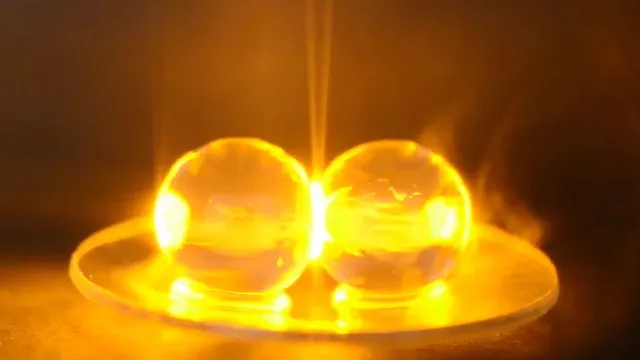
Microwaving Grapes Makes Plasma
Based on Veritasium's video on YouTube. If you like this content, support the original creators by watching, liking and subscribing to their content.
Microwaves at about 2.45 GHz form resonant standing-wave modes inside grapes because the effective internal wavelength (set by the grape’s microwave refractive index) becomes comparable to grape size.
Briefing
Microwaving grapes can generate plasma because the fruit acts like a microwave resonator that traps electromagnetic energy and concentrates it where two pieces touch. The key mechanism isn’t “microwaves heating from the outside in,” but rather the formation of standing-wave modes inside the grape. Those modes create the strongest electric fields in the center of each grape, driving rapid heating and setting the stage for electrical breakdown of nearby air.
A typical household microwave operates around 2.45 gigahertz, corresponding to a wavelength of about 12 centimeters in free space. While a grape is far smaller than 12 centimeters, the relevant wavelength shrinks inside the grape because the grape’s effective refractive index in the microwave regime is much higher than in visible light—around 10 in the explanation. That makes the microwave wavelength inside the grape roughly 1.2 centimeters, putting it in the same ballpark as the fruit’s dimensions. When a grape’s size matches the wavelength in the material, microwaves can become trapped via total internal reflection, forming resonant electromagnetic patterns with maximum field strength near the center. Heating then follows that internal field distribution, so the hottest region is where the standing-wave amplitude peaks.
The plasma effect becomes dramatic when two grapes are brought close enough to couple their electromagnetic fields. If two grapes sit side-by-side and remain in contact, the strongest electric field shifts to the contact point between them. That concentrated field can exceed the threshold for ionizing air, producing sparks and a burst of plasma. The plasma’s pulsing—reported as 120 hertz, twice the 60 hertz mains frequency—matches the idea that microwave amplitude oscillates twice per AC cycle. Spectral measurements of the plasma indicate emission lines consistent with potassium and sodium, implying those ions are abundant in the grape and become the charged species once the air breaks down.
The phenomenon isn’t unique to grapes. Similar results can be produced with hydrogel water beads—tiny polymer spheres that swell dramatically when soaked—because the crucial ingredients are the right size and the right microwave-absorbing refractive properties. Water absorption matters: without absorption, field amplification would occur only at a narrow set of resonant sizes, but real water-containing materials broaden the resonance, allowing the effect to work across a range of grape sizes.
Beyond the novelty, the mechanism points to a potential route for focusing electromagnetic energy into tiny gaps. The explanation links this to a major bottleneck in microchip fabrication: lithography. If the same kind of sub-wavelength focusing achieved by two coupled spheres could be replicated with light, it could enable much finer patterning than current techniques—potentially supporting resolutions on the order of nanometers and helping extend the pace of Moore’s Law by packing more features into each chip.
Cornell Notes
Microwaving grapes produces plasma because the fruit traps 2.45 GHz microwaves and supports resonant standing-wave modes inside the material. The grape’s microwave refractive index is high enough that the effective wavelength inside the fruit becomes comparable to the grape’s size, enabling internal trapping and strong electric fields near the center. When two grapes touch, their resonant fields couple and the maximum field shifts to the contact point, where the electric field can ionize air and create sparks and plasma. Emission spectra point to potassium and sodium ions as key contributors. Similar plasma can occur with hydrogel water beads, since the effect depends mainly on size and microwave-absorbing properties, not on grapes specifically.
Why does a grape resonate with 2.45 GHz microwaves even though its size is far smaller than the free-space wavelength?
What role does “trapping” play in heating and field formation?
How does touching two grapes change where the strongest electric field appears?
What turns concentrated electric fields into plasma?
What does the plasma’s composition reveal?
Why do hydrogel water beads work even though they aren’t grapes?
Review Questions
- How does the grape’s microwave refractive index change the effective wavelength inside the fruit, and why does that matter for resonance?
- Explain why the strongest electric field shifts to the contact point when two grapes touch.
- What evidence from plasma spectroscopy suggests which elements are involved, and how does that connect to the ionization process?
Key Points
- 1
Microwaves at about 2.45 GHz form resonant standing-wave modes inside grapes because the effective internal wavelength (set by the grape’s microwave refractive index) becomes comparable to grape size.
- 2
High refractive index enables microwave trapping in the grape via total internal reflection, concentrating electromagnetic fields near the center and driving inside-out heating.
- 3
Plasma formation requires strong electric fields at a location where air can break down; coupling two touching grapes concentrates the field at their contact point.
- 4
The plasma pulses at 120 hertz, consistent with microwave amplitude varying twice per mains cycle.
- 5
Spectral lines indicate potassium and sodium are prominent in the plasma, pointing to grape-derived ions as key charged species.
- 6
Hydrogel water beads can reproduce the effect because the mechanism depends on size and water-driven microwave absorption, not on grapes specifically.
- 7
The same focusing-by-coupled-spheres concept could, in principle, inform future lithography approaches if adapted to light for nanometer-scale patterning.