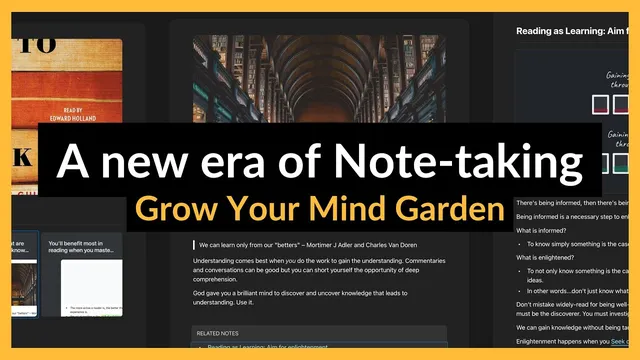
Mind Gardens: how to cultivate curiosity, grow in knowledge and produce new ideas (note-taking tips)
Based on Greg Wheeler's video on YouTube. If you like this content, support the original creators by watching, liking and subscribing to their content.
Treat notes as a living system by following a three-stage flow: seed curiosity, grow knowledge, then produce new thoughts.
Briefing
A “mind garden” is a structured way to turn scattered notes into a living system for curiosity, knowledge, and original thinking—built on the idea that ideas grow only when they’re tended, revisited, and connected. Instead of treating notes like a junk drawer, the approach frames the mind as a garden with three stages: seeding curiosity with quality input, growing knowledge through personal understanding, and producing new thoughts by consistently reviewing and linking what’s been captured. The payoff is practical: notes become a source of discovery rather than a storage problem.
The first stage—cultivating curiosity—starts with what goes into the system. Notes are only as strong as their sources, so the emphasis lands on “quality content.” One method for finding better ideas is “time travel”: seek out older books that have stood the test of time, using them as a counterweight to today’s endless, equally accessible information. Another method is “curiosity-driven notetaking,” where people follow whatever genuinely pulls them in—even if it begins as a side interest—because unexpected insights often emerge when learning isn’t forced into a narrow plan.
The second stage—growing knowledge—centers on transforming input into something usable. Writing in one’s own words is treated as a retention engine: saving others’ ideas is acceptable, but converting them into a personal version helps ideas stick and leaves room for later additions or rephrasings. The notes themselves should also be “atomic”: each note contains one idea and can stand alone without needing extra context. Over time, attention naturally shifts—people revisit different parts of their garden depending on what matters during each season of life. That seasonal pull isn’t a flaw; it’s part of how the system reveals what’s resonating and what deserves deeper chewing.
The final stage—producing new thoughts—depends on use, not accumulation. A mind garden only becomes powerful through consistent review and connection-making. The guidance is blunt: capturing information and never revisiting it produces little value. Instead, scheduled review time is positioned as the mechanism that turns stored notes into new understanding. For connecting ideas, the approach highlights bidirectional linking: when one note links to another, the relationship is visible from both directions, making it easier to trace idea trails, spot overlaps, and even wander into different fields that still connect.
The system can also take different forms with modern tools. Examples include “Evergreen notes,” designed to evolve and accumulate across projects; a “digital garden” style that resembles a personal wiki with back links; and a “wild garden” concept that explicitly welcomes drafts, partial fragments, and unfinished ideas—reducing pressure to publish only polished work. The underlying message is that writing and sharing can accelerate growth: putting ideas into the world, even early or under an assumed name, helps establish identity and invites feedback. The session ends with a promise to demonstrate a mini mind garden built using Craft Docs, inviting viewers to share their own setups.
Cornell Notes
A mind garden is a note-taking and knowledge system built to grow ideas over time, not to store them and forget them. It runs on three stages: seed curiosity with high-quality input (including “time travel” to older books and curiosity-driven learning), grow knowledge by rewriting ideas in one’s own words and keeping notes atomic (one idea per note), and produce new thoughts through consistent review and connection-making. Bidirectional linking is presented as a practical way to trace relationships between notes and discover unexpected connections. The approach also emphasizes that attention shifts by “season,” so revisiting certain parts of the garden more than others is part of the process.
Why does “atomic” note-taking matter in a mind garden?
What’s the role of writing in one’s own words?
How does “time travel” cultivate curiosity differently from scrolling for information?
What turns a mind garden from storage into idea production?
Why is bidirectional linking emphasized for discovering connections?
What do the examples of “evergreen,” “digital,” and “wild” gardens suggest about how people should use the system?
Review Questions
- How would you redesign a multi-idea note into atomic notes, and what linking opportunities would that create?
- What specific review schedule would you set to ensure connections get made, and how would you measure whether it’s working?
- Give an example of how curiosity-driven notetaking could lead to an unexpected connection in a different field.
Key Points
- 1
Treat notes as a living system by following a three-stage flow: seed curiosity, grow knowledge, then produce new thoughts.
- 2
Use “time travel” by reading older books that have stood the test of time to improve the quality of inputs.
- 3
Practice curiosity-driven notetaking by following what genuinely pulls attention, even if it starts as a side interest.
- 4
Rewrite ideas in your own words to improve retention and create room for later additions or rephrasings.
- 5
Keep notes atomic: one idea per note, written so it can stand alone without extra context.
- 6
Schedule consistent review time; connections and new thoughts emerge from revisiting notes, not from collecting them.
- 7
Use bidirectional linking to trace idea trails and reveal both related and cross-domain connections.