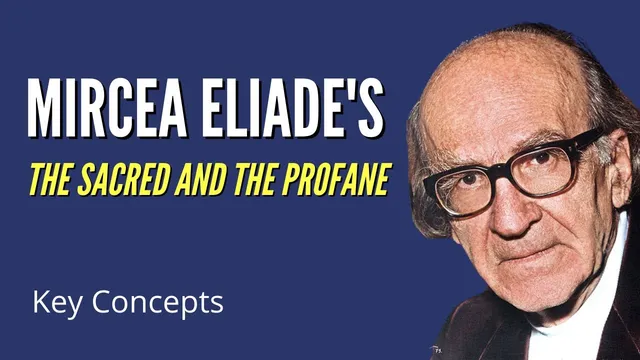
Mircea Eliade's The Sacred and the Profane: Key Concepts
Based on Research-Hub's video on YouTube. If you like this content, support the original creators by watching, liking and subscribing to their content.
Eliade treats the sacred as an interruption of ordinary routine, producing numinous experiences of mystery, awe, and meaning.
Briefing
Mircea Eliade’s core claim is that “the sacred” keeps breaking into everyday life—so thoroughly that even people who call their world fully secular still experience moments of the numinous, mystery, and awe. That recurring encounter matters because it reshapes how religion is understood: not as a set of doctrines, but as a fundamental human way of organizing reality into meaningful centers and boundaries.
Eliade frames religion through a binary opposition—sacred versus profane—while also insisting the line cannot hold forever. The profane is the ordinary, homogeneous, quotidian world: life as routine, with nothing extraordinary to stop attention or provoke wonder. The sacred, by contrast, is what interrupts that sameness. It “causes one to stop and take notice,” like the biblical image of Moses pausing at the burning bush. In Eliade’s terms, the sacred is experienced as numinous—overwhelming and charged with the “tremendum” (awe mixed with fear) and the “fascinans” (captivating attraction).
To explain how the sacred enters human experience, Eliade introduces hierophany: the revelation or unconcealment of the sacred to people. Hierophany is broader than the familiar idea of theophany because it can manifest not only through personal divine beings but also through non-personal forms of the divine. Crucially, hierophany includes two sides: the sacred’s manifestation and the human awareness of it. That awareness belongs to homo religiosus—the “religious person” not defined by creeds or institutions, but by an existential readiness to recognize meaning, transcendence, and the sacred’s appearance.
Eliade also argues that humans are inherently religious in this existential sense. Even atheists, he says, cannot escape the experience of something mysterious or supernatural. The longing behind that experience is not merely belief; it is a drive toward transcendence, freedom, and meaning-making. Sacredness therefore functions as an orientation point: it locates reality’s deeper source and gives shape to human life.
The sacred is not confined to belief systems or temples alone. It sacralizes space and time. Temples, churches, and other places become special because they mark an axis mundi—an imagined center connecting the human world to a higher order. Rituals and myths also periodically renew sacred time, making calendars and holy days (like the Sabbath) feel qualitatively different from ordinary time.
Nature and the cosmos, too, are “fraught with religious values.” For Eliade, the supernatural shines through the natural: the world is not merely created and then left alone, but structured so that sacred modalities appear within it. Water symbolism illustrates this vividly. Waters precede forms, support creation, and carry meanings of death and rebirth—through floods, submersion, baptism-like renewal, and myths of humanity emerging from water. Mother Earth similarly becomes a symbolic reservoir of life, nourishment, and abundance.
By the end, Eliade’s project expands beyond the sacred/profane divide toward a broader anthropology. Humans create order out of chaos, and the sacred/profane distinction reasserts itself whenever people ground their lives in meaningful centers—places and times that feel unlike the rest. Even memories of youth or first love can become “elevated” moments, suggesting that sacralization is not optional decoration but a recurring feature of consciousness itself.
Cornell Notes
Eliade’s framework divides experience into the sacred and the profane. The profane is ordinary, homogeneous life; the sacred interrupts routine through the numinous—mysterious, awe-filled encounters that can feel both fearful and captivating. The sacred appears through hierophany, a revelation that includes both the manifestation of the sacred and the human awareness of it, understood through homo religiosus. Eliade argues that humans are inherently religious in an existential sense: even nonbelievers can’t avoid experiences of mystery, and people long for transcendence, meaning, and order. Sacredness then shapes space and time, making certain places and moments qualitatively different and renewing life through rituals, myths, and symbolic patterns like water and earth imagery.
What does Eliade mean by “sacred” versus “profane,” and how does that distinction show up in everyday life?
How does hierophany work, and why is it broader than theophany?
Who is homo religiosus in Eliade’s system, and what makes someone “religious” without formal belief?
Why does Eliade connect the sacred to space and time, and what is the axis mundi?
What role do nature and cosmic symbolism play in Eliade’s account of religion?
How does Eliade’s view move beyond a strict sacred/profane binary?
Review Questions
- How do hierophany and homo religiosus together explain why sacred experiences can occur even outside formal religious belief?
- What mechanisms does Eliade use to show that sacredness shapes both space (e.g., temples, centers) and time (e.g., rituals, holy days)?
- Which symbols—especially water and Mother Earth—illustrate Eliade’s claim that nature expresses transcendent meaning?
Key Points
- 1
Eliade treats the sacred as an interruption of ordinary routine, producing numinous experiences of mystery, awe, and meaning.
- 2
The profane is the homogeneous, everyday world; the sacred is what makes certain realities feel qualitatively different.
- 3
Hierophany is the sacred’s revelation to humans and includes both the manifestation and the human awareness of it.
- 4
Homo religiosus is defined existentially—by readiness to recognize sacred meaning and a longing for transcendence—rather than by specific creeds.
- 5
Sacredness sacralizes space and time, creating centers (axis mundi) and renewing sacred periods through rituals and myths.
- 6
Nature and cosmic phenomena are “fraught with religious values,” so the supernatural shines through the natural world.
- 7
Eliade argues that humans inherently seek order and meaning, so the sacred/profane distinction reappears even in secular or atheist lives through elevated moments and memories.