Misconceptions About the Universe
Based on Veritasium's video on YouTube. If you like this content, support the original creators by watching, liking and subscribing to their content.
Special relativity forbids faster-than-light travel through space, but it does not forbid space itself from expanding in ways that produce superluminal recession speeds.
Briefing
The universe’s expansion can make distant galaxies appear to be moving away faster than light without violating Einstein’s special relativity—because nothing is required to travel through space faster than light; instead, space itself stretches. During inflation, the early universe expanded extremely rapidly, which often gets framed as “faster-than-light motion.” That framing misses a key distinction: special relativity bans faster-than-light movement through space, not the recession speeds that arise when the metric of space expands.
Hubble’s late-1920s observations established that recession speed increases with distance: the farther a galaxy, the faster it recedes on average. From that relationship comes the idea of the Hubble sphere, a notional boundary around us where the average recession velocity equals the speed of light. Beyond the Hubble sphere, galaxies recede faster than light relative to us—so it seems like their light should never reach Earth. Yet light from extremely distant galaxies is observed, which is possible because the Hubble sphere is not fixed in size. As space continues to expand, the boundary where recession equals light speed can grow faster than light can “escape” outward, allowing photons emitted in a superluminal region to later find themselves in a subluminal region where they can travel toward us.
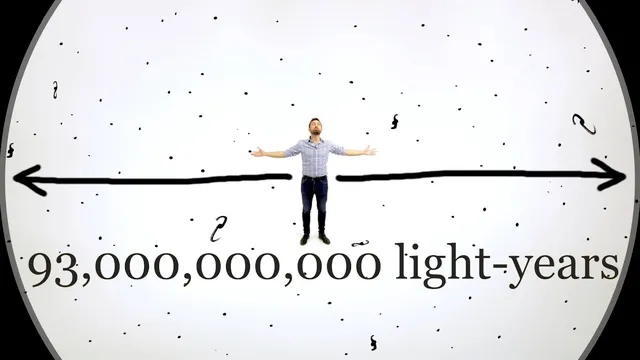
This mechanism helps explain why the observable universe is larger than the Hubble sphere. The limit on what can be seen is instead set by the particle horizon, determined by how long light has had to travel since the universe’s beginning. Using an age of about 13.8 billion years, estimates place the observable universe’s radius at over 46 billion light-years and its diameter around 93 billion light-years. Because expansion has accelerated, regions now far beyond 13.8 billion light-years away can still have emitted light that eventually reached us.
The discussion then turns to the Big Bang and the question of what “expanding from a point” means. If the universe were finite, the earliest state would resemble a tiny, dense singularity. But if the universe is infinite—as it may be—the Big Bang would effectively occur everywhere at once, not from a single location. In that case, the universe doesn’t need to expand into something external; it can expand “into itself,” since infinity doesn’t run out of space.
Overall, the central takeaway is that faster-than-light recession is a property of expanding space and the evolving Hubble sphere, not a sign that matter or light is breaking relativity’s speed limit. That distinction resolves a common misconception and clarifies why we can observe galaxies whose recession speeds exceed light speed today.
Cornell Notes
Cosmological “faster-than-light” recession doesn’t violate special relativity because it describes space expanding, not objects moving through space faster than light. Hubble’s observations show recession speed grows with distance, defining a Hubble sphere where recession equals light speed; beyond it, galaxies recede superluminally from our perspective. Even so, light emitted outside the Hubble sphere can eventually reach us because the Hubble sphere grows over time, moving the photon from a superluminal region into a subluminal one. What ultimately limits what we can observe is the particle horizon, tied to the universe’s age (~13.8 billion years), not the Hubble sphere. If the universe is infinite, the Big Bang would have occurred everywhere, and expansion need not be into an external space.
Why doesn’t superluminal recession automatically break Einstein’s special relativity?
What is the Hubble sphere, and what does it imply about galaxies beyond it?
How can light from beyond the Hubble sphere reach us?
What sets the size of the observable universe if not the Hubble sphere?
If the Big Bang happened everywhere, what does “expanding into” mean for an infinite universe?
Review Questions
- How does the distinction between motion through space and expansion of space resolve the apparent faster-than-light problem?
- Explain the role of the Hubble sphere’s growth in allowing photons from superluminal regions to reach us.
- What is the particle horizon, and how do its limits differ from the Hubble sphere’s limits?
Key Points
- 1
Special relativity forbids faster-than-light travel through space, but it does not forbid space itself from expanding in ways that produce superluminal recession speeds.
- 2
Hubble’s distance–recession relationship implies a Hubble sphere where recession speed equals the speed of light; beyond it, galaxies recede faster than light relative to us.
- 3
Light emitted from beyond the Hubble sphere can still reach Earth because the Hubble sphere grows over time, shifting photons from superluminal to subluminal regions.
- 4
The observable universe’s boundary is set by the particle horizon, which depends on the universe’s age and the time available for light to travel.
- 5
Accelerating expansion allows the observable universe to extend to distances far greater than 13.8 billion light-years even though the universe is only about 13.8 billion years old.
- 6
If the universe is infinite, the Big Bang would occur everywhere at once, and expansion need not be into an external “outside” space.