Modern Art and the Decline of Civilization
Based on Academy of Ideas's video on YouTube. If you like this content, support the original creators by watching, liking and subscribing to their content.
The transcript frames modern art as a symbolic record of a cultural shift from Christianity to a scientific worldview, with psychological consequences.
Briefing
The central claim is that the West’s shift from a Christian worldview to a scientific one left a psychological and spiritual void—and modern art becomes the clearest evidence of that inner crisis. As religion’s old framework weakened, artists increasingly stopped portraying a dignified, hopeful human being and instead foregrounded anxiety, isolation, fragmentation, and even demonic or chaotic forces. The result, according to the transcript, is not just a change in artistic style but a symptom of a civilization-wide “spiritual sickness” that also lives inside individuals.
The argument begins with a psychological premise: art functions as a kind of cultural barometer. Drawing on Carl Jung and Rollo May, the transcript treats major artists as “unwitting mouthpieces” of their era’s psychic atmosphere. When the Christian worldview lost its center—accelerated by events like the French Revolution’s attack on the Church and the subsequent “de-Christianization” of France—art’s subject matter shifted accordingly. Earlier centuries, the transcript says, tended to beautify the world and transfigure the human being; even depictions of suffering framed people as heroic. By contrast, the 19th century introduced a new dominant mood: works that elicit dread, confusion, and anxiety.
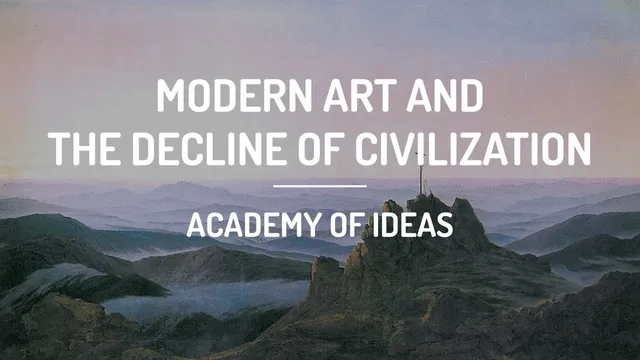
Two recurring patterns anchor the 19th-century section. First is an “ethos of desolation” spreading across Europe. In Caspar David Friedrich’s landscapes, nature becomes cold and empty, making the viewer feel alone and homeless in vast spaces. In Edvard Munch’s paintings, the isolation moves from the natural world into society: figures appear as “lonely souls,” sealed off from others, unable to reach connection or solace. Second is the rise of darker, nocturnal, chthonic forces—seen in references to Francisco Goya’s chilling figures and to works involving masks confronting death—where artists externalize terrifying visions to avoid being swallowed by madness.
The transcript then argues that the chaos intensifies in the early 20th century. Picasso’s art is described as breaking the human body into fragments and reassembling it in disjointed forms, stripping away the “faculty” of seeing wholes. Surrealism goes further by exalting irrational confusion as a principle of life, with Salvador Dalí and André Breton cited for treating life and death, real and imagined, as no longer opposites. Meanwhile, cubism and futurism are framed as impulses to dissolve the human into the inorganic world—turning man into a thing among things, with objects like lamps and streets penetrating the human form.
From these artistic shifts, the transcript draws a sweeping diagnosis: modern civilization suffers deep existential loneliness, a negation of human nature, and a fragmentation of the human person—possibly even a “sickness unto death.” Yet it insists the problem is not only “out there.” If modern art is degenerate, individuals are implicated too, since the cultural collapse mirrors a personal collapse of the canon and a shared alienation.
Hope enters through Nietzsche: healing cannot come from simply returning to the past or adopting the current worldview uncritically. Instead, renewal requires a “revaluation of values,” with individuals acting as “physicians of culture.” The transcript closes by arguing that civilization’s fate depends on whether individuals can transform their own attitudes—because political, social, and philosophical change ultimately begins with the self.
Cornell Notes
The transcript argues that the West’s move from Christianity to a scientific worldview created a spiritual and psychological void, and modern art records that change in striking form. As the Christian “center of gravity” weakened, artists increasingly portrayed anxiety, isolation, demonic forces, and the fragmentation of the human body. Nineteenth-century examples include Caspar David Friedrich’s cold, empty nature and Edvard Munch’s socially isolated figures; early twentieth-century examples include Picasso’s fractured human forms and surrealism’s exaltation of irrational confusion. The diagnosis extends beyond aesthetics: modern civilization’s “spiritual sickness” is mirrored within individuals, so renewal requires a revaluation of values rather than a simple return to the past.
Why does the transcript treat art as evidence of cultural and psychological change?
What changes in 19th-century art are used to mark the decline of a Christian-centered worldview?
How do Caspar David Friedrich and Edvard Munch function in the argument?
What does the transcript claim happens to the human figure in early 20th-century modern art?
What solution does the transcript propose, and why isn’t it a return to the past?
Review Questions
- Which artistic developments are presented as symptoms of existential loneliness, and how do Friedrich and Munch illustrate that shift?
- How does the transcript connect formal changes in modern art (fragmentation, irrationality, dissolution of the human) to a broader claim about civilization’s spiritual condition?
- Why does the transcript argue that renewal requires a revaluation of values rather than a return to earlier religious or cultural frameworks?
Key Points
- 1
The transcript frames modern art as a symbolic record of a cultural shift from Christianity to a scientific worldview, with psychological consequences.
- 2
It claims that earlier art tended to dignify the human and transfigure the world, while later art increasingly foregrounded dread, isolation, and chaos.
- 3
Caspar David Friedrich and Edvard Munch are used as examples of an “ethos of desolation,” moving from cold nature to socially sealed-off individuals.
- 4
Early 20th-century movements are portrayed as intensifying the crisis by fragmenting the human form (Picasso) and blurring boundaries between opposites (surrealism).
- 5
Cubism, futurism, and related impulses are described as dissolving man into the inorganic world, treating the human as a thing among things.
- 6
The diagnosis extends beyond culture: the transcript argues the same sickness exists within individuals, making personal transformation central.
- 7
Renewal is presented as requiring Nietzsche’s revaluation of values and a “physician of culture” approach, not a simple return to the past.