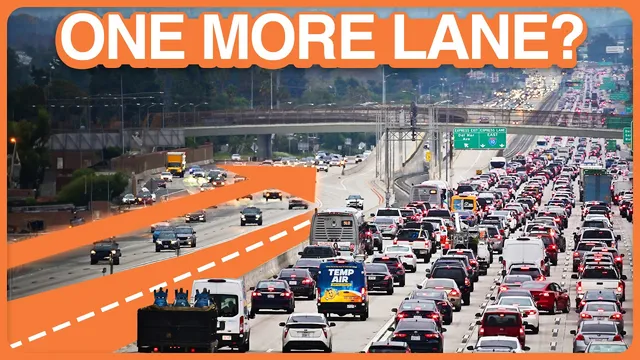
More Lanes are (Still) a Bad Thing (Induced Demand)
Based on Not Just Bikes's video on YouTube. If you like this content, support the original creators by watching, liking and subscribing to their content.
Induced demand means added road capacity attracts new trips and new travel patterns, so congestion relief is often temporary.
Briefing
Road widening and highway expansion repeatedly fail to deliver lasting congestion relief because they trigger “induced demand”: when driving becomes easier, people and businesses reorganize their lives around the new capacity, filling the road back up. The core mechanism isn’t plumbing—it’s behavior. Drivers respond to improved travel times by making new trips and by shifting where they live, work, shop, and send their kids, so the extra lanes don’t create permanent room for existing traffic; they attract additional traffic.
The transcript contrasts two related concepts. Latent demand refers to trips that people would like to make but avoid today due to bad congestion; once a road improves, some of those suppressed trips return. Induced demand goes further: it includes new travel patterns created by the road itself, especially through land-use changes. Wider highways spread development outward, making destinations farther away and more car-dependent. Suburbs, big-box retail, and “lifestyle centers” grow in places that are primarily reachable by car, and that new geography increases the pressure for even more road capacity—an escalating cycle that can nullify the benefits of each expansion.
Evidence is offered through concrete examples. Los Angeles spent over $1 billion widening a 10-mile section of the 405 Highway in 2014; within a year, congestion worsened enough that travel time increased. Houston spent $2.8 billion expanding the KD freeway to 26 lanes in one area, and commute times rose rather than fell after completion. The transcript also points to advocacy efforts around Austin’s I-35 expansion, arguing that traffic models used to justify projects often ignore induced demand.
Beyond induced demand, the transcript adds two additional constraints on “more road = more throughput.” The “Brazes Paradox” claims that adding roads to a network can slow traffic, and it’s presented as something that can be shown mathematically (and even with analogies like springs). A related idea, “traffic evaporation,” suggests the opposite direction can work: removing capacity can reduce total traffic because some trips shift to other modes or disappear entirely. A widely cited example is the removal of Seoul’s Chonggyecheon Expressway, replaced with a riverfront space that improved the city’s quality and coincided with better traffic outcomes.
Why, then, do highway projects keep happening? The transcript argues that institutional incentives matter: traffic engineers are paid to justify construction, often using models designed to produce plausible narratives for growth in future traffic. It cites an example from Washington State’s Evergreen Point Floating Bridge, where successive forecasts for traffic growth failed to match later reality—while toll policy changes later reduced volumes.
The proposed alternative is not “ban cars,” but build viable options so driving isn’t the default. The transcript emphasizes that car traffic grows until alternatives become faster and more reliable, invoking the Downs–Thomson Paradox. It argues that car-dependent cities underinvest in transit and cycling, making those options inferior, and that political choices—not inevitability—determine outcomes. It highlights cities like Arlington, Virginia, and Oslo, where mixed-use zoning, dedicated transit lanes, safer cycling networks, pedestrian improvements, and tolling reduced car trips and even traffic fatalities. The message lands bluntly: there is no lasting fix for car congestion without alternatives to driving—and “one more lane” is unlikely to be the exception.
Cornell Notes
Road widening doesn’t sustainably reduce congestion because increased capacity changes behavior. People take additional trips and reorganize where they live and work, especially when new highways reshape land use into more car-dependent patterns. This process is called induced demand, and it can take time to fully develop; latent demand is the smaller, immediate return of trips people avoided due to congestion. The transcript also adds that adding roads can sometimes worsen network performance (Brazes Paradox) and that removing capacity can reduce total traffic (traffic evaporation). The practical takeaway is that congestion relief requires viable alternatives to driving—transit, cycling, walking, and land-use changes—so driving is no longer the default option.
What is induced demand, and why does it defeat the “add lanes to reduce congestion” logic?
How does latent demand differ from induced demand?
What evidence is used to show that widening can worsen outcomes?
What is traffic evaporation, and how does it challenge the idea that removing roads must increase congestion?
Why do highway expansions keep getting built despite decades of criticism?
What does the transcript propose as the real solution to car congestion?
Review Questions
- How do land-use changes convert a short-term capacity gain into long-term congestion under induced demand?
- Why might traffic evaporation occur even when road capacity is reduced, and what kinds of trip changes would you expect?
- What combination of policies (not just infrastructure) does the transcript treat as necessary to reduce car traffic effectively?
Key Points
- 1
Induced demand means added road capacity attracts new trips and new travel patterns, so congestion relief is often temporary.
- 2
Latent demand is the return of suppressed trips; induced demand is driven by behavior and land-use changes that increase future traffic.
- 3
Widening can worsen outcomes when development spreads outward and makes destinations more car-dependent, increasing demand for the same corridors.
- 4
Network effects can complicate simple “more lanes = more throughput” thinking, including claims like Brazes Paradox.
- 5
Traffic evaporation can reduce total traffic when capacity is removed because some trips shift modes or disappear.
- 6
Highway projects persist partly because traffic modeling and professional incentives can favor construction narratives that ignore induced demand.
- 7
Sustained congestion reduction requires viable alternatives to driving—transit, safe cycling, walkability, and mixed-use land planning—so driving is not the default option.