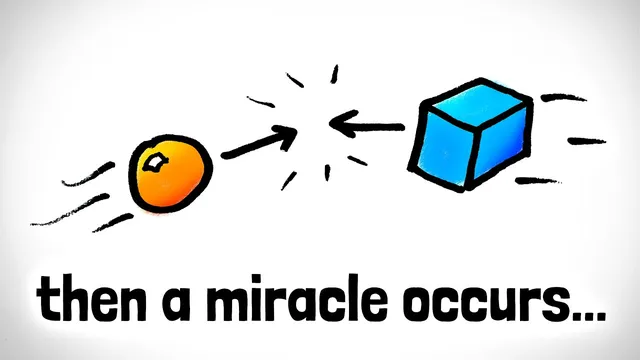
Most Collisions Are Secretly in One Dimension
Based on minutephysics's video on YouTube. If you like this content, support the original creators by watching, liking and subscribing to their content.
In one-dimensional collisions, conservation of momentum and conservation of energy determine the two final velocities uniquely for given masses and incoming velocities.
Briefing
Collisions look chaotic, but for two objects the outcomes are largely locked in by conservation laws—because most collisions effectively behave like one-dimensional events. In a true 1D collision, the final velocities aren’t free to wander: conservation of momentum and conservation of energy each supply an equation. With two unknown final velocities, those two independent constraints uniquely determine the result for any given pair of masses and incoming velocities.
That means the “messy” variety of what could happen collapses into a single predictable outcome. If two identical objects approach each other at the same speed, they rebound. If one object is initially at rest, it ends up taking on the incoming object’s motion while the moving one stops. If a much heavier object is stationary—say twenty times the mass of the lighter one—the lighter object rebounds with 90% of the original speed, while the heavy one starts moving with the remaining 10%. These aren’t guesses; they follow directly from solving the momentum and energy equations for the final velocities.
Energy conservation might seem like a loophole because real collisions generate heat, sound, deformation, and sometimes rotation. But the key move is to treat “lost” kinetic energy as still accounted for—just redistributed into other forms. Once that bookkeeping is included, the energy constraint still applies. The practical difficulty is that experiments often don’t track exactly how much energy ends up in which internal modes, so the velocity outcome can appear surprising. From a physics standpoint, though, the velocities are still uniquely determined once the incoming conditions and the amount of kinetic energy converted to non-kinetic forms are specified.
The same determinism carries into two and three dimensions because most collisions secretly contain a single effective direction of interaction. Even when objects collide in a plane or in space, the net force during the impact typically points along one direction—often perpendicular to the contact surface. In the directions perpendicular to that net force, there is no net acceleration from the collision, so motion there remains unchanged. As a result, the collision can be decomposed into one “secret dimension” where the 1D conservation-law logic applies, and other perpendicular directions where objects simply pass through each other without being redirected.
So the apparent randomness of everyday collisions is mostly an illusion created by geometry and internal energy losses. Once the incoming masses and velocities are known, along with how much kinetic energy is dissipated and the direction of the effective interaction, the outcome is fixed. The determinism holds as long as quantum mechanics can be ignored, and it scales further because large, complicated impacts are often built from many pairwise two-object collisions—each one constrained by the same momentum-and-energy rules. That structure is also why computers can simulate collision-heavy systems efficiently: the physics is constrained enough to be computationally tractable.
(Brilliant is mentioned as a sponsor for interactive science and math learning.)
Cornell Notes
Collisions often look unpredictable, but two-object collisions are tightly constrained. In one dimension, conservation of momentum and conservation of energy provide two equations for two unknown final velocities, so the outcome is unique for given masses and incoming velocities. Even when kinetic energy is lost to heat, sound, deformation, or rotation, the energy constraint can be restored by accounting for that lost energy in the bookkeeping. In 2D and 3D, most collisions still act like a 1D collision in a single “secret” direction because the net force during impact points mainly along one axis; perpendicular components experience no net force and therefore remain unchanged. This makes collision outcomes largely deterministic (ignoring quantum effects) and computationally simulatable.
Why does a 1D collision have only one possible outcome for the final velocities?
What happens if energy isn’t conserved as kinetic energy during a collision?
How can a collision in 2D or 3D still behave like a 1D collision?
What does the “secret dimension” idea imply for predicting collision outcomes?
Why are large, complicated collisions still manageable to simulate?
Review Questions
- In a 1D collision, what two physical principles provide the two independent equations needed to determine the final velocities?
- How does accounting for energy converted to heat, sound, or rotation preserve the ability to predict final velocities?
- In 2D/3D collisions, what physical condition makes motion perpendicular to the net-force direction remain unchanged?
Key Points
- 1
In one-dimensional collisions, conservation of momentum and conservation of energy determine the two final velocities uniquely for given masses and incoming velocities.
- 2
Even when kinetic energy is converted into heat, sound, deformation, or rotation, energy conservation can still be applied by including those non-kinetic forms in the accounting.
- 3
Most collisions in 2D or 3D have a single effective interaction direction where the net force acts, often perpendicular to the contact surface.
- 4
Perpendicular to the net-force direction, there is typically no net force during impact, so velocity components in those directions remain unchanged.
- 5
Once the effective interaction direction (“secret dimension”) and the dissipated kinetic energy are known, collision outcomes are largely deterministic (ignoring quantum effects).
- 6
Large collisions can be simulated efficiently because they are often built from many constrained two-object collisions.