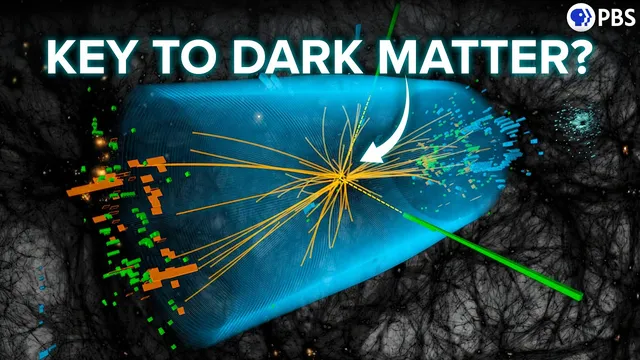
Most of Reality Is Invisible. We May Finally Be About to Reveal It.
Based on PBS Space Time's video on YouTube. If you like this content, support the original creators by watching, liking and subscribing to their content.
A dark sector could consist of particles that carry no Standard Model charges, making them effectively invisible except through rare couplings.
Briefing
The Large Hadron Collider may be able to “open a portal” to a hidden dark sector—not by creating black holes or wormholes, but by producing Higgs bosons that can decay into particles that barely interact with ordinary matter. In this scenario, dark matter isn’t best treated as a single new particle. Instead, it could be a whole parallel family of elementary particles that carries no Standard Model charges, making it invisible to detectors except through rare “portals” that let energy leak between the familiar world and the dark one. The Higgs boson is singled out as the cleanest and most promising portal because it is a scalar field that couples broadly to other fields and is already produced in large numbers at the LHC.
After the Higgs discovery in 2012, the collider program shifted toward finding additional physics—especially supersymmetric particles that might explain the Higgs mass and provide dark matter candidates. But repeated runs have not turned up the expected new particles, and the LHC is approaching its planned energy ceiling (about 6.8 TeV in the most recent run, with a design goal near 7 TeV). That makes it unlikely that heavy, directly produced dark-matter candidates will appear soon. Meanwhile, the parameter space for dark matter as a single weakly interacting particle has tightened, pushing attention toward more complex possibilities.
A dark sector offers one such alternative. For dark matter to evade detection, its particles must have no electric, color, or weak charge, leaving gravity as the only guaranteed link to the Standard Model. Yet the dark sector could still have its own internal forces and structure—potentially including dark quarks and dark analogs of hadrons or even dark atoms. The key is that the Standard Model and the dark sector can exchange energy only through a small set of “singlet” Standard Model field configurations that can couple to dark-sector fields. Examples include photon–dark photon mixing, sterile neutrino and axion couplings, and Higgs interactions. Among these, Higgs-mediated decays are emphasized as especially plausible.
Detecting such decays requires more than just producing Higgs bosons. LHC experiments use fast triggers to discard most collision data, and many analyses rely on a “promptness” assumption: decay products should originate near the proton–proton collision point. That works well for ordinary Higgs decays, such as Higgs → muon pairs, where muon tracks can be reconstructed back to the interaction vertex. But if the Higgs decays into dark-sector intermediaries, the chain can include a detour: dark particles may travel some distance before decaying back into Standard Model particles. The result would be muons (or other visible products) with displaced trajectories—precisely the kind of events that standard trigger and selection strategies might throw away.
The proposed fix is an upgrade to the trigger strategy for the High Luminosity LHC, expected to restart in 2030. With roughly a factor of 10 more collisions per second and an anticipated dataset of about 380 million Higgs bosons over the following decade, experiments would also update “data scouting” and trigger logic to keep events featuring displaced muons. If the dark sector’s couplings and lifetimes cooperate, evidence could emerge within a year of operations—or take several years if interactions are weaker or decays are slower. The payoff would be a coherent, experimentally testable route to one of physics’ most persistent mysteries: what dark matter actually is.
Cornell Notes
The LHC may probe dark matter by exploiting the Higgs boson as a “portal” to a hidden dark sector. Instead of a single dark particle, the dark sector could be a parallel family of particles with no Standard Model charges, making it invisible except through rare couplings—especially Higgs interactions. Higgs decays into dark-sector intermediaries could produce visible particles only after a delay, leading to displaced decay products (e.g., muons whose tracks don’t point back to the collision vertex). Standard LHC triggers often discard such displaced events, but High Luminosity LHC upgrades in 2030 are expected to adjust trigger and data-scouting strategies to retain them. If the dark sector’s properties fit plausible models, displaced-muon signals could become a leading explanation for dark matter.
Why does the Higgs boson matter for a dark sector search more than many other dark-matter candidates?
What makes a dark sector “invisible” to ordinary detectors?
How do displaced muons arise in the Higgs-portal scenario?
Why might existing trigger strategies miss the most interesting dark-sector events?
What changes with the High Luminosity LHC that improve the odds of finding a Higgs-portal dark sector?
What would it take to turn a displaced-muon signal into a convincing dark-sector explanation?
Review Questions
- How does the Higgs portal connect the Standard Model to a dark sector if dark particles have no Standard Model charges?
- What experimental strategy changes are proposed to avoid discarding displaced-muon events at the High Luminosity LHC?
- Why does increasing Higgs production alone not guarantee a dark matter discovery in the dark-sector framework?
Key Points
- 1
A dark sector could consist of particles that carry no Standard Model charges, making them effectively invisible except through rare couplings.
- 2
Energy exchange between the Standard Model and a dark sector can occur only through a small set of portal couplings, with Higgs interactions highlighted as especially promising.
- 3
The LHC’s main obstacle for this search is not producing Higgs bosons, but capturing the right decay topologies in real time.
- 4
If Higgs decays proceed through dark-sector intermediaries, visible decay products can appear with displaced vertices rather than originating at the collision point.
- 5
Standard prompt-vertex selection and trigger logic can discard displaced events, motivating trigger upgrades for the High Luminosity LHC.
- 6
High Luminosity LHC operations starting in 2030 aim to increase Higgs yields dramatically (about 380 million Higgs bosons) and to update data scouting/trigger algorithms to retain displaced muon signatures.
- 7
A credible dark-sector interpretation would require matching displaced-vertex patterns—such as intermediary masses and lifetimes—to specific model expectations.