Most People Don't Know How Bikes Work
Based on Veritasium's video on YouTube. If you like this content, support the original creators by watching, liking and subscribing to their content.
Counter-steering is a balance maneuver: turning the handlebars into the turn often destabilizes the rider unless the opposite steering happens first.
Briefing
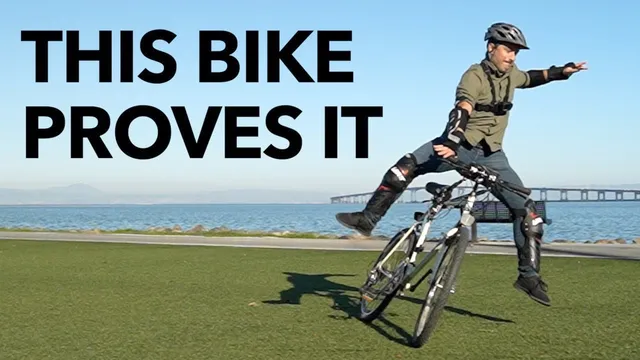
Bicycles don’t stay upright or turn the way most people assume: steering isn’t mainly a “direction control,” it’s a balancing control. A modified bike with steering locked to one side lets a rider prove the point in real time—turning the handlebars the “wrong” way makes balance fail, and the rider can’t initiate a turn without first counter-steering the opposite direction. The experiment shows that you can still ride with steering locked, but you can’t execute a left turn when the bike is prevented from steering left (and vice versa). The takeaway is blunt: steering is for keeping the bike underneath you, not simply for pointing where you want to go.
That counter-steering requirement is why turning feels unintuitive. When a rider tries to make a right turn by steering the handlebars right, the bike effectively moves out from under the rider. The rider leans left, and ground forces push the bike left—so the only way to avoid falling is to steer left, which is effectively the real “setup” for a right turn. To make a right turn, the rider first counter-steers left to lean right into the turn; the same logic applies in reverse for left turns. Observers can even spot this without being told: filming someone riding and asking which way they’ll turn often reveals they counter-steer automatically.
The balancing analogy sharpens the idea. Bike motion is likened to an inverted pendulum: to move the “top” toward a direction, the base must move the opposite way first. The same principle appears on a unicycle, where pedaling backward initiates the forward lean needed for motion. On a bike, the rider is constantly making small steering corrections to keep the contact patch—where the tires meet the ground—positioned relative to their body.
The discussion then shifts to how bikes stay upright without riders. Many people credit wheel spin and gyroscopic effects, but locking the handlebars tells a different story. With steering locked, even fast attempts and extreme balancing techniques fail quickly; the bike becomes as hard to balance as a stationary bike because the rider can’t steer the bike back under themselves. Stability comes from built-in self-steering mechanisms.
At least three mechanisms contribute. First, the front fork’s geometry makes the steering axis intersect the ground ahead of the contact point, so when the bike leans, ground forces turn the wheel back toward the lean. Second, the mass of the handlebars and front wheel sits slightly in front of the steering axis, so leaning shifts weight in a way that steers the front wheel back under the bike. Third, gyroscopic precession helps steering indirectly: pushing on a spinning gyro turns it about 90 degrees from the applied force, aiding corrective motion rather than directly preventing falls.
Finally, a “weird-looking” bicycle prototype demonstrates how design can replace gyroscopic effects: it removes gyroscopic influence using counter-rotating wheels and alters geometry to eliminate caster behavior, yet still achieves stability through mass distribution and gravity-driven steering. The broader message is that bicycle stability is an active research area, now extending toward smart handlebars and models that predict self-stable speed ranges—explaining why people can ride without knowing the mechanics behind every counter-steer and correction.
Cornell Notes
Bicycles stay upright and turn because steering constantly corrects balance, not because riders simply point the handlebars in the direction they want to go. A modified bike that locks steering to one side shows riders can still ride straight but can’t execute a turn without first counter-steering the opposite way. The physics is framed as an inverted pendulum: to lean into a turn, the bike must first be steered the other direction to move the contact patch under the rider. When steering is locked, even high-speed attempts fail, indicating that wheel spin alone isn’t the main stabilizer. Instead, bicycle geometry and mass distribution create self-steering that brings the wheels back under the bike, with gyroscopic precession providing extra help to the steering response.
Why does trying to steer “into” a turn often make a rider fall the opposite way?
What does the steering-lock experiment demonstrate about turning versus riding?
How does the inverted pendulum analogy explain counter-steering?
Why isn’t gyroscopic effect the main reason bikes stay upright?
What three mechanisms create a bike’s self-correcting steering?
How does the “weird-looking” bicycle prototype test the role of gyroscopes and geometry?
Review Questions
- If steering is locked, what specific capability disappears that makes balancing dramatically harder?
- Describe the sequence of steering directions needed to execute a right turn and explain why that sequence is required for balance.
- Which bicycle design features (geometry and mass placement) create self-steering, and how do they respond when the bike leans left versus right?
Key Points
- 1
Counter-steering is a balance maneuver: turning the handlebars into the turn often destabilizes the rider unless the opposite steering happens first.
- 2
A bike can often continue moving with steering constrained, but executing a turn requires the ability to steer back under the rider.
- 3
Steering keeps the contact patch positioned relative to the rider’s body; small continuous corrections maintain upright balance even when traveling straight.
- 4
Bikes are not stable primarily because of wheel spin; locking the handlebars removes the corrective steering and quickly makes balance fail.
- 5
Bicycle stability relies on self-steering from fork geometry (caster-like behavior), mass distribution relative to the steering axis, and gyroscopic precession as secondary assistance.
- 6
Design prototypes can reduce gyroscopic and caster contributions yet remain stable, highlighting the central role of steering dynamics and mass/geometry coupling.