Moving Illusions
Based on Vsauce's video on YouTube. If you like this content, support the original creators by watching, liking and subscribing to their content.
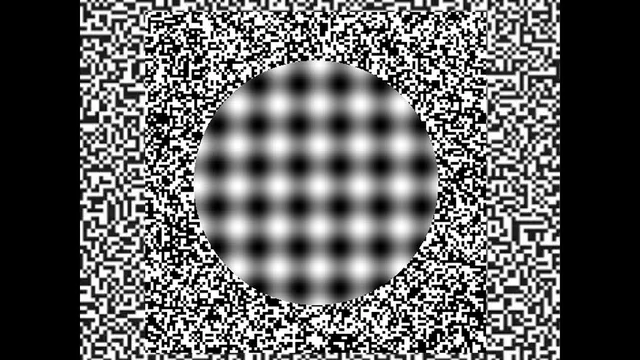
Anomalous motion arises when the brain compensates for saccades using signals that arrive at different speeds, especially across contrast levels.
Briefing
A single still image can look like it’s subtly “boiling” or “waving” because the brain misreads how it should account for the eye’s own movements—an effect called anomalous motion. After a saccade, the brain doesn’t process all parts of a scene at the same speed. Higher-contrast details register sooner than lower-contrast ones, and when the image is arranged to exploit that timing gap, the visual system settles on one wrong explanation: the picture must be moving rather than the perception pipeline being out of sync. Akiyoshi Kitaoka’s “Out of focus” takes the idea further by splitting the image into tiny slices that nearby neurons disagree about after a saccade, making it harder for the brain to factor in what the eyes just did. The result is a convincing illusion of motion created by the brain’s own attempt to stitch perception together.
That same core vulnerability—how perception is assembled from incomplete, delayed signals—shows up far beyond parlor tricks. In nature and warfare, optical illusions become tools. Dazzle camouflage doesn’t hide a ship; it scrambles an enemy’s ability to judge shape, direction, and speed, making the target harder to track. During the Cold War arms race, the Soviet Union’s long-range bomber display used a film trick: the same few aircraft were flown past the camera repeatedly in formations that made it look like far more planes existed. The United States, taking the inflated count at face value, ramped up production—building nearly 2,000 B-52s at enormous cost—while the Soviets actually had only about 150 long-range bombers.
Optical illusions also shape everyday environments and cultural perception. Disney castles rely on forced perspective: the tops appear farther away because they’re actually much smaller. The Müller-Lyer illusion demonstrates that perception isn’t universal. People in Western cultures tend to see the bottom lines as longer, influenced by familiar rules of perspective and straight-edged man-made geometry, while bushmen from Southern Africa and tribespeople from northern Angola and the Ivory Coast are not fooled.
Illusions can even be medical and practical. Kitaoka’s work uses optical illusions to help detect glaucoma earlier than current methods. Anamorphic designs—images that look distorted from most angles but “snap” into clarity from one viewpoint—have been used for traffic safety, including a skewed road decal in West Vancouver, Canada that appears to form a 3D child about to be hit when viewed from a driver’s perspective. Anamorphic techniques have also been used for covert political signaling, such as hidden portraits revealed only when a reflective object is placed correctly on a tray.
Finally, illusions extend into judgment. The “End of History” illusion is the tendency to assume the self today is the final version, even though people consistently underestimate how much they’ll change over time. The illusion of control—named by psychologist Ellen Langer—captures the belief that outcomes depend on one’s actions. In a study with London traders, buttons that had no effect still produced a stronger sense of control, and those who felt most in control performed worse on risk management and earned less. The through-line is sobering: perception and decision-making both rely on shortcuts that can feel convincing—even when they’re wrong.
Cornell Notes
Anomalous motion shows how the brain’s timing and eye-movement compensation can turn a still image into something that appears to wave or boil. After saccades, higher-contrast elements are perceived sooner than lower-contrast ones, and when the image is arranged to exploit that delay, the brain misattributes the mismatch to actual motion. Similar perceptual “errors” become useful in real-world contexts, from dazzle camouflage and wartime deception to forced perspective in architecture and culturally variable illusions like Müller-Lyer. Illusions also reach into medicine (glaucoma detection), safety (anamorphic road decals), and covert communication (hidden portraits revealed by correct viewing conditions). The same theme continues in psychology: people misjudge their future selves and overestimate control over outcomes.
Why can a completely still image look like it’s moving after an eye movement?
How does dazzle camouflage work if it doesn’t hide a ship?
What was the bomber “illusion” behind the 1950s arms race?
Why do Müller-Lyer illusion results differ across cultures?
How can anamorphic illusions be used for safety or hidden messages?
What does the illusion of control reveal about decision-making?
Review Questions
- How do differences in processing speed after saccades enable anomalous motion, and what role does contrast play?
- Give two examples of how optical illusions were used outside entertainment, and explain the practical goal in each case.
- What evidence suggests that the illusion of control can harm performance rather than help it?
Key Points
- 1
Anomalous motion arises when the brain compensates for saccades using signals that arrive at different speeds, especially across contrast levels.
- 2
Kitaoka’s “Out of focus” demonstrates that neural disagreement about image slices after eye movements can make the brain misattribute timing errors to real motion.
- 3
Dazzle camouflage aims to confuse estimates of a ship’s shape, direction, and speed rather than to conceal the ship itself.
- 4
Forced perspective can make objects appear larger or farther away than they really are, as in Disney castle designs.
- 5
Müller-Lyer illusion susceptibility varies by culture, indicating that learned perspective expectations influence perception.
- 6
Anamorphic illusions can be engineered for real-world use, including traffic safety decals and hidden portraits revealed only from specific viewing conditions.
- 7
Psychological illusions—like the End of History and the illusion of control—can distort planning and risk behavior, sometimes with measurable negative consequences.