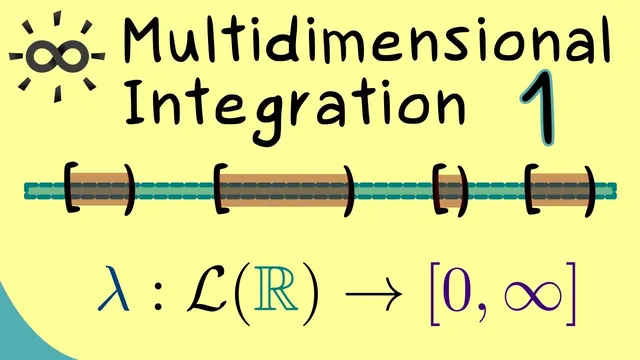
Multidimensional Integration 1 | Lebesgue Measure and Lebesgue Integral
Based on The Bright Side of Mathematics's video on YouTube. If you like this content, support the original creators by watching, liking and subscribing to their content.
Lebesgue measure is built by extending interval length from a pre-measure to a full measure on a -algebra of measurable sets.
Briefing
The course sets up multidimensional integration by building everything from the Lebesgue measure and the Lebesgue integral—starting in one dimension on and laying the groundwork for moving to . The key payoff is a framework that preserves the familiar “length of intervals” idea while gaining the flexibility needed to define integrals in higher dimensions and to prove powerful tools like the change-of-variables formula and Fubini–Tonelli.
It begins with what “measuring” means for subsets of the real line. Intervals already have a natural length (for ), and that rule is treated as a pre-measure—accurate for intervals but not yet defined for all subsets of . To extend this interval-based notion into a full measure, the construction uses Carathéodory’s extension theorem: the pre-measure is first turned into an outer measure (a function defined on every subset, taking values in ). From that outer measure, a -algebra of “measurable” sets is carved out, denoted . Crucially, this measurable collection is not the entire power set—there exist “annoying” non-measurable sets—but the sets that matter in applications typically fall inside .
Once the -algebra is in place, the Lebesgue measure becomes a proper measure on . It satisfies two defining requirements: , and -additivity, meaning that for pairwise disjoint measurable sets , the measure of their countable union equals the sum of their measures. Beyond those basics, the Lebesgue -algebra is larger than the Borel -algebra, so all open and closed sets are measurable. The course also emphasizes null sets: if , then every subset of is also measurable and has measure zero—an important property that later makes integration behave well.
Two additional structural properties anchor the measure to geometric intuition. First, it matches interval length: , so the unit interval has measure one. Second, it is translation invariant: shifting a measurable set by any real number does not change its measure. These features are presented as the one-dimensional prototype for the -dimensional Lebesgue measure.
With the measure defined, the Lebesgue integral is introduced as an integral with respect to , typically written or . The integral is built via approximation by simple functions (step functions in the Lebesgue sense): for nonnegative , simple functions take only finitely many values and sit below . Their integrals correspond to “areas” computed by multiplying each value by the Lebesgue measure of the set where that value occurs. The Lebesgue integral is then obtained by taking the supremum over all such under-approximations. The course highlights a practical advantage: while the Lebesgue and Riemann integrals agree when the Riemann integral exists, the Lebesgue integral can still succeed in cases where Riemann integration fails—setting up a smoother path to and the core tools needed for explicit multidimensional calculations.
Cornell Notes
The course builds multidimensional integration from the Lebesgue measure and Lebesgue integral, starting on . It first defines length for intervals as , then extends that interval rule to a full measure on a -algebra of Lebesgue-measurable sets using Carathéodory’s extension theorem. The resulting Lebesgue measure is -additive, translation invariant, and matches interval length; it also has the key null-set property that every subset of a measure-zero set is measurable and has measure zero. The Lebesgue integral is then defined by approximating nonnegative functions from below with simple functions and taking the supremum of the resulting “area” approximations. This approach matches the Riemann integral when it exists but extends integration to cases where Riemann fails, making it ideal for .
Why isn’t the interval-length rule enough to define a measure on all subsets of ?
What does -additivity mean for the Lebesgue measure?
How does the Lebesgue -algebra relate to the Borel -algebra?
What makes null sets special in Lebesgue measure?
How is the Lebesgue integral constructed from simple functions?
Why does the Lebesgue integral handle more cases than the Riemann integral?
Review Questions
- What steps turn an interval-based pre-measure into the Lebesgue measure on a -algebra?
- State the -additivity property and explain why disjointness is required.
- Describe how simple functions approximate a nonnegative function from below in the definition of the Lebesgue integral.
Key Points
- 1
Lebesgue measure is built by extending interval length from a pre-measure to a full measure on a -algebra of measurable sets.
- 2
Carathéodory’s extension theorem uses an outer measure (defined on all subsets, possibly ) to determine which sets are Lebesgue measurable.
- 3
Lebesgue measure satisfies -additivity: measures of countable disjoint unions add up.
- 4
Lebesgue measurable sets include all open and closed sets, since the Lebesgue -algebra contains the Borel -algebra.
- 5
Null sets have a strong property: every subset of a measure-zero set is measurable and also has measure zero.
- 6
The Lebesgue integral is defined by approximating nonnegative functions from below using simple functions and taking the supremum of the resulting “area” approximations.
- 7
The Lebesgue integral agrees with the Riemann integral when the latter exists, but it can still integrate functions in cases where Riemann integration breaks down.