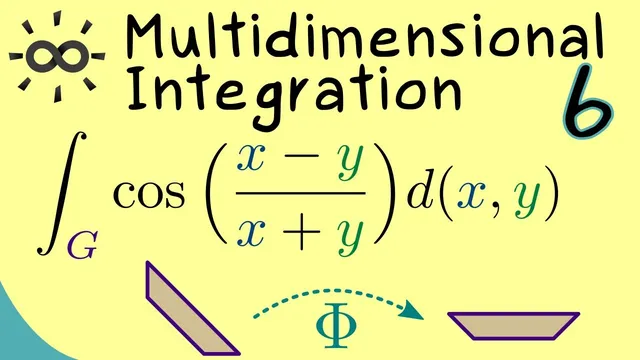
Multidimensional Integration 6 | Example for Change of Variables
Based on The Bright Side of Mathematics's video on YouTube. If you like this content, support the original creators by watching, liking and subscribing to their content.
Rewrite the integrand’s fraction (x − y)/(x + y) by selecting u = x − y and v = x + y so the cosine becomes cos(u/v).
Briefing
A two-dimensional change of variables turns a tricky cosine integral over a polygonal region into a pair of one-dimensional integrals that can be finished with a simple antiderivative. The key move is mapping the original coordinates (x, y) to new variables (u, v) using the transformation u = x − y and v = x + y, which straightens the integration region so one variable has clean bounds.
The starting point is a double integral of the form ∫∫_G cos((x − y)/(x + y)) dA, where the domain G in the xy-plane is defined by several inequalities. After rewriting the “outer” inequalities, the region is shown to lie entirely in the first quadrant (x ≥ 0 and y ≥ 0). The remaining constraints reduce to a wedge between two lines: y ≥ 1/2 − x and y ≤ 1 − x. Geometrically, G is a triangular region bounded by those linear relationships.
To apply the change of variables formula, the transformation (x, y) ↦ (u, v) is chosen to match the expression inside the cosine. The Jacobian matrix of (u, v) with respect to (x, y) is computed from u = x − y and v = x + y, giving determinant det(J) = 2 everywhere. That constant determinant means the area-scaling factor in the formula is just |det(J)| = 2, so the integral picks up a simple multiplicative adjustment.
The inequalities defining G are then translated into the uv-plane. From the definitions, u and v relate back to x and y via u + v = 2x and v − u = 2y. Since x and y are nonnegative on G, it follows that u + v ≥ 0 and v − u ≥ 0, which can be rewritten as v ≥ −u and v ≥ u. Meanwhile, the original constraints involving x + y become bounds on v itself: v lies between 1/2 and 1. Putting these together, the image region fi(G) becomes a strip in v with linear boundaries in u, namely u ranges between −v and v.
With the transformed region in hand, the integral splits cleanly using Fubini’s theorem. The outer integral runs over v from 1/2 to 1, and for each fixed v, the inner integral runs over u from −v to v. The inner integral uses an antiderivative of cos(u/v) with respect to u; differentiating sin(u/v) produces a factor 1/v, so multiplying by v cancels it. Evaluating at u = v and u = −v yields a sine difference that collapses using odd/even symmetry: the result simplifies to a constant multiple of sin(1) times an elementary v-integral.
Carrying out the remaining one-dimensional integration over v produces the final value: the original double integral equals 3/8 · sin(1). The example demonstrates how a carefully chosen coordinate transformation can preserve the region’s structure while making the bounds separable, turning a two-variable problem into a straightforward computation.
Cornell Notes
The integral involves cos((x − y)/(x + y)) over a polygonal region G in the first quadrant. By switching to variables u = x − y and v = x + y, the cosine’s argument becomes u/v, and the Jacobian determinant is constant: |det(J)| = 2. Translating the inequalities defining G into uv-coordinates shows that v ranges from 1/2 to 1, while u ranges between −v and v. That separable description lets the double integral be evaluated as an inner integral in u and an outer integral in v. The u-integral uses an antiderivative involving sin(u/v), and symmetry collapses the sine terms, leaving a simple v-polynomial integral. The final result is (3/8)·sin(1).
Why choose u = x − y and v = x + y for this problem?
How does the Jacobian affect the integral, and why is it easy here?
How are the bounds on G converted into bounds on the new region in the uv-plane?
What does Fubini’s theorem buy after the region is transformed?
How does the inner integral of cos(u/v) work out cleanly?
Review Questions
- What inequalities define the original region G, and how do they imply x ≥ 0 and y ≥ 0?
- After substituting u = x − y and v = x + y, what are the exact bounds for v and for u in the uv-plane?
- Why does multiplying by v produce a correct antiderivative for cos(u/v) with respect to u?
Key Points
- 1
Rewrite the integrand’s fraction (x − y)/(x + y) by selecting u = x − y and v = x + y so the cosine becomes cos(u/v).
- 2
Compute the Jacobian determinant from u = x − y and v = x + y; here it is constant with |det(J)| = 2.
- 3
Translate the polygonal inequalities defining G into uv-inequalities using u + v = 2x and v − u = 2y.
- 4
Use x + y bounds to get a direct interval for v: v ∈ [1/2, 1].
- 5
Convert x ≥ 0 and y ≥ 0 into u bounds: for each v, u ∈ [−v, v].
- 6
After transforming, apply Fubini’s theorem to split the double integral into an inner u-integral and an outer v-integral.
- 7
Evaluate the u-integral using v·sin(u/v) and simplify with sine’s odd symmetry to finish with a polynomial v-integral.