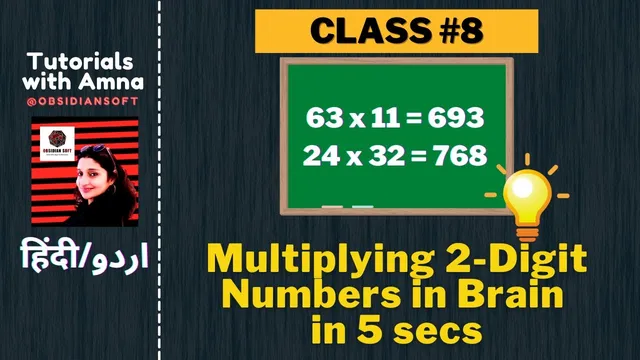
Multiplying 2 digit numbers in mind | Mental Multiplication | Mental Math - Class # 8 Urdu/Hindi
Based on Obsidian Soft's video on YouTube. If you like this content, support the original creators by watching, liking and subscribing to their content.
Ignore trailing zeros during mental multiplication, then restore them after multiplying the non-zero digit(s).
Briefing
Two-digit mental multiplication becomes fast and reliable once learners stop treating multiplication like a full written procedure and instead use targeted shortcuts: temporarily ignore zeros, split numbers into tens/ones, and—when one factor is 11—use a digit-sum pattern that avoids heavy arithmetic. The class centers on practical tricks for multiplying numbers in your head, with worked examples designed to build speed through repetition.
The first set of methods targets cases involving multiples of 10. For problems like 80 × 3, the approach is to ignore the zero, multiply 8 × 3 = 24, then restore the zero to get 240. Similarly, 50 × 4 becomes 5 × 4 = 20, then the zero is put back to reach 200. These steps train a simple habit: when a number ends in zero and the other factor is a single digit, the core multiplication happens on the non-zero digit, and the trailing zero is reinstated afterward.
Next comes a more general “split and combine” technique for two-digit numbers that aren’t clean multiples of 10. For 62 × 4, 62 is split into 60 and 2. Multiply 60 × 4 = 240, then use the earlier single-digit multiplication idea for 2 × 4 = 8. Add the partial results: 240 + 8 = 248. The same structure is applied to 65 × 8: 65 becomes 60 + 5, so 60 × 8 = 480 and 5 × 8 = 40, then 480 + 40 = 520. The class emphasizes that zeros can be ignored briefly during multiplication, then handled during addition.
The biggest leap in efficiency appears when one of the two-digit factors is 11. For 45 × 11, the method writes the first digit (4), leaves a middle gap, writes the last digit (5), then adds the digits to fill the middle: 4 + 5 = 9, producing 495. For 62 × 11, the first digit is 6, the last digit is 2, and the middle becomes 6 + 2 = 8, giving 682. The class also extends the idea to larger cases like 13 × 42 by splitting each number into parts: multiply the first two digits of the overall structure to get the “front” chunk, multiply the last two digits to get the “end” chunk, and compute the middle chunk using cross-digit products in a specific order. This middle chunk is then inserted into the correct position, with careful attention to where the “tens” and “ones” digits land.
Finally, a full worked example ties the technique together: 42 × 53. The method multiplies 4 × 5 = 20 for the front, multiplies 2 × 3 = 6 for the end, and computes the middle using cross products: 2 × 5 = 10 and 4 × 3 = 12, which sum to 22. The result is assembled as 226, with the middle “22” placed in the correct digit position so the final number aligns properly. The class closes by encouraging practice using a mental math app with timers for speed-building.
Cornell Notes
The class teaches mental multiplication shortcuts for two-digit numbers by reducing work to small, repeatable steps. When one number is a multiple of 10, learners temporarily ignore the zero, multiply the non-zero digit(s), then restore the zero. For general cases, numbers are split into tens and ones (e.g., 62 = 60 + 2), partial products are computed, and results are added. A special high-speed pattern is provided for multiplying by 11: keep the first and last digits and place their sum in the middle (e.g., 45 × 11 = 495). For other two-digit multiplications, the method uses front chunk, middle cross-products, and end chunk, then assembles the final answer in the correct digit positions.
How should someone handle a two-digit number times a single digit when the two-digit number ends in 0 (like 80 × 3)?
What’s the core strategy for multiplying two-digit numbers that aren’t multiples of 10 (like 62 × 4)?
Why is multiplying by 11 unusually fast, and how does the digit-sum pattern work?
How does the class build the result for a multiplication like 42 × 53 without full written multiplication?
For a case like 13 × 42, what determines the middle chunk?
Review Questions
- When multiplying a number ending in 0 by a single digit, what two-step process replaces the full multiplication?
- For 11-based multiplication, how do you determine the middle digit from the outer digits? Try it on a new example like 37 × 11.
- In the front–middle–end assembly method (e.g., 42 × 53), which products form the middle chunk, and how are they combined?
Key Points
- 1
Ignore trailing zeros during mental multiplication, then restore them after multiplying the non-zero digit(s).
- 2
Split two-digit numbers into tens and ones (e.g., 62 = 60 + 2) to turn one hard multiplication into two easier ones plus an addition.
- 3
For multiplying by 11, keep the first and last digits and place the sum of those digits in the middle (45 × 11 = 495; 62 × 11 = 682).
- 4
For general two-digit × two-digit problems, compute a front chunk, a middle chunk from cross-products, and an end chunk, then assemble them by digit position.
- 5
Cross-products for the middle chunk come from multiplying the ones digit of one number by the tens digit of the other, and the tens digit of the first by the ones digit of the other; add those results.
- 6
Assembling the final answer requires careful placement of the middle chunk so digit positions line up correctly (e.g., 42 × 53 → 20 + 22 + 6 → 226).