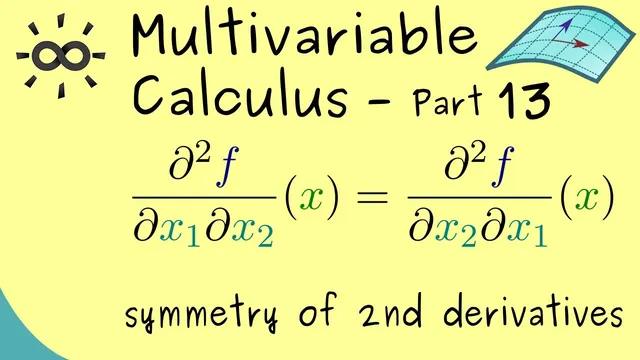
Multivariable Calculus 13 | Schwarz's Theorem
Based on The Bright Side of Mathematics's video on YouTube. If you like this content, support the original creators by watching, liking and subscribing to their content.
Schwarz’s theorem states that mixed second partial derivatives are equal: ∂^2f/∂x_i∂x_j = ∂^2f/∂x_j∂x_i.
Briefing
Schwarz’s theorem guarantees that mixed second partial derivatives match—so long as they exist on an open set and behave continuously there. In practical terms, for a function f on an open set U ⊂ R^n with all second-order partial derivatives existing and being continuous, the equality ∂^2f/∂x_i∂x_j = ∂^2f/∂x_j∂x_i holds at every point in U. This matters because it removes ambiguity in higher-order derivative calculations: once the assumptions are met, there’s no need to compute both orders or worry about which differentiation comes first.
The theorem’s setup starts with an open domain U in R^n, ensuring every point has a neighborhood fully contained in U. The function f is defined on U, and all second-order partial derivatives must exist throughout U. Beyond existence, the key requirement is continuity: the second partial derivatives are continuous functions from U into R. That continuity is what allows limits to pass through the derivative expressions during the proof.
A proof sketch focuses on the simplest nontrivial case n = 2, taking indices i = 1 and j = 2, and shifting the point of interest so the argument happens at the origin. The core strategy is to relate partial derivatives to one-dimensional difference quotients, then apply the ordinary mean value theorem twice—once in the x1 direction and once in the x2 direction.
To implement this, the proof begins by approximating partial derivatives using secant slopes. It forms a difference quotient in the x1 direction, then packages part of that expression into a new two-variable function U(H1, H2) = f(H1, H2) − f(H1, 0). Holding H2 fixed turns the x1 dependence into a one-dimensional function, allowing the mean value theorem to produce an intermediate point C1 between 0 and H1. This step yields an expression involving the mixed derivative ∂^2f/∂x2∂x1 evaluated at a point where x1 lies at C1 and x2 remains tied to H2.
Next, the argument repeats the mean value theorem in the x2 direction. The intermediate points now appear as C2 (between 0 and H2), and the resulting expression corresponds to the order ∂^2f/∂x1∂x2.
To show the two orders agree, the proof swaps the roles of the directions: it defines an analogous auxiliary function V(H1, H2) built from the same original difference quotient but arranged so the mean value theorem is applied first in x2 and then in x1. This produces the same structural expression but with the mixed derivative in the opposite order, along with intermediate points η2 and η1.
Because both derivations start from the same difference quotient and use the mean value theorem with the same step sizes H1 and H2, the two expressions match up to factors of H1 and H2. After canceling those factors, the proof takes the limit as H1 → 0 and H2 → 0. Continuity of the second partial derivatives is what permits the intermediate points to converge to the origin and lets the limit pass through the derivative terms. The result is that both mixed second derivatives equal the same value at (0,0), and the same reasoning extends to any point in U.
In short: under continuity and existence on an open set, mixed second derivatives are symmetric, making higher-order differentiation consistent and computationally simpler.
Cornell Notes
Schwarz’s theorem says mixed second partial derivatives are equal when they exist on an open set and are continuous there. For f: U → R with U ⊂ R^n open, if all second-order partial derivatives exist and are continuous, then for any indices i and j, ∂^2f/∂x_i∂x_j = ∂^2f/∂x_j∂x_i at every point in U. The proof reduces to n = 2 and uses difference quotients to connect partial derivatives to one-dimensional slopes. Applying the ordinary mean value theorem first in one coordinate direction and then in the other produces one mixed-derivative order; reversing the order produces the opposite mixed-derivative order. Continuity is the final ingredient that lets limits pass through, forcing both orders to agree.
What assumptions make Schwarz’s theorem work, and why does continuity matter?
How does the proof connect partial derivatives to the one-dimensional mean value theorem?
Why introduce auxiliary functions U(H1, H2) and V(H1, H2)?
What role do the intermediate points C1, C2, η2, and η1 play?
How does the proof conclude equality of ∂^2f/∂x1∂x2 and ∂^2f/∂x2∂x1?
Review Questions
- Which specific continuity condition on second partial derivatives is needed to interchange the order of differentiation?
- In the n = 2 proof, what difference-quotient construction allows the ordinary mean value theorem to be applied?
- How do intermediate points from the mean value theorem behave as H1 and H2 approach 0, and why is that behavior essential?
Key Points
- 1
Schwarz’s theorem states that mixed second partial derivatives are equal: ∂^2f/∂x_i∂x_j = ∂^2f/∂x_j∂x_i.
- 2
The theorem requires an open domain U ⊂ R^n so neighborhoods around points stay inside U.
- 3
All second-order partial derivatives must exist throughout U.
- 4
Continuity of the second partial derivatives on U is the key technical condition that makes the limit argument work.
- 5
The proof uses difference quotients to convert partial-derivative questions into one-dimensional mean value theorem applications.
- 6
Applying the mean value theorem in x1 then x2 yields one mixed-derivative order; reversing the order yields the other.
- 7
After canceling step-size factors and taking limits, continuity forces both mixed derivative orders to match at the same point.