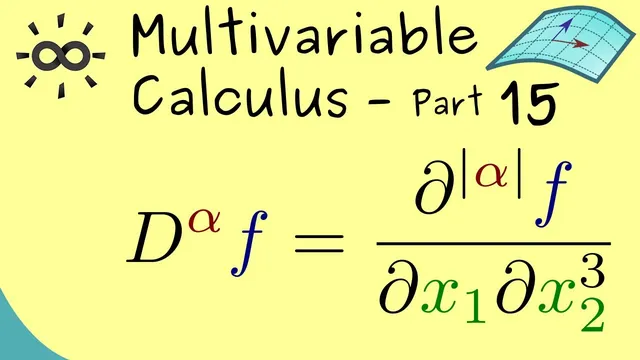
Multivariable Calculus 15 | Multi-Index Notation
Based on The Bright Side of Mathematics's video on YouTube. If you like this content, support the original creators by watching, liking and subscribing to their content.
A multi-index is an n-tuple of nonnegative integers (zeros allowed) that encodes how many times to differentiate with respect to each variable.
Briefing
Multi-index notation streamlines multivariable partial derivatives by packaging “which variables to differentiate” and “how many times” into a single object. Instead of writing long strings of partial derivative operators with an order index and evaluation point, the notation uses an n-dimensional multi-index whose entries are nonnegative integers (allowing zeros). The key payoff is compact formulas—especially for higher-order derivatives and later Taylor expansions—without losing precision about derivative order or variable selection.
The starting point is the familiar partial-derivative conventions: one can denote repeated differentiation using an upper order index and a Leibniz-style fraction where the denominator lists variables, each raised to a power indicating repetition. Schwartz’s theorem then justifies rearranging the order of mixed partial derivatives when the function is sufficiently smooth—specifically, when all relevant higher-order partial derivatives exist and are continuous. That commutativity means the notation can ignore the sequence of differentiation and focus only on counts.
A multi-index provides exactly those counts. Its “length” (also called absolute value) is defined as , which becomes the total order of the derivative. The same multi-index also encodes monomials: for a vector , the expression means . Factorials generalize similarly: , with the convention . These definitions let formulas treat multi-variable polynomials and derivative operators in a uniform way.
The central operator notation is , which stands for applying partial derivatives according to : . Here, the multi-index simultaneously determines which variables appear and the exponent on each variable’s differentiation. For example, when and , and reduces to . When , the total order is , , and the operator becomes a mixed fourth-order derivative: .
The transcript also notes that generalized binomial coefficients can be defined for multi-indices (though they’re deferred for later use). The immediate motivation is clear: multi-index notation sets up the compact, systematic indexing needed for multivariable Taylor polynomials, where many derivatives of different orders and variable combinations must be organized efficiently.
Cornell Notes
Multi-index notation packages repeated partial differentiation in multivariable calculus into a single n-tuple . Each is a nonnegative integer (zeros allowed), and its length gives the total derivative order. The same also encodes monomials and factorials (with ). The derivative operator means , and Schwartz’s theorem supports ignoring the order of mixed partials when the function is smooth enough. This compact indexing is designed for later formulas like multivariable Taylor polynomials.
What exactly is a multi-index , and what restrictions apply to its components?
How does relate to the order of the partial derivative ?
How does work for a vector ?
What does mean in terms of partial derivatives with respect to each variable?
Why does the notation not track the order of differentiation steps?
Review Questions
- Given in , what are and ?
- Compute and for .
- Explain how Schwartz’s theorem justifies using without specifying an order of mixed partial derivatives.
Key Points
- 1
A multi-index is an n-tuple of nonnegative integers (zeros allowed) that encodes how many times to differentiate with respect to each variable.
- 2
The total derivative order is .
- 3
Monomials in several variables are written compactly as .
- 4
Multi-index factorials generalize the usual factorial: , using .
- 5
The derivative operator means .
- 6
Schwartz’s theorem supports ignoring the order of mixed partial differentiation when derivatives are continuous enough.
- 7
The notation is designed to make later multivariable Taylor polynomial formulas shorter and easier to index.