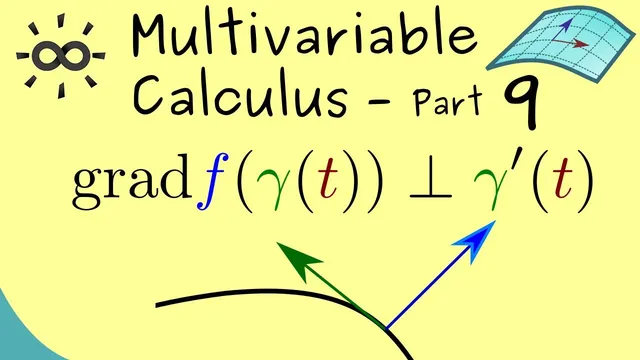
Multivariable Calculus 9 | Geometric Picture for the Gradient
Based on The Bright Side of Mathematics's video on YouTube. If you like this content, support the original creators by watching, liking and subscribing to their content.
If a curve γ(t) satisfies f(γ(t)) = c for all t, then f ∘ γ is constant and its derivative with respect to t is zero.
Briefing
The gradient’s geometric meaning becomes concrete: whenever a curve stays on a level set (a contour line) of a multivariable function, the gradient at every point on that curve is perpendicular to the curve’s direction. That perpendicularity is the key link between algebraic derivatives and the “shape” of functions in the plane—and it scales to higher dimensions.
Start with a function f: R^n → R. In two dimensions, f(x, y) can be visualized using contour lines, where each contour line consists of points mapped to the same constant value c. If a curve γ(t) runs through the domain in such a way that f(γ(t)) = c for all t, then the composition f ∘ γ is literally a constant one-variable function. Since the derivative of a constant is zero, d/dt[f(γ(t))] = 0 everywhere along the curve.
Applying the multivariable chain rule turns that zero derivative into a geometric statement. The chain rule gives a product of Jacobians: the Jacobian of f evaluated at γ(t) times the Jacobian of γ at t. For f, the Jacobian can be expressed using the gradient: the gradient is the transpose of the Jacobian. For γ, the Jacobian reduces to γ′(t). The result is that the gradient of f at γ(t), when paired with γ′(t) via the standard inner product, equals 0. An inner product of zero means orthogonality—so the gradient vector is perpendicular to γ′(t).
To interpret γ′(t), note that γ′(t) is tangential to the curve at the point γ(t). This follows directly from how derivatives arise as limits of difference quotients, capturing the curve’s instantaneous direction. Putting the pieces together: the gradient is perpendicular to the tangent direction of any curve lying on a contour line. Equivalently, the gradient points “away” from the contour line, because moving in the gradient direction changes the function value most strongly.
The discussion also emphasizes that nothing about the argument depends on being in two dimensions. In higher dimensions, one can still consider curves that lie entirely within a constant-value set of f. Along such curves, the same chain-rule logic forces the gradient at each point to be orthogonal to the curve’s tangent direction. The payoff is a reusable geometric rule: at any point, the gradient is normal to the level set through that point, and it governs how the function changes when moving off that set. The next step, teased for a follow-up, is to quantify changes in specific directions via directional derivatives.
Cornell Notes
A curve γ(t) that stays on a level set of a multivariable function f satisfies f(γ(t)) = c for a constant c. Because f ∘ γ is constant, its derivative with respect to t is zero. The multivariable chain rule rewrites this derivative as an inner product between the gradient of f at γ(t) and the tangent vector γ′(t). Since the inner product is zero, the gradient is perpendicular to the curve’s tangent direction. Geometrically, that means the gradient is normal to the contour line (level set) and points in the direction where f increases most. The same reasoning extends to higher dimensions by using curves lying in constant-value sets.
Why does f(γ(t)) being constant force the derivative d/dt[f(γ(t))] to be zero?
How does the chain rule turn the zero derivative into an orthogonality statement?
What is the geometric meaning of γ′(t) in this setup?
Why does orthogonality between ∇f and γ′ imply the gradient is perpendicular to the contour line?
Does the perpendicular-to-level-set rule depend on working in R^2?
Review Questions
- Given f(γ(t)) = c, what does the chain rule imply about ⟨∇f(γ(t)), γ′(t)⟩?
- How does the tangent direction to a contour line relate to the gradient direction at the same point?
- Why can the same gradient-perpendicular-to-level-set conclusion be made in higher dimensions?
Key Points
- 1
If a curve γ(t) satisfies f(γ(t)) = c for all t, then f ∘ γ is constant and its derivative with respect to t is zero.
- 2
The multivariable chain rule converts d/dt[f(γ(t))] = 0 into an inner product condition involving the gradient.
- 3
Because the gradient is the transpose of the Jacobian of f, the chain rule yields ⟨∇f(γ(t)), γ′(t)⟩ = 0.
- 4
The vector γ′(t) is tangent to the curve at γ(t), so the gradient is perpendicular to the contour line through that point.
- 5
Following the gradient changes the function value, while moving along a contour line keeps the function value fixed.
- 6
The same orthogonality logic applies in higher dimensions by using curves that lie within constant-value sets of f.