Music And Measure Theory
Based on 3Blue1Brown's video on YouTube. If you like this content, support the original creators by watching, liking and subscribing to their content.
Harmony depends on closeness to simple rational ratios with small denominators, not on rationality alone.
Briefing
A ratio of musical frequencies can sound harmonious or cacophonous depending less on whether it is rational or irrational, and more on how well it matches simple frequency patterns—especially those with small denominators. The discussion starts with the familiar Pythagorean rule of thumb: rational ratios like 3/2 (a fifth) or 4/3 (a fourth) align with repeating beat patterns that the ear can lock onto as rhythm-like structure. But that neat dichotomy breaks down because many rational numbers are “too complicated” (for example, 211/198 or 1093/826), and the ear may fail to detect the corresponding beat pattern. The argument then shifts to approximation: even irrational ratios can sound good if they lie very close to a simple rational ratio. This is not just a theoretical point—pianos are tuned using the 12th root of 2, so common musical intervals correspond to irrational powers of 2 that happen to sit extremely near simple fractions (e.g., 2^(7/12) is close to 3/2). The upshot is a refined criterion: harmony is tied to closeness to rationals with small denominators, with “how close” depending on musical sensitivity.
That leads to a provocative thought experiment: imagine a musical savant who finds pleasure in every pair of notes with a rational frequency ratio, even the highly complex ones. Would such a person then find every ratio R between 1 and 2 harmonious—including the irrational ones? Since every real number is arbitrarily close to some rational, it’s tempting to say yes. But the second half of the material delivers a counterintuitive mathematical answer through a measure-theory style covering problem.
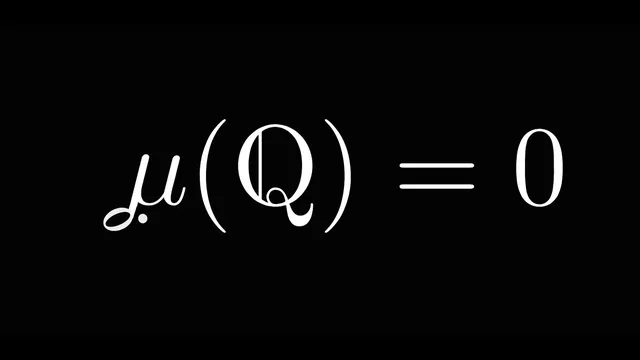
The challenge asks whether one can cover all rational numbers in (0,1) using open intervals whose total length is strictly less than 1, even though rationals are dense and every interval contains infinitely many rationals. The construction works by enumerating the rationals in reduced form (a systematic infinite list) and assigning to the nth rational an interval whose length is the nth term of a convergent series. By choosing a series that sums to any ε>0, the total length of all intervals can be made as small as desired—so small that most points in (0,1) lie outside the union of intervals, even though every rational is included. Geometrically, the intervals become tiny extremely fast for rationals that appear late in the list, which correspond to fractions with large denominators.
A visual zoom near √2/2 illustrates the intuition: rationals close to a given irrational may exist, but the intervals placed on them shrink faster than the rationals approach the irrational. In the ε=0.3 case, √2/2 lands in the uncovered 70%. When ε is reduced to 0.01, the “covered” 1% consists mostly of numbers near simple rationals—while the “cacophonous” set includes rationals with large denominators and irrationals that sit extremely close to them. The final connection reframes the earlier musical question: even if a savant loves all rational ratios, the set of ratios that can be treated as “harmonious” under a tolerance model can still be small in measure. The paradox—dense coverage with tiny total length—mirrors how a world full of rationals can still leave most real numbers effectively “uncovered,” and thus effectively cacophonous for that savant’s exponentially tightening tolerance.
Cornell Notes
Harmony is linked to how frequency ratios align with simple rational patterns, not merely to whether a ratio is rational. Many rationals are “too complicated” for the ear, and irrational ratios can still sound good when they approximate simple fractions with small denominators—an idea reinforced by piano tuning using the 12th root of 2. The measure-theory challenge shows a parallel phenomenon: all rationals in (0,1) can be covered by open intervals whose total length is as small as any ε>0. The trick is to enumerate rationals and assign the nth rational an interval of length equal to the nth term of a convergent series, making intervals for large-denominator rationals extremely tiny. This implies that even if every rational is “liked,” most real numbers can remain effectively “uncovered” under a tolerance model.
Why does “rational ratios sound harmonious, irrational ratios sound cacophonous” fail as a universal rule?
How does piano tuning using the 12th root of 2 support the “approximation to simple rationals” idea?
What is the covering challenge asking, precisely?
How can all rationals in (0,1) be covered with total interval length ε, where ε can be arbitrarily small?
What does the zoom near √2/2 illustrate about “dense sets” versus “measure”?
How does the math covering result connect back to the musical savant question?
Review Questions
- What role do small denominators play in turning beat patterns into perceived harmony, and how does approximation change the rational/irrational distinction?
- Describe the construction that covers all rationals in (0,1) with total interval length ε. Why does it not contradict density of rationals?
- In the analogy to music, what does it mean for an irrational number to land outside the union of intervals, and how does that relate to “tolerance” for complex rationals?
Key Points
- 1
Harmony depends on closeness to simple rational ratios with small denominators, not on rationality alone.
- 2
Irrational intervals can sound good because they are tuned to lie near simple fractions (as with 2^(7/12) near 3/2).
- 3
A convergent series lets infinitely many open intervals cover every rational in (0,1) while keeping total length equal to any chosen ε>0.
- 4
Enumerating rationals and assigning the nth rational an interval of length equal to the nth series term forces intervals for large-denominator rationals to become extremely small.
- 5
Dense sets can still have “small coverage” in the sense of measure: every rational is covered, yet most real numbers remain outside the union.
- 6
The musical savant thought experiment fails under a tolerance model: even if all rationals are liked, most irrationals can remain effectively cacophonous when tolerances shrink fast for complex fractions.