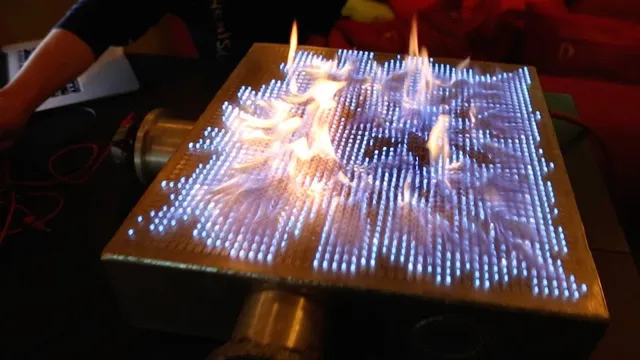
Musical Fire Table!
Based on Veritasium's video on YouTube. If you like this content, support the original creators by watching, liking and subscribing to their content.
A Pyro Board with ~2,500 holes visualizes standing waves by turning sound pressure nodes and anti-nodes into differences in flame height.
Briefing
A Denmark-built “Musical Fire Table” turns a classic acoustics experiment into a wall of flames that visually maps sound standing waves—down to where microphones detect nodes and anti-nodes. Instead of a single Ruben’s tube (a perforated pipe that turns gas flow into a line of Bunsen burners), the team scales the idea into a two-dimensional grid: a Pyro Board with about 2,500 holes producing roughly 2,500 tiny flames. By playing sound into the system at specific frequencies, the gas flow and flame height reorganize into a stable pattern, letting viewers see the same spatial vibration structure that normally stays invisible.
The underlying mechanism is straightforward but striking: standing waves in the air create alternating regions of high and low sound pressure. Those pressure variations influence how much gas flows from the tube into the surrounding atmosphere, which in turn changes flame height. At the right “fundamental” frequency, the flames rise in the anti-nodes—locations where sound pressure is maximal—while nodes show much less flame activity. The demonstration makes the physics feel immediate: people can hear the pattern before they can clearly see it, and the microphone readings line up with what the flames do.
The group also probes how the pattern changes when conditions shift. Lowering the frequency below the normal standing-wave setting produces a different standing-wave arrangement, described as the lowest frequency that still forms a standing wave in the pulse. When volume is varied, the flames and sound respond in tandem, reinforcing that the acoustic field is actively steering the combustion output.
As frequency increases, the experience becomes less comfortable—viewers report being “right in the anti-node,” and the sound becomes painful enough that the team pauses the experiment. That discomfort highlights how strongly the system couples acoustics to flame behavior: the same regions that amplify sound pressure also drive the most intense flame response.
To end on a more controlled note, the team switches from pure tones to music with prominent bass. The flames then behave like a visual equalizer, pulsing according to the frequency components that create stronger pressure variations in the standing-wave pattern. The result is both educational and performative: a direct, spatially resolved translation of sound physics into combustion, demonstrated with a large-scale array of synchronized flames.
The segment closes with a brief outreach pitch—visiting schools and teaching physics with the Pyro Board—and a plug for related content and events, alongside an Audible sponsorship and a book recommendation about Galileo’s personal life.
Cornell Notes
A “Musical Fire Table” uses a large, two-dimensional Ruben’s-tube-style device (a Pyro Board with ~2,500 holes) to turn sound standing waves into visible flame patterns. Sound played into the system forms nodes (low sound pressure) and anti-nodes (high sound pressure). Those pressure regions affect gas flow and therefore flame height, so flames rise most strongly at anti-nodes and diminish at nodes. The demonstration shows that people can often hear the standing-wave structure before seeing it, and microphone measurements match the node/anti-node locations. Higher frequencies intensify the effect—sometimes to the point of discomfort—before the setup transitions to music with bass to produce a more pleasing visual rhythm.
How does a Ruben’s tube turn sound into a visible pattern?
What changes when the experiment becomes a two-dimensional “Pyro Board” instead of a one-dimensional tube?
What does “fundamental” mean in this context, and how is it identified?
How do microphones and human perception relate to nodes and anti-nodes?
Why does increasing frequency become painful, and what does that imply about the coupling?
Why switch to music with bass at the end?
Review Questions
- What physical quantity distinguishes a node from an anti-node, and how does that difference show up in flame height?
- Why does changing frequency alter the flame pattern, and what is the significance of the “fundamental” frequency?
- How does the system’s behavior support the idea that sound pressure variations directly affect gas flow and combustion output?
Key Points
- 1
A Pyro Board with ~2,500 holes visualizes standing waves by turning sound pressure nodes and anti-nodes into differences in flame height.
- 2
Standing waves form when sound is played into the device at specific frequencies, creating stable spatial regions of low and high pressure.
- 3
Flames rise most strongly at anti-nodes because sound-pressure variations influence the gas flow rate out of the holes.
- 4
Microphone measurements align with where people perceive stronger versus weaker sound pressure, matching the flame pattern.
- 5
Lowering frequency can shift the standing-wave arrangement, with the “fundamental” described as the lowest frequency that still forms a standing wave in the pulse.
- 6
Higher frequencies can intensify anti-node effects enough to cause discomfort, underscoring the strong coupling between acoustics and flame behavior.
- 7
Switching to bass-heavy music produces a more pleasing, dynamic flame display by exciting multiple frequency components.