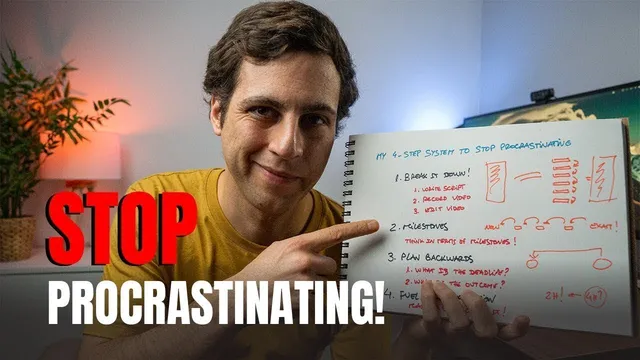
My 4 Step System to Stop Procrastinating
Based on Dan Silvestre's video on YouTube. If you like this content, support the original creators by watching, liking and subscribing to their content.
Identify procrastination as either overwhelm (can’t start) or boredom (can’t sustain), then choose the matching fix.
Briefing
Procrastination often isn’t a character flaw—it’s a predictable response to two problems: tasks feel either too overwhelming to start or too boring to sustain. Dan Silvestre’s four-step system targets those two drivers directly by shrinking the work until starting feels manageable, then forcing progress through deadlines and time pressure, and finally making the remaining “boring” parts feel like a game.
The first step is to break a big project into smaller subtasks—think “one bite at a time,” not “eat the whole elephant.” When a task is framed as a massive undertaking, the mind gets stuck on the scope and the emotional weight of everything that remains. Split it into concrete next actions (e.g., “write the script,” then “record,” then “edit”), and attention narrows to the next step. Silvestre recommends making those chunks small enough to complete in 25 minutes or less, borrowing the mental structure of the Pomodoro technique. A 25-minute timer reduces the psychological barrier: anyone can work briefly, and momentum builds as progress becomes visible.
The second step is to add deadlines—especially intermediate ones—because vague timelines invite delay. Silvestre points to a study of university students writing three papers over three weeks: the group with strict weekly deadlines performed best, while students allowed to choose their own deadlines did worse. The practical takeaway is that long projects create an invisible “finish line,” so people assume they have plenty of time. To counter that, he recommends working backward from the final due date and setting milestone deadlines along the way, including buffer time for delays.
That leads to the third step: backwards planning. Start by defining the end goal clearly—what “done” looks like—and then ask what must happen immediately before it. Repeat that question until reaching the first task. Silvestre illustrates with a website redesign: he set a three-month target for the redesign to go live, brainstormed what a “more professional look” meant (fonts, color choices, navigation, including a “start here” page for new users), then mapped the sequence backward from the final checks and page builds to the earliest planning tasks. He also advises scheduling completion earlier than the final deadline to account for the tendency to overestimate how much can be done.
The fourth step addresses boring tasks by using time pressure as motivation. Silvestre invokes Parkinson’s law—work expands to fill the time available—and suggests shrinking the allotted time to create urgency. If a task seems like it will take four hours, he recommends setting a shorter timer (two or three hours) and treating it like a self-competition. The result is a race against the clock that can make dull work move faster.
Together, the system turns procrastination into a sequence: make starting easier, make progress unavoidable, plan execution from the end, and convert boredom into urgency. The underlying message is that motivation follows action—so the real goal is designing work so the next step is always within reach.
Cornell Notes
Procrastination tends to come from two sources: tasks feel overwhelming to begin or boring to continue. A four-step system counters both. First, break projects into small subtasks and aim for chunks you can finish in 25 minutes, using a timer to build momentum. Second, set intermediate deadlines rather than relying on one distant due date; strict weekly deadlines outperform self-chosen ones. Third, plan backward from a clearly defined end goal, repeatedly identifying the step right before the current one and adding buffer time. Fourth, make boring tasks faster by using Parkinson’s law—give yourself less time than you think you need and treat it like a timed challenge.
What are the two main reasons people procrastinate, and how does the system respond to each?
Why does breaking work into smaller subtasks help beyond just “making it easier”?
What does the deadlines evidence suggest about procrastination on long projects?
How does backwards planning work in practice?
How can Parkinson’s law be used to make boring tasks easier to start?
Review Questions
- If a project feels overwhelming, what specific subtask structure would you create (including a 25-minute target), and what would your first “next action” be?
- What intermediate deadlines would you set for a multi-week project, and how would you decide those milestones using backwards planning?
- For a boring task you keep delaying, how would you apply Parkinson’s law by choosing a shorter timer and defining what “done” means within that time window?
Key Points
- 1
Identify procrastination as either overwhelm (can’t start) or boredom (can’t sustain), then choose the matching fix.
- 2
Break large tasks into concrete subtasks and make them small enough to complete in 25 minutes or less.
- 3
Use a timer (e.g., 25 minutes) to lower the psychological barrier to starting and to generate momentum.
- 4
Add strict intermediate deadlines; relying on one distant due date encourages delay.
- 5
Plan from the end goal backward by defining the final outcome, then mapping the step sequence in reverse and adding buffer time.
- 6
For boring tasks, apply Parkinson’s law by allocating less time than you think you need and treating it like a timed challenge.