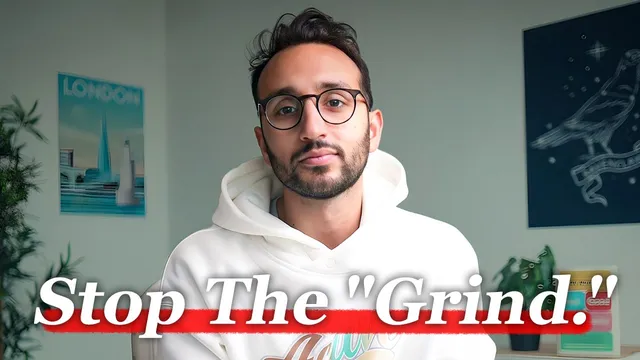
My honest advice to someone who wants financial freedom
Based on Ali Abdaal's video on YouTube. If you like this content, support the original creators by watching, liking and subscribing to their content.
Reframe financial freedom as a learnable skills sequence: idea → offer → sales → sustained execution, rather than a luck-driven outcome.
Briefing
Financial freedom is less a matter of luck than a learnable sequence of skills—so the path to a six-figure lifestyle business becomes a “skills problem” rather than a “hope and pray” gamble. The core message is that most people get stuck on three bottlenecks: not knowing what to sell (the idea problem), not knowing how to get customers (the sales problem), and not being able to sustain the work alongside real life (the time/energy/focus problem). Once those obstacles are reframed as skills that can be practiced, the goal shifts from waiting for the right break to building the right capabilities.
Ali Abdaal grounds the advice in his own origin story: as a teenager entering medical school, he noticed many doctors had autonomy problems even when they enjoyed the work. He set a concrete target—an extra £3,000 per month—so he could work fewer days. That goal collided with a key critique of traditional education: school trains people to be dependent on a single employer and rarely teaches budgeting, investing, or how to generate income independently. Reading Tim Ferriss’s The 4-Hour Work Week pushed him toward entrepreneurship, and he spent years experimenting online—publishing, testing, and iterating—until the income goal became achievable.
From there, the talk argues that 2025 is unusually favorable for building online businesses. The “video game” analogy frames entrepreneurship as pressing the right inputs in the right order: small teams can create outsized outcomes (citing Instagram and WhatsApp as examples) because modern distribution and tooling let individuals build and sell without massive infrastructure. But the emphasis is not on chasing “wild success” like billion-dollar exits. For most people, the realistic target is “mild success”—a six-figure lifestyle business that buys time freedom and flexibility—where luck plays a smaller role than skill.
To make the process actionable, Abdaal introduces the Four S’s framework: Strategy (knowing what to do), Skills (knowing how to do it), Starting (doing it despite friction), and Sustaining (continuing long enough to see results). He stresses that smart, high-achieving people often stall at the starting line because they want the perfect idea from day one, unlike school where there’s a single correct answer. Instead, entrepreneurship requires iteration: build something, sell it, deliver, refine—then compound progress from small market signals.
He then maps the three main obstacles to specific skill clusters. For ideas: identify a compelling product by clarifying the target person, the outcome they want, and the solution offered (niche, idea generation, idea validation, and offer design). For sales: use “magnetic marketing,” built from content, ads, and outreach (with email as a middle-of-funnel lever). For time: manage time, energy, and focus early on, then later solve the workload through delegation, automation, and systems.
The talk also highlights practical mindsets: treat every attempt as education because skills stack over time; use community and accountability to keep going; and when emotions like fear or imposter syndrome show up, follow the plan anyway. The closing takeaway is deliberately demystifying: financial freedom is not reserved for rare geniuses—it’s built by learning the right sequence of skills, starting, and sustaining long enough for compounding returns.
Cornell Notes
Financial freedom—especially via a six-figure lifestyle business—depends less on luck and more on learnable skills. Abdaal frames the journey around three common blockers: the idea problem (what to sell), the sales problem (why anyone would buy), and the time problem (how to do it alongside a job, family, and limited energy). The Four S’s—Strategy, Skills, Starting, and Sustaining—turn those blockers into a step-by-step system. The key shift is treating entrepreneurship like iteration: there’s rarely a “perfect first idea,” and progress comes from small market signals that compound over time. Community and accountability help people sustain the work when motivation fades.
Why does Abdaal argue that “mild success” is mostly a skills game rather than luck?
What are the three obstacles that commonly stop people from reaching a six-figure lifestyle business?
How do the Four S’s translate into a practical workflow?
What does “magnetic marketing” mean, and what are the customer-acquisition methods?
How does Abdaal suggest solving the time problem?
What role do accountability and community play in sustaining the plan?
Review Questions
- What are the three main blockers to financial freedom in Abdaal’s framework, and which skills address each one?
- How do Strategy, Skills, Starting, and Sustaining differ—and why does Starting tend to be the hardest for high-achievers?
- If someone refuses to do content marketing, what customer-acquisition options remain, and what trade-offs does that create?
Key Points
- 1
Reframe financial freedom as a learnable skills sequence: idea → offer → sales → sustained execution, rather than a luck-driven outcome.
- 2
Treat the three common bottlenecks—idea, sales, and time/energy/focus—as solvable skill gaps with specific training paths.
- 3
Use the Four S’s (Strategy, Skills, Starting, Sustaining) to turn vague goals into an execution system that can be iterated.
- 4
Avoid the “perfect first idea” trap; entrepreneurship improves through market feedback and refinement, not one-time correctness.
- 5
Build customer acquisition around “magnetic marketing” using content, ads, and/or outreach (with email as a middle-of-funnel lever).
- 6
Solve early time constraints through personal productivity (time, energy, focus), then later through delegation, automation, and systems.
- 7
Increase consistency with accountability buddies and community so progress doesn’t depend solely on motivation.