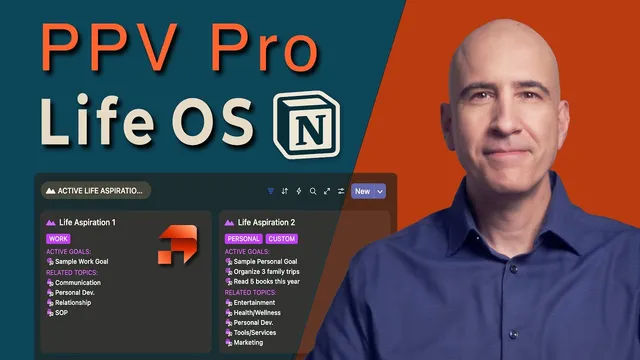
My Notion PPV Tour: the original Notion Life OS, reimagined for 2026
Based on August Bradley's video on YouTube. If you like this content, support the original creators by watching, liking and subscribing to their content.
PPV frames a life operating system as a way to prevent drift into chaos by tracking open loops, prioritizing deliberately, and surfacing the right information when it’s needed.
Briefing
Pillars, Pipelines & Vaults (PPV) is pitched as a “life operating system” in Notion that turns messy, competing demands into a single, connected workflow—so people can keep track of open loops, prioritize what matters, and resurface the right knowledge at the right moment. The core claim is that deliberate structure reduces drift into chaos and reaction, replacing it with clarity, “guard rails,” and ruthless prioritization. Instead of treating productivity as efficiency for its own sake, PPV centers on doing the right things—aligned to values and long-term aspirations—then supports execution with a daily action system and a knowledge system that feeds those actions in context.
PPV’s structure rests on three linked outcomes: Focus, Alignment, and Knowledge resurfacing. Focus is designed to make it easier to sit down and do the work that matters now, using a short, manageable daily list rather than an overwhelming backlog. Alignment ensures weekly and daily actions map back to life aspirations, which themselves trace to pillars—succinct expressions of what a person values. Knowledge resurfacing addresses the “fire hose” problem by curating resources and making them reappear inside the projects, goals, and topics where they’re relevant, while keeping unrelated information out of the way.
The system’s architecture is built around systems thinking: independent Notion databases become less useful when they don’t inform one another. PPV instead interconnects tiers so that resources, ideas, and activities reappear in the right time and place, producing “emerging qualities” that segmented workspaces don’t deliver. The author frames this as a major upgrade from earlier PPV versions: after five major upgrades, PPV was rebuilt from the ground up about a year earlier to fully leverage Notion’s enhanced database capabilities, enabling more robust structure and automation.
At the top of the hierarchy sit Pillars, distilled from a reflective process into 2–6 words or phrases that act as a “north star” for decisions. Those pillars translate into Life Aspirations—emotional, vision-like targets such as financial stability or a loving family—then into Goals, which are time-bound and outcome-oriented. Goals are advanced through two “engines” at equal status: Projects (specific, time-bound work toward completion) and Routines (regularly scheduled behaviors designed rather than instinctive habits). Actions sit at the bottom, scheduled in 30-minute to multi-hour blocks, and roll upward through the hierarchy.
Knowledge is handled through Vaults, including a renamed Topic Vault (formerly “knowledge vault”) and a single database called neurobits. Neurobits store individual discoveries—notes, media, documents, courses, and other learning—tagged to topics so they can resurface across the system. The author also adds “remembrance,” a cross-system notable tagging feature that aggregates meaningful items into year-based collections for reflection.
To prevent entropy, PPV uses Cycles: an annual review and planning layer, two-month DuoCycles that break the year into six intervals, and weekly reviews plus daily entries. In the rebuilt “PPV Pro” interface, three dashboards—Alignment Zone, Focus Zone, and Knowledge Zone—organize the workflow. The Focus Zone emphasizes a due-date practice (“DO dates”) that forces every active action to have a planned execution date, with delays marked as backlog or future items, creating deliberate friction that helps people decide whether tasks should be rescheduled or removed.
Overall, PPV Pro is presented as a connected system that keeps life aspirations translated into daily execution, while knowledge accumulates and resurfaces in context—aiming to make reviews quick (often 15–30 minutes weekly) and to protect time for relationships and personal priorities rather than turning everything into grind.
Cornell Notes
PPV (Pillars, Pipelines & Vaults) is a Notion-based “life operating system” designed to reduce drift into chaos by linking values to daily action. It organizes life into a hierarchy: Pillars → Life Aspirations → Goals → Projects/Routines → Actions, with Projects and Routines treated as equally important engines for progress. Three dashboards—Alignment, Focus, and Knowledge—support the system’s goals: Focus (do the right work now), Alignment (daily/weekly actions match aspirations), and Knowledge resurfacing (relevant resources reappear in context). A Topic Vault built on a single neurobits database stores learning and resources by topic, while Cycles (annual, DuoCycles, weekly, daily) prevent the system from decaying. The result is a workflow that keeps open loops tracked and knowledge available without cluttering day-to-day work.
What makes PPV different from using separate productivity tools and knowledge systems?
How does PPV translate “values” into what someone does each day?
Why does PPV treat Projects and Routines as equally important?
What is the “DO date” practice in the Focus Zone, and what problem is it meant to solve?
How does PPV’s knowledge system work in practice?
How does PPV keep the system from decaying over time?
Review Questions
- Trace PPV’s hierarchy from Pillars to daily Actions. Where do Projects and Routines fit, and what role do they play?
- Explain how the Topic Vault and neurobits are meant to resurface knowledge in context. What does a topic page show beyond stored notes?
- What is the purpose of Cycles (annual, DuoCycles, weekly, daily) in PPV, and how does the DO date practice support Focus?
Key Points
- 1
PPV frames a life operating system as a way to prevent drift into chaos by tracking open loops, prioritizing deliberately, and surfacing the right information when it’s needed.
- 2
The system’s core outputs are Focus, Alignment, and Knowledge resurfacing, organized into three dashboards: Focus Zone, Alignment Zone, and Knowledge Zone.
- 3
Pillars (2–6 value statements) are distilled through reflection and act as a north star that guides major decisions and feeds into Life Aspirations.
- 4
Life Aspirations are translated into Goals, which are advanced through two equally weighted engines: Projects (time-bound work) and Routines (designed regular behaviors).
- 5
A due-date practice called “DO dates” forces every active action to have a planned execution date, using backlog/future labeling to reduce endless task lists.
- 6
Knowledge is centralized in neurobits and organized by topic in the Topic Vault, so resources reappear inside the goals and projects where they matter.
- 7
Cycles (annual review, DuoCycles, weekly reviews, daily entries) are used to prevent entropy and keep the system aligned with what matters next.