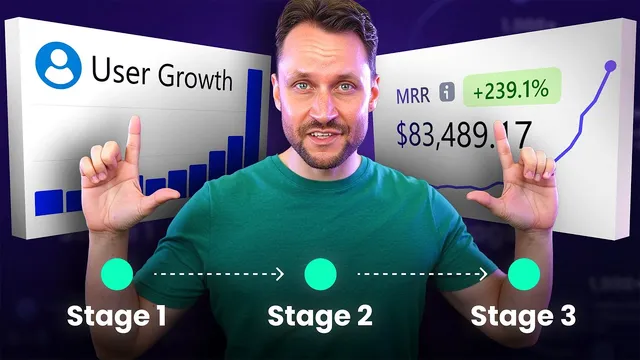
My SaaS User Growth System: Get Your First 100 - 1,000+ Users
Based on Simon Høiberg's video on YouTube. If you like this content, support the original creators by watching, liking and subscribing to their content.
User acquisition can be designed as a model built from method (incoming, outgoing, referrals, advertising), channel, and cost, and the best mix changes by SaaS stage.
Briefing
The core finding: SaaS user growth follows repeatable “acquisition models” built from three levers—method (incoming, outgoing, referrals, or advertising), channel (email/DMS, social/search, ads, etc.), and cost—and the right mix changes at each stage of a company’s journey. Early traction depends on direct, human outreach and tight feedback loops; scaling to hundreds of users requires content-driven inbound discovery; and sustained growth at scale comes from paid acquisition and/or formal affiliate systems that turn customers into an always-on distribution engine.
At the start, the goal is to land the first five users—often the most important cohort because they become both testers and future advocates. The recommended model is outgoing acquisition: founders personally reach out via email or DMs to close network contacts (friends, colleagues, partners, and others who can benefit from the MVP). The cost is $0 because the outreach is manual. The offer is a free account in exchange for feedback. Once those first five users are in place, the playbook shifts from acquisition to retention and co-creation: gather them into a small community (Discord, Facebook, WhatsApp, or similar), fix bugs, implement features based on their requests, and make them feel like they shape the product. The payoff is strategic—these early users are converted into advocates, not just paying customers.
To move from five to roughly 100 users, the model changes to referrals. Early adopters get referral links, and the cost can be kept at zero if the product experience is strong enough that advocates willingly share. If incentives are needed, the approach is to offer a meaningful early-join discount rather than cash payments, so both advocates and new users feel special for being part of something emerging. The discount also functions as a built-in “reason to click,” increasing referral conversion.
Stage two targets 500 to 1,000 users, where zero-cost outreach and manual DMs become unrealistic. The recommended model is incoming acquisition at scale: build awareness through content and “building in public.” Social media and search engines become the channels—long-form YouTube for search visibility, blog posts for Google, TikTok/Reels/Shorts for attention capture, and ongoing updates on LinkedIn, Hacker News, and Indie Hackers. This stage is intentionally slow and uneven; results may lag while content accumulates. Costs rise because producing and iterating on high-quality content is required, with spending guided by average revenue per user (ARPU) and monitored through ongoing optimization.
Stage three focuses on continuous growth from 1,000+ users onward, with two paths: reinvest aggressively for maximum growth or shift toward automation and profit. Two acquisition models fit this phase. First is advertising: repurpose proven content into scalable paid campaigns—Google Ads for search and YouTube video, Meta for image/video ads on Facebook and Instagram, and TikTok ads for video placements. Return-on-ad-spend targets can be set based on goals (for example, aiming for a 3:1 return to fund growth while keeping profit). Second is a scaled referral system via an affiliate program, where users create referral links and affiliates receive compensation tied to recurring revenue (sometimes 10%–50%), or lighter incentives like gift cards and feature unlocks for an automation/profit-oriented approach. The overall roadmap is flexible, but the stage-by-stage logic—human outreach, then inbound content, then paid/affiliate automation—remains the engine behind compounding user growth.
Cornell Notes
SaaS growth can be systematized by designing user acquisition models from three parts: method (incoming, outgoing, referrals, advertising), channel, and cost. The first five users are best won through outgoing outreach (manual email/DMS to close contacts) paired with a tight feedback loop—community-building, bug fixes, and feature requests—so early users become advocates. Moving to 100 users shifts to referrals using referral links, ideally with incentives like early discounts rather than cash if the product experience is strong. To reach 500–1,000 users, manual outreach fails at scale; inbound acquisition via content and “building in public” (YouTube, blogs, TikTok/Reels/Shorts, LinkedIn, Hacker News, Indie Hackers) becomes the engine. For 1,000+ users, growth can be accelerated with paid ads or automated with an affiliate program that compensates partners based on recurring revenue or smaller perks.
Why are the first five users treated as a strategic asset rather than just early customers?
What acquisition model best fits the “five to 100 users” jump, and how is it kept cost-effective?
Why does the roadmap switch away from zero-cost outreach when targeting 500–1,000 users?
What does “incoming acquisition” look like in practice for SaaS growth to 500–1,000 users?
How do stage three strategies differ between “growth mode” and “automation mode”?
What are the two stage-three acquisition models, and what channels are recommended for ads?
Review Questions
- If the goal is to convert the first five users into advocates, what onboarding steps matter most after the initial outreach?
- How would you justify choosing inbound content over outgoing outreach when moving from 100 to 1,000 users?
- What ROAS target and affiliate incentive structure would you pick if the priority is profit over maximum growth, and why?
Key Points
- 1
User acquisition can be designed as a model built from method (incoming, outgoing, referrals, advertising), channel, and cost, and the best mix changes by SaaS stage.
- 2
Recruit the first five users via outgoing outreach (manual email/DMS) to close-network contacts, offering free accounts in exchange for feedback.
- 3
Turn early users into advocates by onboarding them into a small community and iterating quickly on bugs and feature requests they drive.
- 4
Scale from five to 100 users using referrals with referral links, keeping costs low via product-led advocacy or early-join discounts.
- 5
To reach 500–1,000 users, switch to incoming acquisition through content and building in public across search and social channels.
- 6
For 1,000+ users, choose between reinvesting for growth (more aggressive ads) or optimizing for automation/profit (higher ROAS targets and lighter affiliate incentives).
- 7
Use paid ads and/or an affiliate program in stage three to create repeatable, scalable acquisition beyond founder-led outreach.