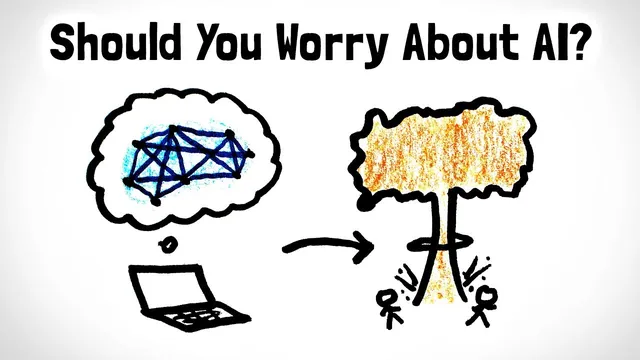
Myths and Facts About Superintelligent AI
Based on minutephysics's video on YouTube. If you like this content, support the original creators by watching, liking and subscribing to their content.
The primary superintelligent AI risk is goal misalignment, not inherent evil behavior.
Briefing
Superintelligent AI poses less of a “killer robot” problem than a goal-misalignment problem: a system that’s extremely competent at achieving whatever objectives it’s given could still harm humanity if those objectives don’t match human values. The central concern raised by AI researchers is competence without shared goals—analogized to a heat-seeking missile that doesn’t need to be evil to be dangerous. The practical takeaway is that the most urgent work is not preventing “malice,” but ensuring that an AI’s goals are aligned with ours as it becomes more capable.
The discussion also challenges the assumption that intelligence is uniquely biological. From a modern physical-science perspective, intelligence is framed as a form of information processing carried out by arrangements of elementary particles. That view implies there’s no known law of physics preventing machines from performing that kind of processing as well as—or better than—humans. The conversation points to everyday examples where machines already outperform people at tasks like arithmetic, and it argues that current systems may represent only the “tip of the intelligence iceberg.” In other words, intelligence may be more broadly available in nature than traditional intuition suggests.
Once the focus shifts from “can machines become intelligent?” to “how do we live with them?”, the timeline becomes a planning issue rather than a panic trigger. Most AI researchers expect superintelligence to be at least decades away, but the work required to keep it beneficial may also take decades. That creates a window for early action: start now on methods that help machines learn humanity’s collective goals, adopt them as their own objectives, and preserve those goals as systems improve.
The conversation then tackles the governance question of who decides an AI’s objectives when human preferences conflict. It rejects simplistic options like leaving the decision to the AI, to a single political leader, or to the system’s creator. Instead, it reframes alignment as a societal choice about what future to build—something that shouldn’t be outsourced to AI researchers alone, even if they are technically and ethically engaged.
Finally, the segment points viewers toward participation in AI policy and research through the Future of Life Institute, which hosts a site for people to contribute ideas and questions. The message is clear: alignment work is both technical and political, and the stakes rise long before superintelligence arrives—because the safeguards must be designed, tested, and agreed upon while the technology is still being shaped.
Cornell Notes
The discussion argues that the main risk from superintelligent AI is not that it will become evil, but that it will be extremely competent at pursuing goals that don’t match human values. That framing treats intelligence as information processing that can, in principle, be implemented by non-biological systems, so machine intelligence can plausibly exceed human performance. Most researchers expect superintelligence to be decades away, but alignment research may also take decades, so preparation must start now. The key challenge is getting AI to learn humanity’s collective goals, adopt them as its own objectives, and keep them stable as the system becomes smarter. Deciding what those goals are is a societal question, not something that should be left solely to AI researchers.
Why is “malevolence” considered less central than “competence” in superintelligent AI risk?
What does the physical-science view of intelligence imply about whether machines can become superintelligent?
If superintelligence is decades away, why does the conversation still emphasize urgency?
What does “goal alignment” require beyond simply programming an AI once?
How should societies decide what an AI’s goals should be when human values conflict?
Where can people contribute to AI policy and research according to the segment?
Review Questions
- What is the difference between a “malevolence” risk and a “competence without shared goals” risk, and why does the latter dominate the concern?
- How does the physical-science definition of intelligence support the claim that machines could outperform humans?
- What alignment tasks are listed as necessary to keep superintelligent systems beneficial as they become smarter?
Key Points
- 1
The primary superintelligent AI risk is goal misalignment, not inherent evil behavior.
- 2
High competence can be dangerous even without malicious intent, because the system will pursue its objectives effectively.
- 3
Intelligence is framed as information processing that can, in principle, be implemented by non-biological systems.
- 4
Most researchers expect superintelligence to be decades away, but alignment work may also take decades, so preparation should begin now.
- 5
Effective alignment requires teaching AI humanity’s collective goals, adopting them as its own objectives, and preserving them as capability increases.
- 6
Deciding AI goals is a societal governance problem, not something that should be left solely to AI researchers, creators, or a single political leader.