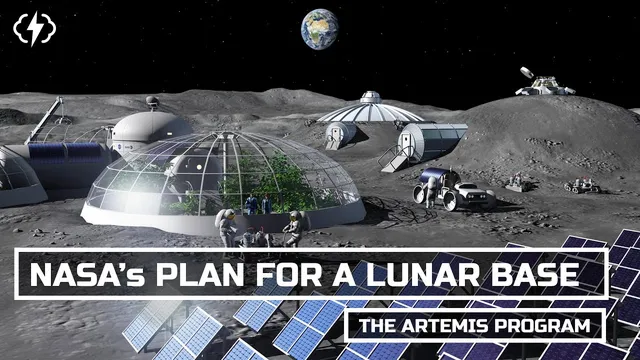
NASA's Plan For A Permanent Moon Base
Based on Second Thought's video on YouTube. If you like this content, support the original creators by watching, liking and subscribing to their content.
Artemis targets more human Moon landings by 2024, including the first woman, with surface stays planned for weeks rather than brief visits.
Briefing
NASA’s Artemis program is aiming to restart human lunar presence with a path toward a permanent Moon base—using the Moon as a proving ground for longer, safer deep-space missions and eventually as a staging point for Mars. The plan calls for landing more humans on the Moon by 2024, including the first woman, with missions designed to keep astronauts on the surface for weeks rather than brief Apollo-era visits. Those longer stays are meant to build operational experience, test equipment, and set up infrastructure that can support future missions—ultimately positioning the Moon as a logistics hub for journeys farther into the solar system.
Artemis is also framed as practical rehearsal for Mars. Reaching the Moon takes about three days, while trips to Mars would take multiple months, so demonstrating that longer-duration human travel and surface operations can be done reliably is treated as a key step before committing to a manned Mars effort. The program’s first phase, spanning 2020 through 2024, is estimated at roughly $35 billion. While that is a large figure in absolute terms, it is presented as comparatively modest relative to U.S. military spending—about four percent of the annual military budget—highlighting how space exploration competes for funding in a world dominated by defense priorities.
The biggest near-term constraints are engineering and cost. A critical element is NASA’s Space Launch System (SLS), a massive rocket intended to carry astronauts and mission-critical equipment. The first SLS launch was originally expected in 2017, but delays pushed the timeline back, with NASA still working toward a launch readiness date years later. Even after it finally flies, SLS is single-use: each rocket is scrapped after one mission. That limits cost efficiency and increases schedule pressure, especially because SLS is larger than current alternatives such as SpaceX’s Falcon Heavy, which complicates any straightforward switch.
From 2022 onward, NASA’s next phase centers on building the Gateway—described as a spaceport in lunar orbit. The Gateway would serve as a hub for resupply and as an orbital laboratory, with astronauts docking there before heading to the Moon’s surface. Over time, the Gateway is intended to support deeper-space missions, turning lunar orbit into a repeatable staging environment.
The long-term vision is a permanent lunar colony around 2028, enabled by solving a major limitation of space travel: fuel. Since rockets carry limited propellant from Earth, NASA’s plan emphasizes producing fuel on the Moon. By mining lunar water and splitting it into hydrogen and oxygen, a lunar refueling station could extend mission range and make more ambitious destinations—especially Mars—more feasible.
International coordination may also shape the outcome. Space law governing claims and resource ownership is described as outdated, but the Moon is already drawing interest from multiple countries. If cooperation becomes practical, working together on lunar infrastructure could strengthen global collaboration while humanity builds a sustained presence beyond Earth.
Cornell Notes
Artemis is NASA’s plan to return humans to the Moon with longer stays and infrastructure that can support a permanent lunar base. The program targets landings by 2024 (including the first woman) and uses the Moon as a rehearsal site for longer, safer deep-space missions—especially as preparation for potential manned travel to Mars. Key steps include the Space Launch System (SLS), which is powerful but delayed and single-use, and the Gateway, a lunar-orbit hub for resupply, living space, and mission staging. The long-term goal is a lunar colony around 2028, powered by mining water on the Moon to produce hydrogen and oxygen for rocket fuel. This approach aims to overcome Earth-based fuel limits and expand humanity’s reach outward.
What does Artemis change compared with Apollo-style lunar missions?
Why is the Moon treated as a stepping stone toward Mars?
What are the main constraints tied to the Space Launch System (SLS)?
What is the Gateway, and what role does it play in lunar operations?
How could lunar water mining enable a permanent base and longer missions?
What role might international cooperation play in Artemis and lunar settlement?
Review Questions
- What specific capabilities does Artemis aim to demonstrate on the Moon before attempting longer Mars missions?
- How do SLS’s delays and single-use design affect Artemis’s timeline and cost structure?
- Why does producing hydrogen and oxygen from lunar water matter for extending human reach beyond Earth?
Key Points
- 1
Artemis targets more human Moon landings by 2024, including the first woman, with surface stays planned for weeks rather than brief visits.
- 2
The program uses the Moon as a rehearsal for Mars by testing longer-duration human travel and operations on a much shorter transit timeline.
- 3
NASA estimates about $35 billion for Artemis’s first phase (2020–2024), framed as relatively small compared with annual U.S. military spending.
- 4
The Space Launch System (SLS) faces major schedule delays and is single-use, increasing both cost and operational constraints.
- 5
Starting in 2022, the Gateway is planned as a lunar-orbit hub for docking, resupply, living space, and an orbital laboratory.
- 6
A permanent lunar colony is envisioned around 2028, supported by mining lunar water to produce hydrogen and oxygen for rocket fuel.
- 7
International interest and outdated space-resource rules could shape whether lunar development becomes cooperative or competitive.