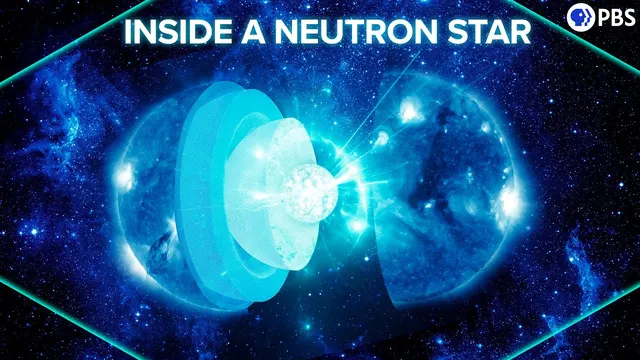
Neutron Stars: The Most Extreme Objects in the Universe
Based on PBS Space Time's video on YouTube. If you like this content, support the original creators by watching, liking and subscribing to their content.
Neutron stars’ interiors progress through distinct matter phases: magnetospheric pair plasma, an ionized plasma atmosphere, a frozen crystalline crust, neutron-rich drip regions, nuclear pasta, and a core with superfluid/superconducting behavior.
Briefing
Neutron stars pack matter into a sequence of exotic states—ranging from a plasma “atmosphere” to crystalline, neutron-rich crust phases and finally superfluid/superconducting cores—where quantum rules and nuclear forces reshape what matter can even be. The payoff is observational: these inner structures may leave fingerprints in pulsar timing glitches and in a faint, continuous gravitational-wave “hum” that instruments like LIGO are actively hunting.
The journey begins outside the star in the magnetosphere, home to the strongest magnetic fields in the universe. Even the weakest neutron stars generate fields about a billion times stronger than Earth’s or the Sun’s. In this environment, extreme-energy photons convert into electron–positron pairs. Charged particles then stream along magnetic-field lines in opposite directions, forming jets whose motion produces the radiation seen from Earth as pulsars.
Just beyond the magnetosphere, the surface is not a normal gas layer but an ultra-thin plasma atmosphere. Temperatures reach roughly a million Kelvin for young neutron stars, stripping electrons from nuclei so the layer is ionized. Despite being only about a meter thick (with most plasma confined to a ~10 cm shell), the atmosphere sits under crushing gravity—around 100 billion G’s—so the pressure and density jump far more abruptly than on Earth.
At the surface, the star’s “solid” matter behaves like a frozen plasma crystal. Nuclei form a regular lattice even though they are positively charged, because at these densities the short-range nuclear/repulsive effects prevent nuclei from sliding past one another—described as gridlocked traffic. The lattice is mostly iron, an element forged in the hours before the supernova that created the neutron star.
As depth increases, electrons become increasingly energetic and trigger electron capture: electrons merge with protons to form neutrons, converting iron into more neutron-rich, heavy nuclei. Deeper still, “neutron drip” occurs when nuclei become so neutron-heavy that neutrons leak out into the spaces between nuclei. That transition is expected to begin around half a kilometer down, at densities at least a trillion times Earth’s.
Further inward, nuclei lose their distinct boundaries and matter reorganizes into “nuclear pasta”—shapes driven by the tug-of-war between short-range nuclear attraction and long-range electric repulsion. Depending on density, matter can form spaghetti-like cylinders, lasagna-like sheets, and other layered or rod-like structures. These pasta mountains could be up to ~10 cm tall, yet each cubic centimeter would weigh as much as a mountain on Earth. Their rotation would generate a continuous gravitational-wave signal at twice the pulsar’s rotation frequency, weaker than merger signals and therefore harder to detect.
Near the core, neutrons pair up into Cooper pairs, enabling superfluid behavior with quantized vortices; some models link vortex dissipation to pulsar “glitches” in spin rate. A smaller population of protons may form a superconducting component, potentially helping sustain the star’s magnetic field. At the very center, matter may become even more speculative: hyperons with strange quarks, or a quark–gluon plasma where protons and neutrons dissolve.
The transcript ends by tying these extreme interiors to the star’s life cycle: if the neutron star accretes enough mass from a binary companion, it could collapse into a black hole, making escape impossible—an ultimate boundary where the same quantum and nuclear physics can no longer hold matter in place.
Cornell Notes
Neutron stars are structured layers of matter under crushing gravity and extreme magnetic fields, producing states that don’t occur elsewhere. The outer magnetosphere hosts electron–positron pair creation and particle jets that generate pulsar radiation. The surface and crust progress from a thin ionized plasma to a frozen, crystalline lattice (mostly iron), then to degenerate electron support, electron capture, and “neutron drip,” where neutrons leak out of nuclei. Deeper still, nuclei reshape into “nuclear pasta” (spaghetti/lasagna-like forms) that could produce a continuous gravitational-wave signal at twice the rotation frequency. In the core, neutrons form Cooper pairs leading to superfluidity, while protons may become superconducting; the center may further transition to hyperons or even a quark–gluon plasma.
Why does a neutron star’s magnetosphere produce pulsar radiation?
How is a neutron star “atmosphere” different from Earth’s atmosphere?
What stops further collapse in the outer crust, and what does the matter look like?
What is “neutron drip,” and why does it matter for the star’s structure?
How does “nuclear pasta” form, and what observational signature could it leave?
What happens in the core that changes the rules for matter?
Review Questions
- Which physical processes in the magnetosphere generate the jets and radiation associated with pulsars?
- Walk through the sequence from electron capture to neutron drip and explain how support changes from electron degeneracy to neutron degeneracy.
- What competing forces produce nuclear pasta, and why would its rotation generate gravitational waves at twice the pulsar’s spin frequency?
Key Points
- 1
Neutron stars’ interiors progress through distinct matter phases: magnetospheric pair plasma, an ionized plasma atmosphere, a frozen crystalline crust, neutron-rich drip regions, nuclear pasta, and a core with superfluid/superconducting behavior.
- 2
Neutron star magnetic fields can exceed Earth’s or the Sun’s by about a billion times, enabling electron–positron pair creation and jet formation that produces pulsar radiation.
- 3
The surface plasma layer is extremely thin—about a meter thick overall, with most confined to ~10 cm—yet it sits under gravity around 100 billion G’s.
- 4
Electron degeneracy pressure supports the outer crust, but electron capture converts protons into neutrons and drives the crust toward neutron-rich nuclei.
- 5
Neutron drip occurs when nuclei become too neutron-heavy to hold all their neutrons, releasing a neutron gas and shifting the dominant support toward neutron degeneracy pressure.
- 6
Nuclear pasta forms when nuclei touch and reorganize under the tug-of-war between nuclear attraction and electric repulsion; its rotation could yield a continuous gravitational-wave signal at twice the spin frequency.
- 7
In the core, neutron Cooper pairing can produce superfluidity (linked to pulsar glitches), while proton superconductivity may help sustain the star’s magnetic field.