New AI Model Quietly Outclasses GPT-4 Image Gen!
Based on MattVidPro's video on YouTube. If you like this content, support the original creators by watching, liking and subscribing to their content.
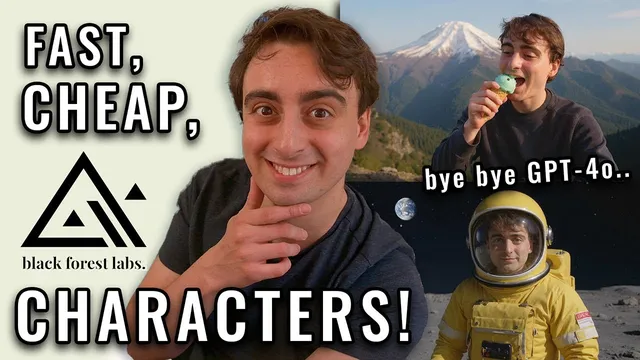
Flux Context is framed as a direct image-editing model that often preserves composition and facial features better than GPT-4–native image generation.
Briefing
Black Forest Labs’ Flux Context is positioned as a faster, higher-quality alternative to GPT-4–native image generation for image editing and character consistency—especially when the goal is to modify an existing image while preserving its composition. In side-by-side tests, removing an object from a face (a snowflake blocking part of the face) produced more realistic results with Flux Context, while GPT-4–native image generation hit OpenAI content-policy limits for the same request. Flux Context also showed a clear editing advantage: it tends to keep more of the original scene structure and facial features, rather than fully reconstructing a new image from scratch.
The strongest demonstrations focused on iterative edits and “staying in character.” Starting from a single reference image, Flux Context could place the same subject on a city street, then add a new environmental change (covering the person in snow) while maintaining facial detail and overall identity. In a more stylized scenario, a character with a VR headset and a distinctive beak-through effect was duplicated and moved into different settings (a movie theater, then a grocery trip, then a celebratory launch scene). Across these variations, the model preserved the character’s visual style—head shape, headset look, and even glove-like hands—more reliably than GPT-4–native image generation in the same general workflow. Text handling also looked promising: swapping a logo text prompt (e.g., “you had me at beer” to “you had me at context”) often retained background details instead of regenerating the entire image.
Flux Context’s quality came with tradeoffs. Iterative editing in the playground can “deep fry” the image over time—progressively degrading details into a mushy, AI-blobby look after multiple edits. Character replication sometimes required rerolls to land on a usable match, and subtle features (like hands) could become slightly mushy. When the subject was placed in complex new contexts—such as turning a moon background into an Earth background—Flux Context generally succeeded, but the resulting identity match could still drift across further downstream steps.
Under the hood, Flux Context is described as neither a traditional diffusion-only approach nor an auto-regressive LLM chatbot like GPT-4 Omni; it’s its own architecture. Access is available via a free “Flux Playground” that requires signing in with a Google account. The model also offers selectable variants (including a “Max” option) that can improve quality, though safety controls may need adjustment to get closer to the intended output.
Beyond the base playground, the transcript emphasizes community deployment. Flux Context is available through Replicate, where users have built specialized apps—style transfer with background/outfit preservation, multi-image workflows (including two-image reference setups), and “become a character in any style” tools. These community apps were showcased as producing notably consistent results, such as converting a high-definition portrait into Lego, Simpsons, or anime-style variants while keeping earrings, facial styling, and clothing.
Finally, the comparison sharpened around edge-case identity: a character with a missing arm. Flux Context struggled to preserve the missing-arm detail, often regenerating the missing limb, while GPT-4–native image generation was described as uniquely capable of maintaining that specific inconsistency—though at higher cost and slower generation. The takeaway is a practical one: Flux Context is a strong, cheaper, fast option for most editing and consistent-scene workflows, while GPT-4–native image generation may still be the better choice when extremely specific anatomical details must remain unchanged.
Cornell Notes
Flux Context by Black Forest Labs is presented as a high-quality image editing model that often preserves the original image’s composition and character features better than GPT-4–native image generation. In demos, it handled object removal, environmental changes, and multi-scene character edits (including consistent VR-headset character styling) with strong visual continuity, plus workable text edits. The playground supports iterative editing, but repeated edits can degrade results (“deep frying”) and some rerolls may be needed for a close character match. Flux Context also shows limits on very specific anatomy—like maintaining a missing arm—where GPT-4–native image generation reportedly performs better. Community-built apps on Replicate extend Flux Context with style transfer, background/outfit preservation, and multi-image reference workflows.
Why does Flux Context often look better for “edit this image” tasks than GPT-4–native image generation?
What evidence suggests Flux Context can maintain character consistency across multiple edits and settings?
What are the main failure modes when using Flux Context iteratively?
How does Flux Context handle text and logos in edits?
Where does GPT-4–native image generation outperform Flux Context in the transcript’s tests?
What role do community apps on Replicate play in improving Flux Context workflows?
Review Questions
- In what kinds of tasks does Flux Context most clearly preserve the original image’s structure, and what does that imply for editing workflows?
- What specific “deep frying” behavior was observed during repeated edits, and how might that affect multi-step production pipelines?
- Why might a model struggle to preserve a rare anatomical detail like a missing arm, and how did the transcript’s comparison reflect that?
Key Points
- 1
Flux Context is framed as a direct image-editing model that often preserves composition and facial features better than GPT-4–native image generation.
- 2
Object removal (snowflake blocking a face) produced more realistic results with Flux Context, while GPT-4–native image generation hit content-policy limits for the same request.
- 3
Flux Context can maintain a character’s distinctive style across multiple scene changes, including VR-headset and glove-like hand details.
- 4
Iterative editing in the Flux Playground can degrade outputs over time, turning fine details mushy after repeated modifications.
- 5
Text edits can work as targeted modifications (e.g., swapping logo text) while keeping much of the background intact.
- 6
Flux Context struggles more with extremely specific anatomical inconsistencies (like a missing arm), where GPT-4–native image generation reportedly holds up better.
- 7
Community-built Flux apps on Replicate add practical controls—style transfer, background/outfit preservation, and multi-image references—that improve consistency.