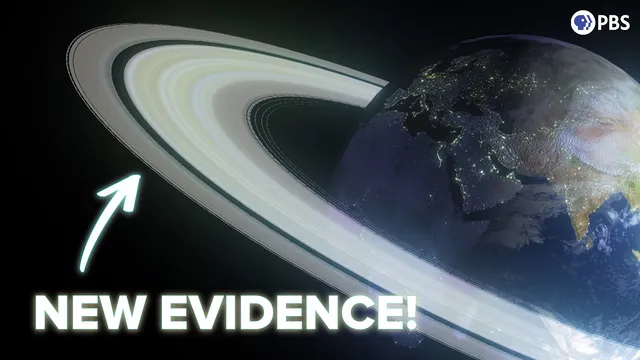
NEW EVIDENCE: Earth Had Rings (and Might Regain Them)
Based on PBS Space Time's video on YouTube. If you like this content, support the original creators by watching, liking and subscribing to their content.
Earth rings are transient: particles either fall onto the planet or clump into moons, depending on dynamical cooling and the Roche limit.
Briefing
Earth may have hosted a ring system—potentially for tens of millions of years—during the Ordovician period, and a 2024 study argues the timing and geography of a meteorite “impact spike” fit that scenario better than the usual asteroid-belt explanation. The claim matters because it links a specific, measurable pattern in Earth’s ancient rocks to a large-scale dynamical event in near-Earth space, with possible knock-on effects for climate and mass extinction.
Rings are not permanent. They can vanish when ring particles either fall onto the planet or merge into moons. Whether a ring survives depends heavily on two ideas: dynamical “temperature” (whether particles move slowly enough to clump under their own gravity) and the Roche limit (the distance inside which tidal forces prevent bodies from gravitationally holding together). Beyond the Roche limit, particles can coalesce into moons if they cool; inside it, they tend to remain as rings. Saturn’s rings are dynamically cold, and the same physics implies Earth could keep a ring only if the material stayed within its own Roche limit.
The new evidence centers on an Ordovician meteorite influx recorded in sedimentary rocks. Around 466 million years ago, Earth experienced an “impact spike” lasting roughly 40 million years, when sediments became enriched in L-chondrite meteorites by about a factor of 100–1000. The leading hypothesis has been a major collision in the asteroid belt that flooded the inner solar system with debris. But that explanation runs into a problem: Mars and the Moon show no matching increase in impact rates during the same interval. That mismatch pushed researchers from Monash University to consider a more localized source near Earth.
Their proposed mechanism begins with a near miss: a roughly 10-kilometer asteroid passes thousands of kilometers above Earth, but crucially below Earth’s Roche limit. Extreme tidal forces disrupt the body, and some debris is captured into Earth orbit. Early on, debris follows highly elliptical, widely tilted paths; collisions among particles help circularize and flatten the orbits into a disk-like ring. Earth’s equatorial bulge further encourages a preferred orbital plane, producing a very flat equatorial ring. Material that drifts beyond the Roche limit could briefly form small moons, but tidal forces would drive it back inward until it is disrupted again.
The ring then gradually drains. Because the debris orbits largely within Earth’s exosphere, tiny atmospheric drag causes orbital decay. Particles spiral inward one by one, ultimately burning up as they plunge into denser atmosphere—explaining both the sustained meteor activity and the long duration of the enrichment.
Testing the origin requires tracking where the impacts landed. If debris came from the asteroid belt, impacts should be distributed broadly across Earth’s surface. If debris came from an equatorial ring, impacts should cluster near the equator. The study examines 21 craters attributed to this interval and reconstructs their paleolatitudes by rewinding tectonic motion. All fall within about 30 degrees of the equator (over a ~60-degree band), and the team estimates the probability of such a tight clustering from a random global distribution at roughly 1 in 25 million. That statistical result is presented as strong support for a localized equatorial reservoir—consistent with a ring.
The ring hypothesis also offers a climate angle. The Ordovician impact spike precedes the Hirnantian glaciation and the second-largest mass extinction in Earth’s history. An equatorial ring could act like a sunshade, intensifying winter conditions in the hemisphere tilted away from the Sun and potentially helping drive runaway glacier growth.
Still, the case is not closed. The authors call for more craters from the same era, improved dating and mineral matching of the meteorite material, and checks for similar “sibling” impacts far from the equator—outcomes that would either strengthen or weaken the ring interpretation. If the idea holds, Earth’s rings would be a recurring possibility: a near-miss asteroid, a temporary ring phase, and then a long meteor shower culminating in major environmental change.
Cornell Notes
A 2024 Monash University study argues Earth likely had a ring system during the Ordovician, lasting about 40 million years around 466 million years ago. The evidence comes from a large enrichment of L-chondrite meteorites in sediments and from the paleolatitudes of impact craters tied to that interval. Instead of a global, random distribution expected from asteroid-belt debris, the craters cluster near the equator when reconstructed by tectonic plate motion—matching what an equatorial ring would deliver. The proposed origin is a near-miss asteroid passing below Earth’s Roche limit, getting tidally disrupted into debris that circularizes into a flat ring and then slowly drains via exosphere drag. If correct, the ring could also have contributed to the lead-up to the Hirnantian glaciation by shading winters and amplifying cooling.
What physical conditions allow a planet to keep a ring instead of turning it into moons?
How does the Roche limit connect to the idea of an equatorial ring on Earth?
Why does the asteroid-belt explanation for the Ordovician impact spike struggle?
What mechanism turns a near-miss asteroid into a long-lived ring and a sustained meteor shower?
How do researchers use crater locations to test whether the debris came from a ring or from random space?
What climate link does the ring hypothesis propose for the Ordovician?
Review Questions
- What two factors—one dynamical and one gravitational—determine whether ring material can persist instead of forming moons?
- How does the paleolatitude reconstruction of craters strengthen (or weaken) the equatorial ring hypothesis?
- What observational mismatch with Mars and the Moon challenges the idea that the Ordovician spike came from an asteroid-belt collision?
Key Points
- 1
Earth rings are transient: particles either fall onto the planet or clump into moons, depending on dynamical cooling and the Roche limit.
- 2
The Roche limit marks where tidal forces prevent self-gravity from assembling moons; inside it, material is more likely to remain as a ring.
- 3
A 2024 Monash University study links an Ordovician meteorite enrichment (L-chondrite, ~100–1000×) to a proposed near-Earth ring formed by a tidal disruption event.
- 4
The asteroid-belt flooding hypothesis is weakened by the lack of a matching impact-rate increase on Mars and the Moon during the same interval.
- 5
Crater paleolatitudes reconstructed via tectonics cluster near Earth’s equator, with an estimated probability of ~1 in 25 million under a random global distribution.
- 6
The ring would gradually drain as exosphere drag decays orbits, producing a long-lasting meteor shower over ~40 million years.
- 7
An equatorial ring could plausibly intensify winter shading and contribute to the lead-up to the Hirnantian glaciation and major extinction.