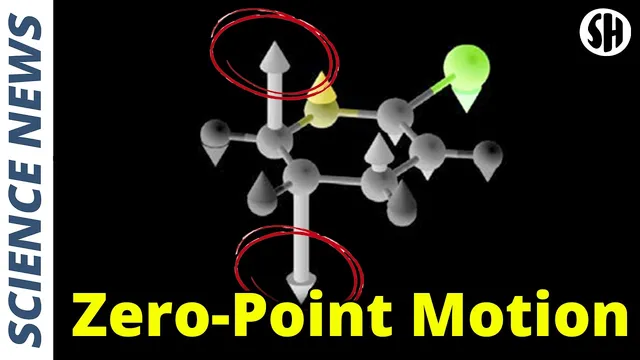
New Experiment Shows Zero Point Motion is Real!
Based on Sabine Hossenfelder's video on YouTube. If you like this content, support the original creators by watching, liking and subscribing to their content.
Zero-point energy persists because quantum particles behave like waves and must fit allowed standing-wave patterns inside a confining potential.
Briefing
Zero-point motion—random atomic movement that persists even when a molecule sits in its lowest-energy state—has been measured directly, strengthening the case that quantum randomness is not just a measurement artifact. The core claim matters because it challenges a common intuition: if a system is already at minimum energy, there should be no leftover “wiggling.” Quantum mechanics predicts otherwise, linking unavoidable zero-point energy to real, measurable motion.
The discussion starts by distinguishing zero-point energy from the more familiar idea of quantum entanglement. Zero-point energy arises because quantum particles behave like waves. When a particle is confined by a potential well—such as a “box” with hard walls or an electromagnetic confinement—only certain standing-wave patterns fit. That means the lowest possible energy level sits above the classical “no energy” baseline. Crucially, this energy cannot be removed even at zero temperature; it remains in the vacuum because the particle cannot stop being a wave.
Zero-point motion is the expected dynamical consequence: if zero-point energy is always present, it should drive random motion of atoms in a molecule, even when the molecule itself is not vibrating in the usual, thermal sense. Earlier attempts to detect it in atom clouds reportedly fell short, so the new strategy targets a different scale and observable: the motion of individual atoms within a molecule’s lowest-energy configuration.
The experiment uses Coulomb Explosion Imaging. A large molecule is hit with an intense X-ray laser that rapidly strips electrons from the atoms. With electrons removed, the positively charged nuclei repel each other strongly, causing the molecule to “explode.” Researchers then measure the momenta of the nuclei after the explosion. Because the explosion is fast compared with the initial internal dynamics, the measured momentum distribution can be traced back to how the atoms were moving before the X-ray pulse.
The results reportedly indicate that zero-point motion is indeed real: atoms exhibit motion consistent with the quantum-mechanical expectation, not the classical expectation of stillness at minimum energy. The takeaway is less about extracting usable energy and more about what the measurement implies for the foundations of quantum theory. The Schrödinger equation itself contains no explicit randomness; the randomness is usually associated with measurement. Observing motion before measurement raises the lingering question of whether quantum randomness is fundamental or whether something deeper is at play. For now, quantum mechanics continues to outperform common sense in a direct, experimentally grounded way.
Cornell Notes
Zero-point energy is unavoidable in quantum systems because particles behave like waves, forcing a lowest-energy state above the classical “no energy” level. That energy should imply zero-point motion: random atomic movement even when a molecule is in its minimum-energy configuration. Researchers tested this using Coulomb Explosion Imaging, blasting a molecule with a strong X-ray laser to strip electrons and make the positively charged nuclei repel and fly apart. By measuring each nucleus’s momentum after the explosion, they infer how much motion the atoms had before the pulse. The findings support the quantum prediction that zero-point motion is real, sharpening questions about where randomness enters quantum physics.
Why does quantum confinement produce “zero-point energy” even at absolute zero?
What is the intuitive expectation about motion in a molecule’s lowest-energy state, and what does quantum mechanics predict instead?
How does Coulomb Explosion Imaging translate pre-explosion atomic motion into measurable data?
Why were earlier attempts in atom clouds described as insufficient, and what changed in the new approach?
What does the measurement imply about the role of randomness in quantum physics?
Review Questions
- How does the wave nature of quantum particles force the existence of a minimum energy above the classical “no energy” level?
- Explain, step by step, how stripping electrons with an X-ray laser and measuring nuclear momenta allows inference of pre-explosion zero-point motion.
- What foundational question arises from the fact that the Schrödinger equation is deterministic while quantum outcomes appear random?
Key Points
- 1
Zero-point energy persists because quantum particles behave like waves and must fit allowed standing-wave patterns inside a confining potential.
- 2
The lowest quantum energy state lies above the classical zero, so it cannot be eliminated even at zero temperature.
- 3
Zero-point motion is the expected dynamical counterpart: atoms should move randomly due to zero-point energy even when a molecule is in its minimum-energy state.
- 4
Coulomb Explosion Imaging tests this by using a strong X-ray laser to strip electrons, turning the molecule into a rapidly exploding set of repelling nuclei.
- 5
Measuring each nucleus’s momentum after the explosion lets researchers infer the atoms’ motion before the X-ray pulse.
- 6
The results support the quantum prediction that zero-point motion is real, intensifying questions about where randomness enters quantum physics.
- 7
No practical method for harnessing zero-point energy is presented; the main impact is theoretical and foundational.