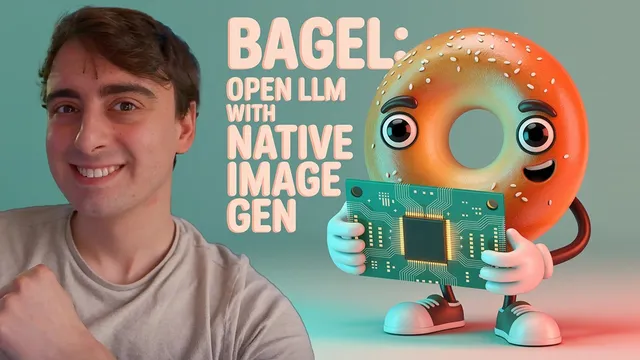
New GPT-4o native image Clone is Open Sourced!
Based on MattVidPro's video on YouTube. If you like this content, support the original creators by watching, liking and subscribing to their content.
Bagel is an Apache 2.0 open-source unified multimodal model that can both ingest images and generate images natively.
Briefing
Bagel, an Apache 2.0–licensed open-source multimodal model from ByteDance, is positioned as a “native” GPT-4o-style alternative that can both understand images and generate images directly—without bolting image generation onto a separate system. With 7B active parameters (14B total) and a foundation-model setup, it’s built for fine-tuning, distillation, and deployment “anywhere,” and it’s marketed as best-in-class for multimodal understanding and, uniquely among open models, native image output.
The most consequential claim is capability: Bagel isn’t just described as an image captioner. It’s shown producing outputs that maintain consistent characters across multiple frames (a 16-frame “animation”/slideshow demo), performing image editing with continuity (changing a specific element while keeping the same person and background), and handling spatial instructions like “rotate the camera” from a single uploaded image—generating multiple views that imply basic 3D understanding. It also demonstrates more utility-oriented transformations, such as mapping a color palette onto a person’s skin or swapping a person into a new scene (e.g., placing Einstein on Mount Fuji) in ways that are traditionally harder for diffusion-only pipelines.
A key differentiator in the workflow is “thinking mode,” which adds an internal reasoning step before generating an image. In the transcript’s tests, enabling thinking improved the coherence of a character backstory for an uploaded image of a lemon gangster persona, producing a richer narrative than the non-thinking run. However, the same thinking toggle did not reliably improve image refinement tasks. When asked to “refine” an already-generated image to fix hand imperfections, the results reportedly degraded—deepening contrast/brightness and leaving the hands still wrong. That suggests thinking helps with planning and narrative structure more than with pixel-level correction in the current configuration.
Hands-on comparisons against closed multimodal systems were mixed. In a “Snapchat-style” scenario—turning a person into a meme-like character raiding a market for lemons—Bagel produced images that resembled the subject but struggled with prompt intent and output quality. The transcript notes issues like garbled or missing Snapchat text, inconsistent action (sometimes the subject wasn’t clearly “running away”), and occasional anatomical problems such as finger errors. When the same prompt was tested with GPT-4o native image generation, the results were described as closer to the intended scene and caption, while Gemini’s outputs were faster but less detailed, and Grok’s attempts were largely failures (including context loss and low-quality “deep fried” artifacts).
Overall, Bagel’s current value is framed as stronger for developers and enterprises than for casual users. The model is free to try via a web demo, and local experimentation is supported through a Gradio-based quick-start and training setup. The transcript argues that open-source access—plus the ability to fine-tune for specific styles, character anatomy, and constraints—could address current weaknesses (like hand fidelity and text rendering). For businesses, the Apache 2.0 license and modifiability could also reduce costs versus proprietary image-generation APIs. The bottom line: Bagel is a credible open alternative for native image input/output and multimodal consistency, but it still lags behind top-tier closed models in raw image potency and reliability, especially for complex meme captions and fine-grained corrections.
Cornell Notes
Bagel is an open-source multimodal model licensed under Apache 2.0 that can both take image inputs and generate images natively, aiming to match the “unified” experience of GPT-4o-style systems. It’s marketed as strong at character consistency across multiple frames, image editing with continuity, and spatial transformations like rotating a scene from a single image. A “thinking mode” improves narrative coherence in text-driven tasks, but it doesn’t consistently fix image-level defects—refinement can even worsen outputs. In hands-on comparisons, Bagel can produce recognizable results from an image reference, yet it struggles with complex prompt intent and Snapchat-style text, while GPT-4o native image generation is described as more reliable for that specific meme scenario. The practical upside is open access: fine-tuning and deployment flexibility could improve quality for targeted use cases.
What makes Bagel different from typical open-source vision-language models?
How does “thinking mode” affect results, and where does it fall short?
What examples illustrate Bagel’s claimed spatial understanding?
Why does the transcript emphasize fine-tuning for image quality?
How did Bagel perform in the Snapchat-style “lemon raid” meme test compared with GPT-4o, Gemini, and Grok?
What practical advantages does open-source Bagel offer for developers and enterprises?
Review Questions
- In what kinds of tasks did thinking mode improve Bagel’s outputs, and what evidence suggests it doesn’t reliably fix image artifacts?
- Which specific Bagel capabilities were described as uniquely strong among open-source options, and how were they demonstrated (e.g., rotation, multi-frame consistency, editing continuity)?
- Based on the transcript’s comparisons, what prompt or capability gaps most affected Bagel’s performance in the Snapchat-style meme scenario?
Key Points
- 1
Bagel is an Apache 2.0 open-source unified multimodal model that can both ingest images and generate images natively.
- 2
The model is marketed as strong at character consistency, image editing with continuity, and spatial transformations like rotating a scene from a single image.
- 3
“Thinking mode” can improve narrative coherence, but it doesn’t consistently improve pixel-level refinement and may worsen images in some cases.
- 4
Hands-on tests report recurring anatomical issues (especially hands/fingers) and occasional confusion between cartoon and realistic anatomy, suggesting fine-tuning is important.
- 5
Bagel’s open demo and local Gradio quick-start make it accessible to experiment with generation controls like CFG and steps.
- 6
In a complex meme-style task requiring both scene action and Snapchat caption text, GPT-4o native image generation was described as more reliable than Bagel, with Gemini faster but less detailed and Grok largely failing.
- 7
For developers and enterprises, Bagel’s open-source modifiability and deployment flexibility are framed as the main advantage, potentially enabling cost savings and targeted quality improvements via fine-tuning.