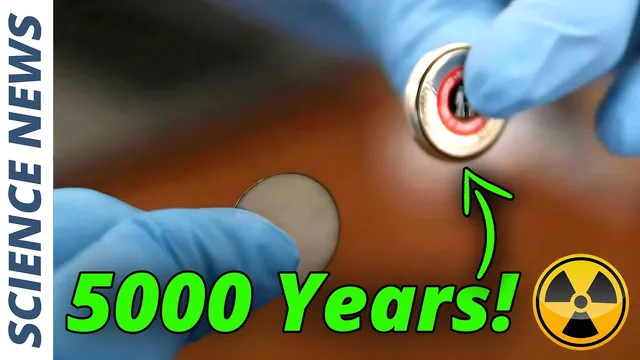
New Nuclear Waste Battery Can Run For 5000 Years
Based on Sabine Hossenfelder's video on YouTube. If you like this content, support the original creators by watching, liking and subscribing to their content.
Carbon-14 from reactor graphite waste has a half-life of about 5,700 years, enabling battery lifetimes exceeding 5,000 years.
Briefing
A British team has built a prototype “nuclear waste battery” that can keep producing electricity for more than 5,000 years by using carbon-14—an isotope found in graphite waste from nuclear reactors. The core idea is to turn a long-lived radioactive material into a direct source of electrical power, avoiding the inefficiency of older nuclear batteries that first convert decay heat into electricity.
The battery centers on carbon-14, a radioactive isotope created inside reactor cores’ graphite shielding. Carbon-14 decays with a half-life of about 5,700 years, emitting an electron as it transforms. Arkanite, a spin-off from the University of Bristol, has reportedly made a device from carbon-14 and claims a runtime exceeding 5,000 years. The approach is described as a “better voltaic battery,” aiming to convert the randomness of radioactive decay into a directed electric flow using engineered crystal structures. The concept relies on creating two different layers with distinct arrangements so that decay events preferentially drive electrons in one direction rather than merely generating heat.
The prototype’s construction details are not fully public—there are no technical reports shared in the account—so the manufacturing steps are inferred. One plausible route involves separating carbon-14 from stable carbon, then combining it with other elements (suggested examples include nitrogen and phosphorus) and depositing the resulting material as layered structures on a surface. Because stray electrons could be hazardous, the design also requires shielding around the battery, though the radiation type is described as relatively straightforward to contain (with the practical caveat that people shouldn’t handle it casually).
Despite the striking longevity, the power output is extremely small—likely below a microwatt. That means the battery is not a replacement for laptops or mainstream electronics; powering a laptop would require on the order of 100 million such units. The low wattage also helps explain why nuclear energy density claims don’t translate directly: nuclear power plants rely on controlled fission chain reactions, while these batteries draw only from slow radioactive decay.
Where the technology could matter is in applications that prize decades-long operation over high power. The long lifetime makes it attractive for medical implants that need continuous monitoring or regulation, such as devices that can trigger alarms or modulate signals related to pain or heart rhythm. In space, tiny sensors on long missions could stay active for years without maintenance. On Earth, similar low-power sources could support remote environmental monitoring, including seafloor systems tracking ocean currents.
The carbon-14 battery is not the first nuclear battery. The American company City Labs has sold tritium-based nuclear batteries for years. Tritium has a shorter half-life of about 12 years, but those devices can produce up to roughly 100 microwatts—far more than the carbon-14 prototype—making them useful for remote sensors that can be serviced on a shorter cycle. City Labs’ batteries are already deployed in wilderness weather stations and other hard-to-reach monitoring setups.
Overall, the development highlights a broader push to make long-lived radioactive sources practical again—less about powering everything, more about enabling devices that must keep running when replacement is impossible.
Cornell Notes
A British prototype nuclear battery uses carbon-14 from graphite waste in reactor shielding to generate electricity for over 5,000 years. Carbon-14’s half-life is about 5,700 years, and its decay emits electrons that can be converted into directed current using engineered layered crystal structures (“better voltaic” approach). The tradeoff is power: output is likely below a microwatt, so it’s unsuitable for high-demand devices like laptops. Instead, the long lifetime fits niches such as medical implants, long-duration space sensors, and remote monitoring where maintenance is difficult. The work also contrasts with tritium-based commercial nuclear batteries (City Labs), which produce more power but last only about 12 years due to tritium’s shorter half-life.
Why is carbon-14 considered a promising fuel for ultra-long-life batteries?
How does the carbon-14 battery aim to turn radioactive decay into electricity directly?
What limits the carbon-14 battery’s usefulness despite its extreme lifetime?
Why doesn’t nuclear “energy density” translate cleanly to these batteries?
How do tritium-based nuclear batteries compare, and where do they fit?
What real-world use cases match the strengths of ultra-low-power, ultra-long-life batteries?
Review Questions
- What physical property of carbon-14 makes multi-millennial battery operation plausible, and what is its half-life?
- Why is the carbon-14 battery’s power output too small for consumer electronics, and what scale of battery count would be needed for a laptop?
- Compare the strengths and limitations of carbon-14 versus tritium nuclear batteries in terms of both power output and operational lifetime.
Key Points
- 1
Carbon-14 from reactor graphite waste has a half-life of about 5,700 years, enabling battery lifetimes exceeding 5,000 years.
- 2
Arkanite’s prototype uses a layered crystal design intended to convert radioactive decay electrons into directed current (“better voltaic” concept).
- 3
The carbon-14 battery’s power output is expected to be below a microwatt, making it unsuitable for high-power devices.
- 4
The low power is consistent with radioactive-decay power generation, which differs from the high-energy mechanism of fission chain reactions.
- 5
Ultra-long-life, low-power applications include medical implants, long-duration space sensors, and remote environmental monitoring.
- 6
City Labs’ tritium batteries produce more power (up to ~100 microwatts) but last about 12 years, fitting shorter maintenance cycles.
- 7
The technology’s practical value lies in powering devices where replacement is difficult rather than replacing mainstream power sources.