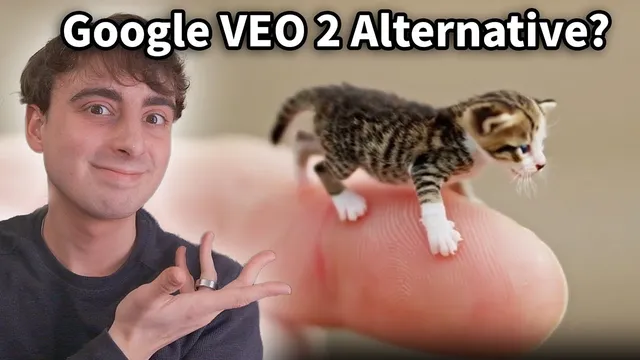
New Promising AI Video Generator! VEO 2 Alternative?
Based on MattVidPro's video on YouTube. If you like this content, support the original creators by watching, liking and subscribing to their content.
Ray 2’s early strengths center on cinematic instruction-following, with smoother camera motion and fewer unwanted morphing artifacts in complex prompts.
Briefing
Luma Labs’ Ray 2 is being positioned as a strong alternative to Google’s hard-to-access Video generation model, with early tests emphasizing unusually good instruction-following—especially for cinematic prompts—while also exposing reliability and “edge-case” weaknesses. In practice, Ray 2’s best results cluster around smooth, film-like camera movement, stable subjects, and coherent motion that tracks what’s written, even when the scenario is surreal (gorillas surfing, humpback whales with minimal morphing, turtles in macro-like shots, and cinematic fly-throughs). The model also accepts multiple input types on Luma’s site—text instructions plus image/video input—though the transcript’s hands-on testing focuses on text-to-video.
A key theme is prompt fidelity. The most impressive examples highlighted are the ones where the subject stays recognizable and physically consistent: fencing blades that wiggle with plausible physics, a whale whose fins remain aligned rather than melting into the scene, and a turtle that holds shape even during a dramatic camera move. Ray 2 also handles “non-standard” ideas that are less likely to appear in training data—like a tiny kitten walking on a fingertip, polar bears relaxing on an iceberg while wearing Hawaii shirts and sunglasses, and a ship captain smoking a pipe while a storm looms—suggesting the model can generalize beyond common stock-like prompts.
Ray 2’s strengths extend into physics-leaning visuals and photo-real detail. The transcript points to effects such as slow-motion water and particles, a floating orb of water in a forest (explicitly framed as physically impossible in real life), and a spiderweb at sunrise where wind reshapes the web’s structure. There are also “goopy” and liquid scenarios (maple syrup on pancakes, water splashing around a truck) that look promising but still show imperfections—jumpiness, slight instability, or incomplete realism.
Where the experience breaks down is consistency and throughput. The tester reports that Ray 2 only worked in “describe mode” on their account, while other attempts left Ray 2 greyed out. More seriously, generations sometimes get stuck in a queue or fail to complete even on paid plans, with some prompts running for long periods and then erroring. That reliability gap becomes a major drawback when the model is marketed as usable immediately.
Community reactions reinforce a broader industry bottleneck: consistent characters across scenes. Several users raise the same concern—faces, clothing, and identity staying stable over multiple clips—calling it the biggest limiter for storytelling. Even when Ray 2 delivers cinematic sequences (including a Last of Us–style clip made with Ray 2), the transcript suggests the model is optimized for certain styles and camera-driven storytelling rather than every complex, highly dynamic prompt.
Bottom line: Ray 2 looks competitive on cinematic instruction-following and visual polish, available today in Dream Machine with up to 10 seconds at 720p and 30 fps, plus an API path for third-party integrations. But it isn’t a “universal” replacement yet—server reliability, describe-mode limitations, and character consistency remain unresolved issues. The transcript frames Ray 2 as a fun, capable tool now, while the field still needs major advances to make complex, story-grade generation dependable.
Cornell Notes
Luma Labs’ Ray 2 is presented as a cinematic-focused AI video generator that tracks text instructions more reliably than many peers, producing stable subjects and smooth, film-like camera motion in a range of surreal scenarios. Highlights include minimal morphing in difficult prompts (e.g., a humpback whale with fins staying aligned, a turtle that holds shape during a complex camera move) and strong “physics-feeling” visuals like particles, slow-motion water, and wind-driven effects. The transcript also notes practical limitations: Ray 2 may be restricted to “describe mode” on some accounts, and generations can stall or error even on paid plans. Community discussion centers on the still-unsolved problem of consistent characters across multiple clips, which is crucial for storytelling.
What specific capabilities make Ray 2 stand out in early examples?
Where does Ray 2 struggle compared with its best-case demos?
How does the model’s “cinematic” focus show up in practical testing?
Why is consistent character generation treated as a major bottleneck?
What reliability and access constraints affect Ray 2 usage right now?
How is Ray 2 expected to reach developers and third-party platforms?
Review Questions
- Which types of prompts in the transcript are most likely to produce stable, cinematic results, and why?
- What two categories of problems (technical vs. creative) limit Ray 2’s usefulness according to the testing and community discussion?
- How does the transcript connect character consistency to the ability to tell stories with AI video?
Key Points
- 1
Ray 2’s early strengths center on cinematic instruction-following, with smoother camera motion and fewer unwanted morphing artifacts in complex prompts.
- 2
Several standout examples involve stable subjects during motion (e.g., whale fins staying aligned, turtle remaining non-morphing during a camera move).
- 3
Ray 2 can generate physically suggestive visuals (particles, slow-motion water, wind-driven effects), but liquid and goopy-material scenarios still show imperfections like jumpiness.
- 4
Practical access and reliability issues matter: Ray 2 may be limited to “describe mode” on some accounts, and generations can stall or error even on paid plans.
- 5
The biggest industry bottleneck highlighted is consistent characters across multiple clips, which is essential for coherent storytelling.
- 6
Ray 2 is available now in Dream Machine (720p, up to 10 seconds, 30 fps) and is expected to reach developers via a Luma API for third-party integrations.