New Sora Quality AI Video we Might Access Soon? - Kling AI
Based on MattVidPro's video on YouTube. If you like this content, support the original creators by watching, liking and subscribing to their content.
Kling AI is presented as a Chinese text-to-video model producing unusually realistic clips, often with strong motion coherence and fewer visible AI artifacts.
Briefing
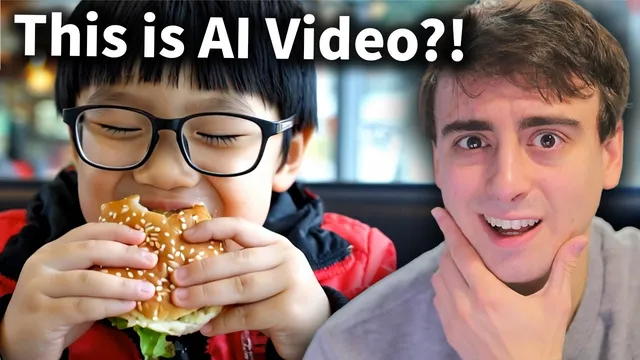
A new Chinese text-to-video model called Kling AI (often referred to as “Kling”) is drawing major attention for producing unusually realistic clips—so convincing that viewers struggle to spot obvious AI artifacts. Multiple demos emphasize lifelike motion and physical detail: a child biting into a burger with consistent hands and clothing, a corgi walking on a beach with believable sand and waves, and a panda strumming an acoustic guitar while seated by water—scenes that require the model to combine object appearance, lighting, and plausible movement in a single prompt. The standout theme across examples is coherence: reflections, textures, and small continuity cues (like fingers and mouth contact) hold up far better than many earlier text-to-video systems.
The transcript also highlights “hard” everyday actions where generative video often breaks down. A coffee pour demo is described as nearly seamless—cream flows into the cup and fills it to the brim with stable reflections. Other clips include time-lapse flower blooming, a bunny reading a newspaper, and a person eating noodles; while some imperfections are noted (occasional warping or mushiness over longer sequences), the overall realism is presented as competitive with OpenAI’s Sora. Even when certain shots look less polished—such as a car racing sequence or a horse scene that turns grainy—the motion and scene logic are still framed as strong enough to suggest the field is moving quickly.
Beyond realism, the model’s prompt-following is portrayed as a key differentiator. Several demos are described as “novel” combinations unlikely to appear in training data: a panda playing guitar, a blue bird-like creature, a latte/volcano concept with fire and melted chocolate or coffee, and a night sky time-lapse paired with people walking in the foreground. The transcript argues that these examples show the system learning relationships between elements (fire, melting, liquid flow) rather than simply outputting generic footage.
Access is presented as the main friction point. Kling’s product page reportedly lists demos and supports multiple resolutions and aspect ratios, including 1080p, and the system is described as using a self-developed 3D VAE. But getting an account may require the Kuaishou/Kwai iOS app, a Chinese phone number, and possibly QR-code-based entry—steps that are difficult for people outside China due to separate internet access. The transcript also notes that prompts shown on the site are translated from Chinese, implying the native prompting experience may differ.
The broader implication is competitive pressure. As Chinese models approach Sora-level quality, OpenAI may face increased demand for faster access to Sora and related upgrades. The transcript frames open-source as the long-term lever: if high-quality models become widely available, it reduces reliance on a few closed platforms. At the same time, the transcript acknowledges risks from powerful generative media, while arguing that democratized access can expand creative possibilities—especially for filmmakers and creators who want b-roll, short films, or stylized animations without the traditional production bottleneck.
Cornell Notes
Kling AI, a Chinese text-to-video model, is presented as producing highly realistic clips that often look indistinguishable from real footage. Demos emphasize physical coherence—hands, reflections, textures, and continuity during actions like eating, pouring coffee, and time-lapse blooming. The transcript also stresses prompt novelty, including unusual character-object combinations (like a panda playing guitar) and complex effects (fire, melting, and liquid flow). While some sequences show warping or mushiness over time, overall motion and scene logic are described as competitive with OpenAI’s Sora. Access appears possible through a Chinese app and may require a Chinese phone number or QR-code entry, limiting availability outside China.
What kinds of realism problems do the demos try to overcome, and how do the examples address them?
Why are the panda-guitar and latte-volcano concepts treated as more than “generic footage”?
What limitations are acknowledged even while the quality is praised?
How does the transcript suggest people might access Kling, and what barriers exist?
What competitive impact does the transcript predict for OpenAI and Sora?
How does the transcript connect generative video to creativity and economics?
Review Questions
- Which demo categories (eating, pouring, time-lapse, character-object interactions) are used to argue Kling’s realism is unusually strong, and what specific continuity cues are mentioned?
- What access requirements are described for Kling, and why might they be harder for users outside China?
- What does the transcript claim would change the competitive landscape most: faster closed releases or open-source availability?
Key Points
- 1
Kling AI is presented as a Chinese text-to-video model producing unusually realistic clips, often with strong motion coherence and fewer visible AI artifacts.
- 2
Several demos focus on “physics-heavy” actions—like coffee pouring and eating—where generative video commonly struggles with reflections, contact, and fluid behavior.
- 3
The transcript treats certain prompts (panda playing guitar, latte-volcano melting effects) as unusually novel, implying the model can compose complex relationships rather than output generic scenes.
- 4
Some limitations are acknowledged, including warping or mushiness over longer sequences and occasional character/limb inconsistencies.
- 5
Access may be possible through the Kwai/Kuaishou iOS app, but the transcript suggests Chinese phone-number requirements and QR-code entry could block non-China users.
- 6
The competitive takeaway is that rapid progress from Chinese labs may increase pressure for faster Sora access and upgrades from OpenAI.
- 7
The transcript frames open-source as a key factor for wider creative access and reduced concentration of power among a few closed platforms.