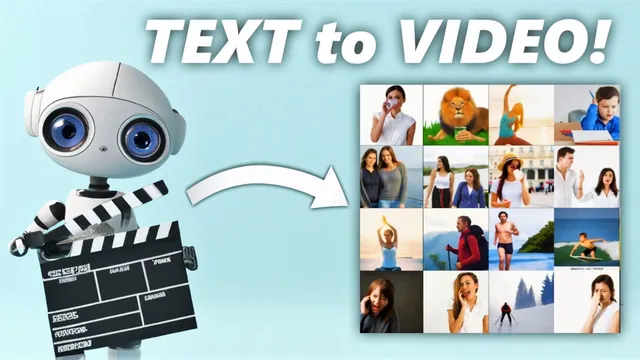
NEW Text to VIDEO AI! / DALL-E 2 vs Google Imagen/Parti
Based on MattVidPro's video on YouTube. If you like this content, support the original creators by watching, liking and subscribing to their content.
Cog Video is presented as a transformer-based model that generates short text-to-video clips (about four seconds) with scene changes that track the prompt.
Briefing
Text-to-video AI has moved from “promising” to “working,” with a transformer-based model called Cog Video producing short, coherent animations directly from text—an advance that matters because it turns image-generation momentum into a new, more powerful media workflow.
The transcript starts with a quick reality check on where image generation stands today. DALL·E 2 is shown producing highly photorealistic cat images, including one that matches a very specific prompt detail: a distant 800mm lens look with shallow depth of field and fine texture. The creator then shares direct messages with OpenAI, where an orangutan steampunk-goggles image request led to additional variations generated by DALL·E 2. That anecdotal access reinforces the broader point: prompt fidelity and training-data scale are already producing convincing results, and users are actively experimenting with prompts to drive motion.
From there, the focus shifts to the competitive landscape in text-to-image. Google’s Imagen (described as a DALL·E 2-like system) is characterized as “shockingly good” but not released to the public. Google’s later Parti is presented as a bigger, more capable model, with a scaling discussion that places Parti at roughly 20 billion parameters—about six times the scale attributed to DALL·E 2 (around 4 billion) and far above smaller systems like Midjourney (around 400 million in the transcript’s comparison). Despite the parameter jump, the transcript emphasizes that bigger isn’t automatically “six times better,” pointing to benchmarks where improvements can be more nuanced than raw size.
The key gap is text-to-video. Google’s public messaging is framed as silent on releasing text-to-video, though OpenAI’s community discussions are said to suggest that text-to-video is on the horizon. Meanwhile, users are already hacking motion out of image models. A Reddit example uses an external tool (described as out scaling) to animate a prompt-driven scene—zooming out and back in—creating a sense of camera movement and object transformation. Another approach stacks multiple prompts to create an evolving sequence, but the transcript stresses that these are still not “full video” in the sense of consistent, end-to-end generation.
The turning point comes with a named research release: “Cog Video: Large-Scale Pre-Training for Text-to-Video Generation via Transformers.” Hosted on GitHub, it’s described as producing four-second clips with multiple examples, where the same scene evolves over time based on the text description. The animations are characterized as GIF-like in structure but with real visual quality—frames changing in ways that look more than just simple interpolation. The transcript claims performance around eight frames per second and highlights clips such as surfing, a lion drinking from a glass, skiing, and a running figure on a beach. The overall takeaway is blunt: short, coherent AI-generated video exists now, and it’s likely only a matter of time before this capability scales into longer, more cinematic outputs.
Finally, the transcript touches on the human impact. Concerns about painters, artists, and graphic designers losing work are raised, alongside the suggestion that entire movies or shows could eventually be generated from text. The message to viewers is to watch for comparable systems and share any alternatives, because—so far—Cog Video is presented as the closest thing to a true text-to-video leap.
Cornell Notes
The transcript argues that text-to-video AI has crossed a threshold: Cog Video, a transformer-based model, can generate short (about four-second) animations directly from text. While image models like DALL·E 2 and Google’s Imagen/Parti show how prompt details and parameter scale affect realism, they don’t automatically solve consistent video generation. Community workarounds can create motion-like sequences (e.g., zooming and prompt-stacking), but they still fall short of fully generated, coherent clips. Cog Video is presented as the first widely visible “real text-to-video” system in this discussion, producing GIF-like animations at roughly eight frames per second with scene changes that track the prompt.
What makes the transcript treat Cog Video as a “real” text-to-video breakthrough rather than a workaround?
How does parameter scale factor into the comparison between DALL·E 2 and Google’s Parti?
Why is the 800mm lens detail highlighted in the DALL·E 2 cat example?
What kinds of motion are shown using user-generated techniques with image models?
What evidence does the transcript give about Cog Video’s output quality and speed?
Review Questions
- How does the transcript distinguish Cog Video from prompt-stacking or external upscaling approaches?
- What role does prompt specificity (like the 800mm lens detail) play in the leap from text-to-image to text-to-video?
- Why does the transcript argue that bigger parameter counts (e.g., Parti vs DALL·E 2) don’t automatically guarantee proportional quality improvements?
Key Points
- 1
Cog Video is presented as a transformer-based model that generates short text-to-video clips (about four seconds) with scene changes that track the prompt.
- 2
Image generation is already highly capable, with DALL·E 2 producing photorealistic results when prompts include specific camera-like details such as an 800mm lens look.
- 3
Google’s Imagen is described as extremely strong but not released publicly, while Parti is discussed as a larger-scale model with roughly 20 billion parameters.
- 4
Parameter scale is treated as important but not a simple multiplier for quality; bigger models can yield improvements that vary across benchmarks.
- 5
Community methods can create motion-like sequences from image models (zoom effects via external tools, or prompt-stacking), but they still don’t equal fully consistent, end-to-end video generation.
- 6
The transcript frames text-to-video as a near-future shift in media creation, with potential implications for artists and the production of longer-form content.